Generator Failure!
It would seem that my engines and I just don't get along. Last night my trusty Honda EU2000i generator stopped working, and this morning she continues to be unresponsive.
Actually, I've been really impressed with the Honda in general; it's definitely the quietest model of generator that I've heard. The 'Eco-Throttle' feature keeps the engine running at just high enough an idle to provide the needed current, and spins the engine up when the demand increases. I can always start her on the first pull of the starter cord, and she's exceptionally good on gasoline.
That being said, she's been running about six to eight hours or more per day for the past six months. I've changed her oil¹ and installed a new sparkplug², but the guy at the Honda dealership said that he'd never actually heard of anyone using an EU2000i that much. Apparently you're supposed to do a bunch more maintenance at regular intervals, like cleaning the air intake and changing the oil at every fifty hours of use, and cleaning the carborator and checking the valves with a set of feeler gauges after every two hundred hours - things that I have absolutely no idea how to do. He also said that using the generator in the harsh marine environment would probably accelerate the wear-and-tear. I left the generator with him, and he said he'll give me a call sometime between noon and 3pm tomorrow.
Perhaps "not working" is a bit vague... last night she was idling a bit roughly, and then she sputtered and coughed, spun up to a higher speed, idled down to normal, sputtered and coughed, spun up to a higher speed, idled down to normal, sputtered and coughed and died. I can now get her to successfully start, and everything seems perfectly normal - but then she dies again after about ten seconds.
What this means for me, unfortunately, is that I have no electricity on the boat for the next few days. I have heat, because the diesel furnaces do not rely on electricity to run - but since my laptop soundcard ceased to function a few weeks ago, and I gave away my broken CD player in disgust, the only sources of audio on the boat lately are my voice and my guitar. I've not been able to watch videos on the internet, because without sound they're somewhat meaningless. And now I'm back to reading books by flashlight again!
The generator is still under warrantee, but the guy said that this warrantee would only cover failure of parts due to "normal" wear and tear, the details of which would be examined by Honda Canada before any warrantee payments would be made. I am looking at $116 for the service call as a minimum, with possibly a lot more if the engine is damaged internally.
It remains cold, and today I saw the first snow of the year.
1: first time doing this ever!
2: first time doing this too!
Keys
Nothing much to write about today. The weekend was a whirlwind of activities and too little sleep, and this morning I awoke to bitter cold, howling winds and a dragging anchor - but those sorts of things have become too common, too "baseline" to bother writing about. The winter has arrived, and I'm sure it will get even worse yet, so I'll save my complaining for the days when things get really bad.
Instead I'll just talk about my keys; the small collection on a keyring that I keep on me at all times. I hadn't put any thought into them, but then I noticed a few days ago that my keyring does not contain a single regular-sized key anymore! Every key is a mini-type; my keychain is five keys for padlocks and two keys for bicycle U-locks, and nothing more. It certainly drove home for me the idea that I've eschewed the ordinary life - no car keys, no house keys, no office keys. My entire life is secured with padlocks.
My keychain is a small plastic Davis "Key Buoy" keychain that contains a chemical pellet that, when immersed in water (due, say, to someone accidentally dropping their keys into the ocean), dissolves and creates carbon dioxide gas. The gas fills a small plastic balloon which unrolls as it fills, becoming a thin orange inflated tube which then hopefully floats the keys back to the surface.
I used to also have my sailing knife, a Myerchin LightKnife Crew Pro, attached to my keychain - but upon reading the specs for the Key Buoy I think the knife is a bit too heavy for that, and so I removed it and just wear it clipped to my pocket at all times. I love the knife, and recommend it even though the locking mechanism keeps breaking on me. The Myerchin lifetime warrantee covers that though, and they've replaced mine for free twice now.
*shrug*. I know keys are nothing exciting, but I figured what the heck, a short post about something trivial trumps no post at all.
Stuff and Nonsense
Ok, ok. You're right. I'm slacking and not updating the blog.
I'm not sure what the real reason is. I've been maddeningly busy, the kind of busy where it seems like every spare minute is taken up but nothing seems to be getting accomplished. Still, that's not to say that life halts, and as such I've got a whole pile of micro-updates that I probably should have been posting all along. Nothing important or earth-shattering, no crazy adventures, just the usual day-to-day crap. Each of these stories should be its own update though, I just have to stop procrastinating and letting them pile up.
To start off with, if you're reading this from somewhere other than Vancouver, British Columbia, you might not realize that it's been raining for something like fifteen goddamned days in a friggin' row. I know that complaining about the rain is one of Vancouver's favourite pastimes, and I knew getting into this that the rain would be something I'd have to face up to sooner or later. It's not actually all that bad, once you realize that "being stylish" and "being comfortable" are mutually exclusive. I've gotten used to living in my tall, bright yellow rubber boots, and leaving the boat without wearing rainpants seems pretty silly these days. Wet clothes hung up to dry can take days to dry on a boat - my sweaters are still damp from laundry day, which was a week ago tomorrow.
The thing about rainpants and raincoats is that they look pretty dorky, but they really work. I have yet to find any that are waterproof, breathable, and look acceptable in public - it seems like you get your choice of any two of those features. I'm willing to pay extra for the good stuff, especially seeing as I use them pretty much every day! I have one set of Helly Hansen raingear that was quite pricy, but it has already paid for itself many times over just through regular use. The other day I caught the pantleg in the chainring of my track bike, pulling it almost the entire way around - but when I unwound myself and pulled it free, the most damage was a bit of chain grease; the rubbery material itself didn't tear at all.
Every day that I go ashore - which isn't every day, mind you - I have to climb down into my rowboat and bail out the rainwater. I use a plastic bucket made from a cut-off 1.89l bottle of blueberry cocktail, which I assume to be roughly 1l in size, and to stave off the bitter cold and monotony of bailing, I count the buckets as I empty them over the side. My record to date is 120l of water in the rowboat from one night of rain. Seriously! I need to track down and cut up a bleach jug or something similar, bailing at 1l per stroke isn't the most efficient solution.
One nice thing about my rowboat is that there are large chunks of foam rubber bolted to the inside of the gunwales, which I'm guessing are supposed to keep the boat afloat and upright even if it fills completely with water. This is reassuring - there are a bunch of other boats in False Creek, many of which aren't liveaboards and the owners don't come down very often to check on them. Those folks have dinghies locked to the nearby dock, but the rain tends to fill the dinghies up and sink them ever few weeks. Last week, one such boat belonging to my friend Eric had sunk in this manner. When I returned home from a night on the town, I heard strange splintering, cracking noises from the dock as I came down the ramp - it turned out to be Eric's dinghy, sunken and trapped lengthwise between the heavy wooden dock and the rocky bottom. The tide was almost all the way out, but it still had a foot or so to go... and the noise was Eric's little fiberglass rowboat, cracking and folding under the massive weight of the dock. Sad, but there was nothing I could do to help.
It has also been cold lately, and as you've probably guessed from my last post, I've been fighting with my furnaces again. The warmth from a diesel stove is delightful... when it works. I heard someone on another forum describe diesel stoves as "more of a hobby than an appliance", and that pretty much sums it up. Twitchy things, these machines, and at times it almost feels more like I'm learning to play a new musical instrument than trying to heat a boat. They constantly remind me that they must be treated with respect - as I type this I have yet another slowly-blistering burn on my forearm from touching the wrong part of the oven door while toasting a bagel in the stove an hour or so ago.
When diesel stoves and heaters are working perfectly they're lovely, but when they start to work badly it's a slippery slope... give them a bit too much or a bit too little fuel and they're inefficient, dirty, smelly and can even be dangerous. I'd been feeding the main stove a bit too much fuel, and it responded by filling up with soot. The last time I had an overabundance of soot, I used my little wet/dry shop-vac to clean it out. I was absolutely pleased as punch with the results - until I noticed that every bit of soot that I'd removed from the stove had been blown straight out the back of the shop-vac and all over the cabin, creating a nightmare of a mess to try to clean up. It was literally weeks before I got the last of it - and actually, from where I sit in the aft cabin right now I can see at least two spots where there is still soot from that fiasco.
This time I did not intend to make the same mistake - I researched shop-vacs and soot on the internet, and came to the realization that the root of my problem was simply a lack of a filter device on the shop-vac. Since I could not find any information about my 'Stinger' shop-vac on the internet, I made a plan to purchase a newer, more appropriate shop-vac - but when I went to the Home Depot to pick one out, I found that my 'Stinger' had merely been renamed to 'Husky', and the colours changed. This certainly wasn't obvious from their website! Fortunately, the Husky model had filters available, and for a whopping $6.99 I left the Home Depot with a filter and a vision of a clean stove.
And it worked! Well, mostly anyway - the stove is now clean and there wasn't a major mess to clean up afterwards. It still wasn't a simple or tidy job, and all of my cuticles are still as black as night, but the stove is once again safe and clean-burning. The only real downside is that the filter didn't seem to get *all* of the soot - I didn't notice any in the air, but when I blew my nose later on I was startled by a pair of jet-black spots on the tissue. *sigh*.
In other news, I've been spending my quieter evenings watching movies I've purchased from The Sailing Channel - and actually, I'm really torn here. The Sailing Channel has made their DVD movies available for $29.99 USD plus shipping, or you can download them for $12.99. Wow! That is some seriously forward thinking for a niche video company, and I'm very happy to help support them; I have purchased four downloaded movies so far and will likely purchase more. The part that tears me a little is that for such a forward-thinking company, their website is hideous. Seriously.
One of the movies, Lin and Larry Pardey's "Get Ready to Cruise", had a bunch of tips that I'd already figured out on my own, but there were two in particular that were each alone worth the price of the video download. One of the tips involved seat cushions in the salon, which I won't bother to explain here (yet, perhaps I'll blog it when I implement it) - but the other was a simple and effective way to build a shower on a sailboat!
I've been working a bit on that tip, and while I've still got a little ways to go I'm nearing completion. The premise is simple: use a basic pesticide sprayer, and refit it with a longer hose and a showerhead attachment with a simple valve assembly. I've expanded on the idea a bit, and replaced the 1/8" feed tube in the sprayer with a 1/4" stainless steel version, which should give me significantly more water flow, making it even more like a real shower. I also chose a black plastic canister, which should mean that in summertime I can just fill the canister with water and leave it outside in the sun and in a few hours I'll have a hot shower. In the meantime, I'll have to boil a pot of water on the stove, but given that there's usually a pot of water on the stove for tea anyway, I don't feel like this is a particular hardship.
After you've got the mechanics sorted, all you need is a spot in your boat configured to handle a bit of water splashing around and you've got a shower! My boat has just such a place - the bathroom, or 'head', right at the front of the boat has waterproofed walls, raised bulkheads and a simple floor to catch the water.
The remaining parts, before I can finally have a shower on the boat, are pretty easy - I need a piece of hose, I need to replace the carpeting in the head with some kind of raised plastic draining tile, I need to fit the bathroom with shower curtains and I need to install a small bilge pump in the bilge to pump out the used shower water. I hope to get those tasks done before the end of the weekend, but we'll see how it goes.
On the engine front, I think the best money I've spent in ages was the $399 for the Cooper Boating 'Diesel Theory - Advanced 5 Session Program' course down on Granville Island. The instructor really knows his stuff, and even though the classes come out to about $25/hour, as Trent pointed out a visit from a diesel mechanic is about $120/hour. I've learned so much about engines in the past few weeks, and it has given me a great deal of confidence in my ability to tackle any problem that should arise on my boat.
That being said, Maude still doesn't start. I've identified the problem; her fuel lift pump is either clogged or the pumping diaphragm has worn out and come apart. It isn't rocket surgery; I have to remove the pump, disassemble it and inspect it. If it is still serviceable I need to clean it out, then purchase and install a primary fuel filter before the pump ($100-$200), then bleed the air out of the fuel lines, and Maude should then start. If the pump isn't serviceable (apparently the diaphragm used to be a replaceable part, but they haven't made them in years) then I have to purchase a new lift pump, which will cost me about $110. I spoke on the phone with Lindsay at 'Stem To Stern', the local Yanmar service center, and he was exceptionally friendly and helpful. He was my first contact with that company, and ensured my business - I'll be heading down to their shop soon to pick up the parts, and I'll probably also stock up on fuel and oil filters, zincs and replacement hoses while I'm there.
So what's the holdup? Well, the fuel lift pump is in a very difficult place to reach without pulling out the whole engine, which is simply not an option at this point. None of my sockets are long enough to reach the bolts holding the pump onto the engine, and so yesterday I went to Canadian Tire to purchase a wrench to do exactly that. I figured a single 10mm wrench would do the trick, however when I saw the Mastercraft ratcheting wrenches on sale for $49 for a set of ten, I went for that instead. Comparing that to $16.99 for the single 10mm socket wrench, $50 was a great deal!
Of course, the wrench doesn't fit - I mean, the sizing of the socket to the bolt is correct, but the thickness of the wrench itself means that I can't get it to set on the head of the bolt. I basically need to go back to Canadian Tire tonight to fetch yet another socket - a longer one this time - and then try my best to manoeuvre my hands in between Maude and the wall, remove the pump and then figure out the next step.
Once that's all done and Maude is starting again, I'm not even close to finishing the other work that she needs. For one, before I purchased Tie Fighter one of the previous owners had had a pump failure while off on a sailing trip, and had to make some emergency repairs - she's been converted to use raw water (ie straight from the ocean) for cooling. That's... acceptable, at least according to the manual, but not optimal. There are a pair of heat exchangers bolted to the engine room wall, and a newly-rebuilt freshwater pump is waiting in the wings to be reinstalled. I'm not sure just how much work that will be, but I'm sure it'll be at least twice as long as my best estimate, which currently is "a Saturday".
Furthermore, I noticed during one of my extended stays in the engine room that the raw water pump belt is very loose! This is especially troubling, in that it could mean the engine could overheat and eventually fail completely. I won't have her started up without first replacing that belt. I do have a replacement belt, I just have to install it - thought that means removing all the other belts first in order to get it on.
Lastly - and the most blatantly obvious to any outside observer - none of the instruments work. Nada. Not one. They're not even hooked up! Neither is the key ignition or the starter switch, none of the gauges or emergency lights... nothing. I basically have to rewire them all individually, which isn't actually all that difficult, but will take some time. Someone in the past has rewired the panel at least twice, probably due to using the wrong gauge wires originally and having them overheat and melt. I think it's probably better to just rip it all out and install it fresh, so that I know the work is good from end to end.
Anyhow. That's what's going on.
Backdraft!
Here's a quick lesson in diesel furnace(*) physics:
(*: or whatever, a wood-burning stove, anything with fire)
The flame in the burner heats up the air, which causes it to rise up the flue and out the chimney. This, combined with the wind passing over the chimney causing a suction effect on the flue, is called "draft". The draft works in combination with a positive pressure in the cabin, created by a combination of vents, wind traps, and the expansion effect of warmer air vs. colder air. With a balance of positive pressure in the cabin and the draft, all smoke and carbon monoxide exits the cabin through the chimney.
The wind passing over the chimney, the suction effect mentioned above, is similar to blowing over the top of a glass bottle - the flute-like whistling that is made is the air oscillating inside the bottle, unable to equalize because there is no hole in the bottle for fresh air to fill the negative pressure created.
Interestingly, if you were to open, say, a hatch cover in a windstorm, it would be very possible to have this very same suction effect come into play. If that happened, you could easily create a negative pressure within the cabin.
Now - hypothetically speaking - if one were to create a strong negative pressure in the cabin, a few interesting things might happen. Firstly, we can probably assume that because the furnace was running, it must be cold outside - creating the suction effect would probably first suck all of the expanded, rising warm air out the cabin. Secondly, because a negative pressure must be balanced, air would flow in rapidly to fill that void - and as we assume in the first point, that air would probably be cold. Thirdly, that air would have to come from somewhere, and a convenient port of exit (and by definition entry) would be the flue, destroying the draft and creating a backdraft.
The dangerous part of a backdraft is that fuel from the furnace could potentially leave the furnace in an ignited state, and if the backdraft were strong enough, the influx of oxygen could cause an explosive fire. With a diesel furnace however, this is quite unlikely, and what would probably happen is that the flame would be immediately extinguished, leaving the backdraft to fill the cabin with smelly, sooty diesel smoke.
Of course, this hypothetical situation could be easily avoided by simply using the barometric equalizer on the flue, in combination with a draft adjuster below the furnace. One might not leave their warm, cozy bed in a heated cabin to peek outside, only to find oneself having to spend the next forty minutes with all the hatches open expelling smoke from the bedroom cabin and filling the cabin with cold November air. One might not spend the next hour with the foul taste of diesel soot in one's mouth, or shiver their way back to sleep without the aid of a furnace.
Well, there you have it. A public service, by way of a basic lesson in physics.
Be glad you didn't have to learn it at 3am in a windstorm.
Friday the Thirteenth
I regularly get asked the question "So, how's life on the boat?", and I have a couple of stock answers ready. "Ridiculous." is the usual one, which in my opinion sums up the whole thing pretty succinctly. Sometimes I'll answer "it's a constant running adventure!", depending on the events of the previous week or so, or if it's been particularly stressful I'll say "up and down, but mostly up.".
Well, today marks one of the more 'down' days; there were a bunch of factors, but it definitely started with my own stupidity. Technically it "started" yesterday but the turning point was at about 2am last night, at least three beers past the "pint of no return", when I decided that my baby sister's suggestion to return to her house with her and some friends for more beers sounded like an excellent plan. That plan involved riding my bike five kilometers in the light rain with a guitar on my back, drinking several more beers, singing songs and laughing for an hour or so and then riding five kilometers back home in the pouring rain, finally arriving back home at about 5:30am. I peeled off my soaking-wet clothes, flexed some blood back into my stiff, frozen fingers, and climbed into an icy bed.
At about 7:00am, I got an SMS message from work - something had broken in the webserver farm, and it needed my attention immediately. Of course, the laptop was in the other cabin, so I had to get out of my (finally) warm bed, get dressed, walk ten feet through the pouring rain to the other cabin where I had left my laptop, and then sit in the cold dealing with a server issue. Fortunately it was nothing terribly difficult and I was back in my bed in about an hour... just long enough for the bed to have gotten cold again. At some point during that hour the rain had stopped and the wind picked immensely, howling in the rigging, blowing the hatches closed and making my halyards slap against the mast with a rhythmic cowbell-like sound.
I had only been asleep for an hour or so more when my phone rang - it was my neighbor Shawn, calling from aboard 'And-E', his 26-foot cruising sailboat. "Hey," he said, "Heads up, that powerboat has dragged his anchor again and just slammed into us, he's headed your way now...". I thanked him and got off the phone and started getting dressed, and just as I put on my boots I felt the shuddering *thud* of another boat hitting my hull.
It was *freezing* out! The strong westerly wind coming up the False Creek channel wicked any semblance of warmth out through the weave of my sweater, but I was still a bit too groggy - and quite possibly still a bit drunk - to remember to put on a windproof jacket. I put out a few fenders, pushed the boat off my bows and let out some more anchor rode. Fortunately it seemed that just as he hit me, his anchor found purchase in the ocean floor, and as I moved ten feet or so away, he swung back and forth in front of me but didn't come any closer.
Now, that's a really good thing - if you've been following along the past few weeks, you'll know that my engine currently doesn't start, which means that if I have to move the boat, I'm... well, in the interest of keeping this blog clean-ish, let's just say it rhymes with "out of lucked". I have faith in my anchor; the 35-pound Delta on 40 feet of heavy chain and 300 feet of strong one-inch polyester rope has held me in place through rougher conditions than this - but that's not to say that there's no stress in wondering if it'll hold this time. The bottom of the ocean floor can change without warning, and False Creek is notorious for garbage and silt. Recently I helped another friend re-anchor after he dragged, and when we pulled his anchor up we found a one-foot length of steel I-beam lodged firmly in the blades; no wonder he hadn't gotten a good hold!
I watched the powerboat warily for a few minutes - I'd spoken with it's owner a few days prior about his constant anchor dragging, but he'd apologized and shown me his brand new 50-pound 'Bruce' anchor, which definitely should be more than enough to keep a little boat like his in place, so I was pretty sure that if he'd found purchase he probably wouldn't be going anywhere. I figured he'd be coming back pretty shortly, and so with the powerboat swinging back and forth ten feet off my bow, I went back to sleep. At this point I realized that it was going to be "one of those days", so I didn't bother taking my clothes off; I just took off my boots and jacket and pulled a blanket over myself.
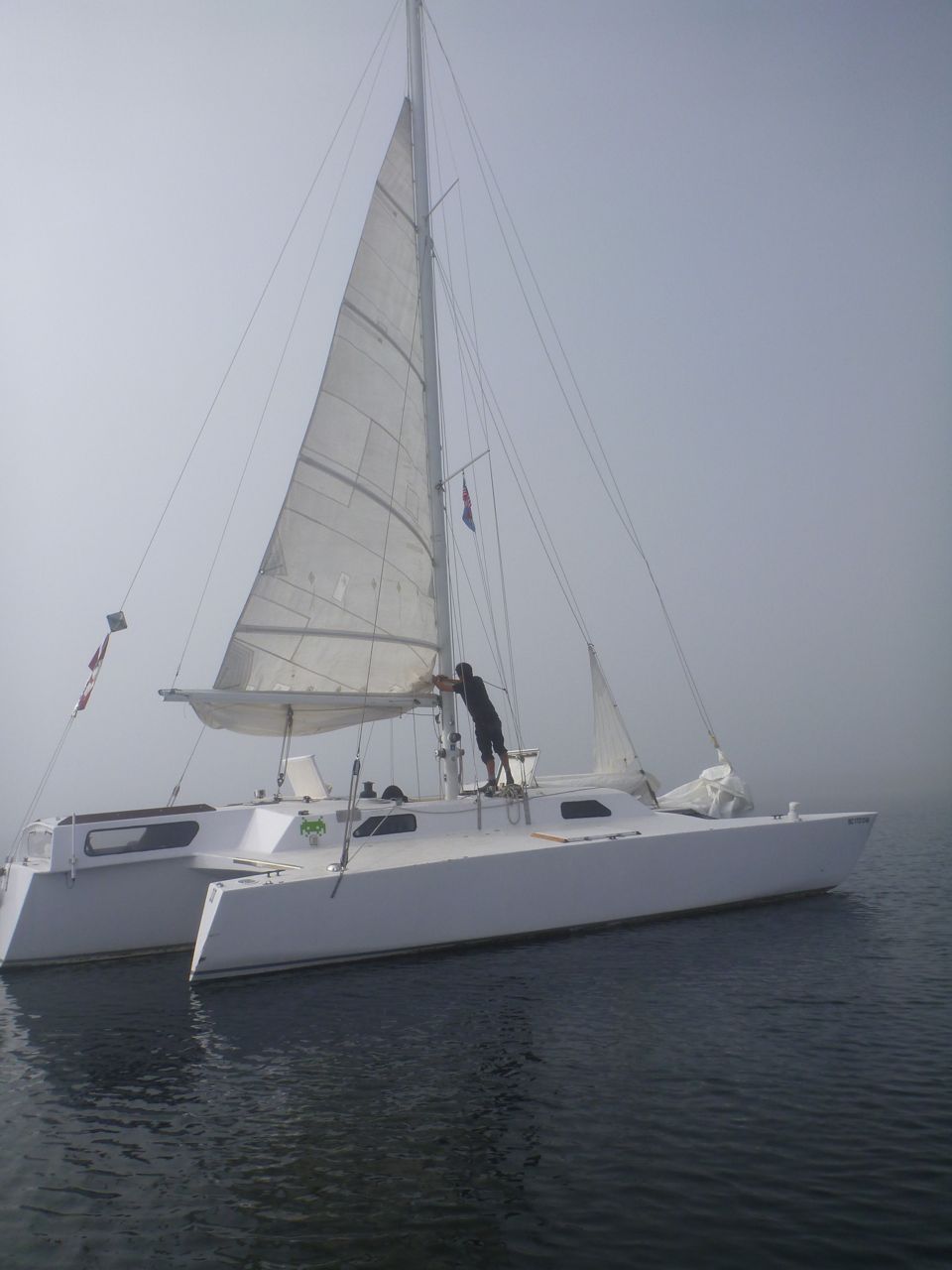
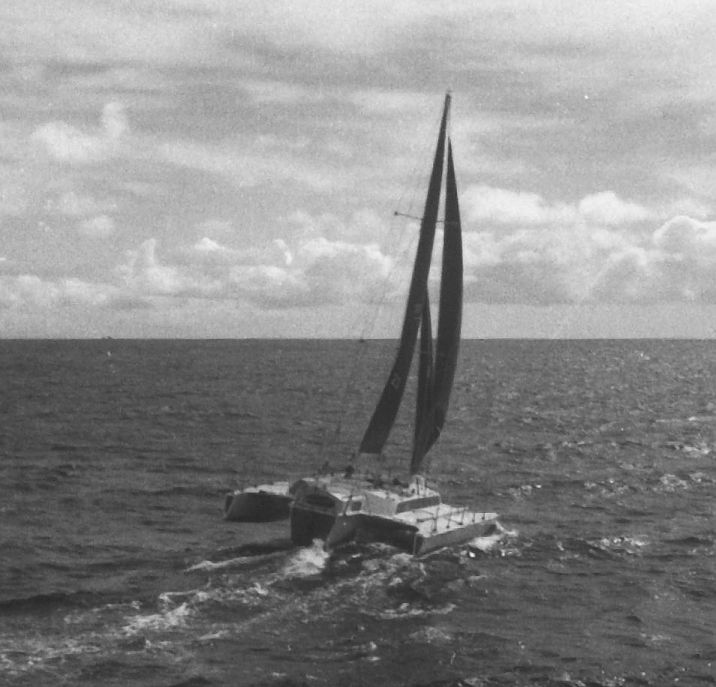
Well, I got a good solid 40 minutes or so of sleep before my phone rang again. This time it was Dale, the owner of the other (and nicer) Searunner trimaran in False Creek. "Drew," he said, "I just got a call from the police, and they say my boat is up on the rocks - are you on your boat? Do you have a spare anchor...?". I looked out my front window, and there was Dale's boat, sitting up on the rocks near Monk's. I do have a big spare anchor, and so it was back out of bed again and into boots and raingear. I put the heavy anchor into the rowboat and fought the howling winds rowing the 300 meters or so west, dropped the anchor into the water, rowed back to Dale's boat and climbed aboard. I wrapped the anchor rode around one of the winches, intending to winch him off the rocks, and went to grab a winch handle... nope. No winch handles.
Fortunately at this point there was a small wave system building, and I was able to rock the boat off the rocks and pull her to safety with just my arms, lying on the foredeck with my legs braced on the stanchions, using the two anchor cleats to gain a mechanical advantage. You'd be surprised just how large a boat you can move with just a sustained pull!
Once Dale's boat was safe, I rowed back to Tie Fighter to try to catch some more sleep - but of course, there were a few emails that needed my attention, so it was another half-hour before I could return to my bed, which was now once again cold. I kept the raingear and boots close and buried my head in the blankets - it took a while to drift off, due to the physical activity, but I was determined.
I had finally nodded off and had been asleep for a good solid forty minutes or so when I was awoken yet again by that now-unmistakable sickening *thud*. I jumped out of bed and threw on my boots, and headed out to find the powerboat crashed into my bows again - this time with a man aboard, doing his best to get his boat untangled from mine. He apologized profusely; apparently he'd come to retrieve his boat, and in doing so his engines had stalled just after he pulled up his anchor, and they were now refusing to start. His problem was cooling fluid, or more accurately a lack thereof. I had some to spare, so we rafted his boat up against my port side and tied him off, and he tackled the cooling problem. In a few minutes, he was up and running again, and we untied his boat. He set off with more apologies, sincere thanks and a promise of a delivery of beer sometime soon.
So that brings me to now, more or less. It's barely 5pm on a Friday, which usually means the day is really only about to begin. I'm due at a very exclusive techno dance party tonight, but with five hours of sleep and very little physical endurance left I'm not sure how that will go. The wind has died down a lot, but it's still quite windy out, and the temperature has dropped a few more degrees - thankfully my diesel furnaces are working very well, and the aft cabin is warm and toasty.
Some days are up, some days are down. I spoke once before about the amplitude of the good-day/bad-day sinewave, but I'm still maintaining that the good days outweigh the bad. This blog pretty much only reflects one portion of my life also, and suffice to say my romantic interests lately have been equally tumultuous - actually, way moreso. *sigh*.
I'm almost afraid to have a nap at this point, lest it anger whatever gods govern Friday the Thirteenth and something else comes up - but I think I'm going to give it one more shot.
Engine Battle, Round One, Fight!
As I've mentioned here recently, my engine ("Maude") is not currently starting. This is actually a bit of a hassle, as it means I'm pretty much stuck here in the middle of False Creek until I get her working again - not that I actually had anywhere I wanted to go, mind you. Still, the knowledge that you can't go anywhere is like a pizza-cheese burn on the roof of your mouth; not really painful per se, but irritating and impossible to completely forget about.
Fortunately, this is also the week that I began my 'Marine Diesel Engine Maintenance' class with Cooper Boating over on Granville Island. I've been to one class so far, and I can already tell that the $399 spent on the class was a very, very good idea! Three more three-hour classroom sessions and one Saturday-afternoon shop session to go - but even after a single class I've gained more understanding of my engine than an entire summer of being around it, blindly trusting it to work when needed.
One interesting part of the class - and in the sailing 'scene' in general around Vancouver - is the age group. At thirty-three years old, I am no spring chicken - but I am the youngest person in the class by at least twenty years. I've also noticed this at anchorages and marinas; I have to admit it puzzles me a bit as so many people that I talk with express a longtime interest in sailing and the liveaboard lifestyle. Is it really the kind of dream that people put off until retirement, at which point you don't have the energy or resilience to take long voyages? That makes no sense to me, but would explain why so many sailboats sit in the marina and never go anywhere.
Regardless, I cannot take any voyages while Maude is still not starting. At first I thought it was water in the fuel lines - that still may be the case, but now that I've drained the water from the fuel/water separator and opened the air-bleed bolts, I still am unable to feed diesel through the fuel lines using the fuel lift pump. I am beginning to think that perhaps the problem is actually in the fuel lift pump itself; these apparently have a diaphragm that wears out eventually, and I wouldn't be at all surprised if mine has worn out.
This weeks' class was mostly about the importance of the lubrication system (ie, engine oil) and the workings of the cooling system (ie raw/fresh water or antifreeze), both of which will require my attention in short order - however, neither of those systems can be maintained without first repairing whatever is going on with my fuel delivery system. Fortunately next week's class is about exactly that - so if I cannot figure out this problem on my own this week, I have a targeted class next Monday to help me.
Maude is the last major 'mystery' system on Tie Fighter, and I will be her master - or at least her capable attendant.