I know that the weather in Vancouver last winter was considered ‘mild’ by most, but between the steep learning curve of diesel furnaces and a general lack of knowledge regarding boat life in colder climates I can’t really say that the experience was particularly pleasant. That being said, nothing last winter prepared me for multiple days of sub-zero temperatures!
Tie Fighter in the snow
Miya and I returned from Oklahoma (she competed in the Route 66 Marathon, finishing in 5:05:24, an excellent time for a first marathon!) on Monday night, but with a -17º windchill we decided that it would probably be best to spend the night at my sister’s house. When we returned in the morning, we discovered the cold had actually frozen much of the plumbing solid, destroying the new galley faucet. Fortunately the new hoses held up to the ice and the new flexible water tanks didn’t freeze, so we didn’t have two hundred liters of water in the bilge to contend with but it was still a nail-biting couple of days waiting for the pipes to thaw. Just to make things interesting, the follow-up to days of bitter cold was a massive (by Vancouver standards anyway) snowfall – Thursday afternoon found me digging out the snow shovel from the depths of the starboard ama and shoveling a solid six inches of snow off the decks. Shortly after I finished, of course, the snowfall turned to sleet and subsequently to rain, cleaning off the remaining snow and leaving me with a pair of dinghies full of icy water to bail out.
Tie Fighter's halls, decked
The rains haven’t really stopped since, but that hasn’t stopped us from continuing with boat projects, albeit indoor ones. I’ve managed (under duress) to get the diesel furnace in the forward cabin working again, a problem that required the routing of diesel fuel lines under the floorboards and rigging an electric transfer pump. Now the forward cabin is toasty and warm, though the new propane stove in the aft cabin is turning out to be not the heat source that the former diesel cookstove was. We’ve had to run the Honda generator for several hours each day, just to keep a pair of small electric heaters going – it’s a disgustingly inefficient way to keep warm, but at least it works. I’m in the market for a second small diesel furnace.
The cold hasn’t stopped Miya from continuing to turn Tie Fighter into a home, and now the aft cabin salon has received some Christmas treatment. We even have a small Christmas tree fashioned from a live rosemary plant! The salon doesn’t smell like a traditional Christmas, but between the rosemary and Miya’s constant baking it definitely smells delicious, a welcome change from the pervasive smell of diesel and the salty sea air.
The weather this past weekend was idyllic, for the season; cold but mostly sunny. No wind meant that the nights in the Kitsilano Anchorage on English Bay were peaceful, with very little rocking save the occasional wake from a passing powerboater. The forecast however called for strong gales on Monday and Tuesday, and we were out of water anyway, so we packed up Tie Fighter and set off to finally return to False Creek.
don't use non-stainless steel cables on a boat.
Miya took the helm, but it was hardly ten minutes before she called out that the wheel was sticking, and that she couldn’t turn to the left. I thought it was just sticking, but when I came to try it myself, the wheel was definitely not moving. We quickly threw out an anchor, and I started taking apart the binnacle to see if I could spot the problem. It was immediately obvious when I pulled at one of the steel steering cables; it came up out of the channel easily, and after a few feet of rusty, oily cable came a frayed and broken end!
The ironic part – and I’m quickly learning that the Gods of the Sea are huuuuge fans of irony – was that not even three hours earlier, Miya had been reading my copy of the CYA Basic Cruising Skills manual, from a course I took a couple of years back. Reading the section on emergency equipment, she asked specifically:
“Drew, where do we keep the spare tiller?”
I answered:
“We don’t have one, baby. There’s no place to attach one, and besides, we have thick steel cables for steering, they shouldn’t ever break…”
Now, you’d assume that something as important as steering – especially on a boat with no emergency tiller attachment – would be rigged with stainless steel cables… but if there’s one thing the Gods of the Sea like better than irony, it’s assumptions. As it turned out, the single exposed section of steering cable was rigged with 3/16ths stainless steel cable, but the rest – the parts impossible to inspect, routed through the walls in rigid conduit – were rigged with regular steel cable. Which, of course, had rusted completely through after a few(?) years of living in a wet conduit.
Darren with the new steering cable
My good friend Darren was in town on Sunday, on “vacation” from the island paradise in Malaysia where he runs a diving school, and so after a leisurely brunch we tackled the problem of routing the new stainless steering cables. We rented a large, industrial crimping tool and bought a bag of aluminum crimps, then settled in for the nightmare job of trying to thread the new cable into the old conduit. To our surprise and delight, the new cable went through the conduit without a hitch, and replacing the entire steering system (including a stopover to lubricate the turning blocks) took around two hours total.
The interesting part is that I think the steering system is actually the final, single system on the boat that I hadn’t actually torn out yet. Every single system aboard has now had my hands in it, either by tearing each system out completely or just removing, cleaning and reinstalling. All of the water lines, all the hoses, the entire electrical system, the bilge pumps, the galley, the head, the lighting, the sailing instruments – everything! Only Maude (the big Yanmar diesel engine) looks more or less exactly like she did when I started, and if you’ve been reading this blog for a while you know that there’s been a serious tonne of work done there as well.
leftover cable turned into spare rigging
Anyhow. The repairs went fine, and the steering is back to 100% again – even better, in fact, as now the turnbuckles turn a lot easier, and without a frayed steel cable scraping the inside of the conduit the steering wheel turns far smoother than before. We are extremely lucky that the cable snapped while we were only about 300m offshore, still in the Kitsilano Anchorage instead of out in the middle of the Georgia Straight like we were the weekend before – I’m honestly not sure how that would have gone.
For now, we’re back in False Creek, and have already survived a November windstorm – though it wasn’t even 40kn of wind, we only had out a single ‘delta‘ anchor. The winds came up suddenly, jumping from a gentle 5kn breeze to a 30kn gale in under five minutes, and that was enough to cause us to drag anchor about 200m east, narrowly avoiding slamming into Erik’s boat ‘Solgangsvind’. We fired up the engine and tried to re-anchor several times, but dragged anchor each time, and on the third time dragging we came a little too close to ‘Solgangsvind’ again and drifted over Erik’s anchor line. I had to quickly tie off our anchor line to a buoy and toss the whole thing overboard, because with his anchor line hooked we couldn’t pull our anchor up without also pulling up his, and that would mean multiple boats drifting free in the 30kn winds – it could have been a real mess! With Miya at the helm we motored back west towards the Granville Bridge, searching for better anchor purchase.
We found a good hold just past Monk McQueen’s restaurant, deploying a 35lbs CQR anchor and having that hold for an hour or so… but then suddenly the wind picked up again and we found ourselves dragging anchor east towards boats moored at the marina! I had Miya take the helm again, and with a panicked look in her eyes, trying to keep a 39′ sailboat off the rocks in the dark with howling winds and driving rains lashing us, she kept the boat steady and pointed into the wind while I pulled up the anchor and attached a second anchor, a 25lbs ‘fortress’, to the end of the chain. This gave us a 25lbs anchor, 20′ of heavy chain, a 35lbs anchor, another 20′ of heavy chain and then a hundred feet of thick rope, which – after we set the anchor properly – held us solid for the rest of the night. Of course we still had the GPS anchor drag alarm set all night, but we were never woken up.
Anyhow – we’re technically back in False Creek, but the boat is locked up solid while we’re away in Oklahoma for the next couple of days so that Miya can run 26.2 miles in the Oklahoma marathon!
Continuing the saga from my previous posting, I bring you the photo-journal of the second month of my brutal summer adventures in the Shelter Island boatyards. Rather than re-introduce the situation, I’ll just jump in…
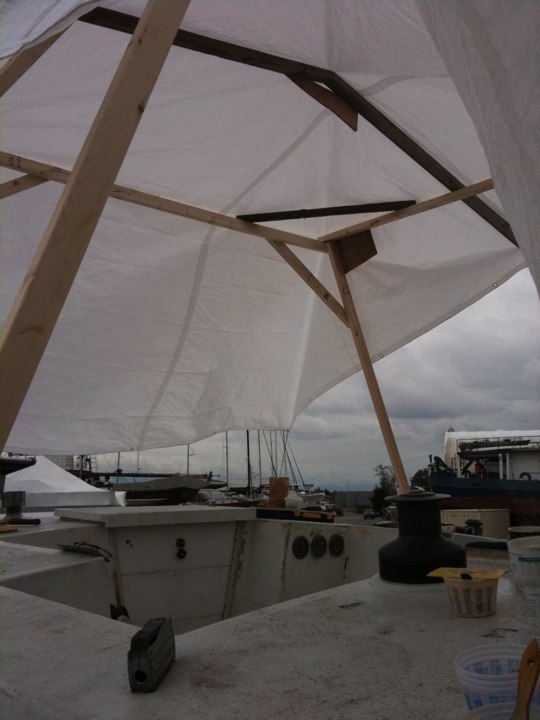
rain cover
Canada Day brought intermittant rain, so mostly we just worked under the boat, sanding the overhead panels and getting our feet wet in the ever-growing puddles that pooled inexplicably under the boat instead of draining to the nearby sewer grate.
centerboard
By the time the rains stopped, the hired boatyard labourer guy had finished grinding off the old bottom paint down to the reddish epoxy barrier coat, before disappearing for a few days – something that would become a recurring theme in the next few weeks. At least the labour was relatively cheap, and honestly the task of grinding off old bottom paint wasn’t something that DR and I were interested in tackling ourselves. Bottom paint on sailboats is “anti-fouling”, meaning it contains nasty poisons, so that things like mussels and barnacles and seaweed won’t be able to grow on the surface of the bottom of the boat.
Let me repeat that for good measure. Many things on worksites are poisonous, but usually the ‘poisonous’ property is secondary, ie. things like motor oil are lubrications that also happen to be poisonous. Bottom paint is poisonous because that’s what it was designed to be: poison. Grinding off old bottom paint throws literally pounds of poisonous dust into the air – no matter how good your respirator mask is, there is no way to make the job any more pleasant!
powertool party!
For the first few weeks, we cleaned up the worksite carefully every night at around 8pm or so, in accordance with the boatyard rules. By the end of July we were pretty much leaving the tools where they fell, and picking up each job the next day right where we left off.
bottom primed
After not showing up for several days (and getting kicked off the worksite following a yelling argument with the boatyard foreman), the hired labourer showed up and finished the job. Finally the bottom grinding was complete, and the bottom was primed with a grey epoxy barrier coat!
sequential circus 7 pre-show setup
July 3rd brought ‘Sequential Circus 7‘, an electronic music concert/party/show that I (with a large group of dedicated friends) throw every six months. Fortunately we’ve been doing this for years now, and everyone really knows their jobs well… there were no hiccups and the show went off without a hitch. By all accounts, a great party.
starboard underwing rot repair
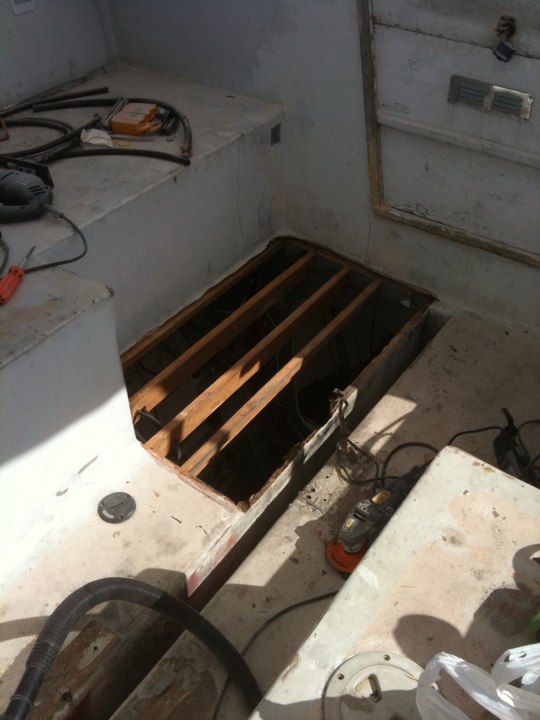
In the starboard wing is a special locker for a horizontal propane cylinder. One of the critical points of keeping propane on a boat is ventilation; because a boat is watertight, and because propane is heavier than air, a propane leak can lead to a boat full of propane, silently awaiting a spark. More than a few boats have been blown apart by a bilge full of gas!
The locker must have holes in the bottom of it so that leaked propane can escape – however, some previous owner didn’t properly seal up the edges of the holes in the wooden floor of the locker, and as a result they rotted through. What looked to be a couple of small (ie a half-foot square) patches of rot turned into a 3’x4′ patch in the hull of the boat.
line locker completed, sort of...
We found a bit of rot in the bottom of the line locker (a locker for ropes and anchors, in the port wing) as well, so we gutted and replaced a few panels in there. I wish I had a ‘before’ photo – the angled bit at the far corner of the locker used to be a pair of five-inch holes with an old corrugated steel elbow joining them; a tunnel to provide ventilation between the inside of the forward cabin and the port ama. The kicker: the steel elbow jutted out into the foot of the guest bunk, and would cut your toes if you kicked it wrong! I replaced it with a plywood enclosure and rounded and filletted all the corners, and added a vent grating to the inside of the cabin.
This project took a lot longer than expected – in this photo it looks complete, but it took another week of work afterwards, due to stupidity on my part. I had found a can of paint labelled ‘Neutral Base Coat’ in the old supplies that came with the original purchase of Tie Fighter, and I had also found a can of white epoxy paint, the same brand. I figured they’d be a good match for the heavy traffic of the line locker, a good base coat followed by a tough layer of epoxy paint. The funny part was that the “neutral base coat” was bright orange! I was a bit run down at that point, so I assumed that they must mean chemically neutral, and so I applied the base coat, waited a day, and then applied the white epoxy coat on top of that.
A week later, the white epoxy paint could still be peeled off with a fingernail, exposing the still-wet orange oil based paint below. I finally figured it out: orange paint is something that multihull sailboats are supposed to carry as a safety precaution… should the boat ever flip over at sea, you are supposed to paint ‘HELP’ or ‘SOS’ or something on the hull in orange to assist the rescue. I had used my rescue paint on my line locker, and worse, it was incompatible with my epoxy coat. I had to painstakingly remove all of the white and orange paint, using scrapers and solvents, before being able to paint the locker white again.
aft cabin disassembled
The next few weeks were the hottest days of the summer, and any job that didn’t require being in direct sunlight was infinitely preferred. We began gutting the salon.
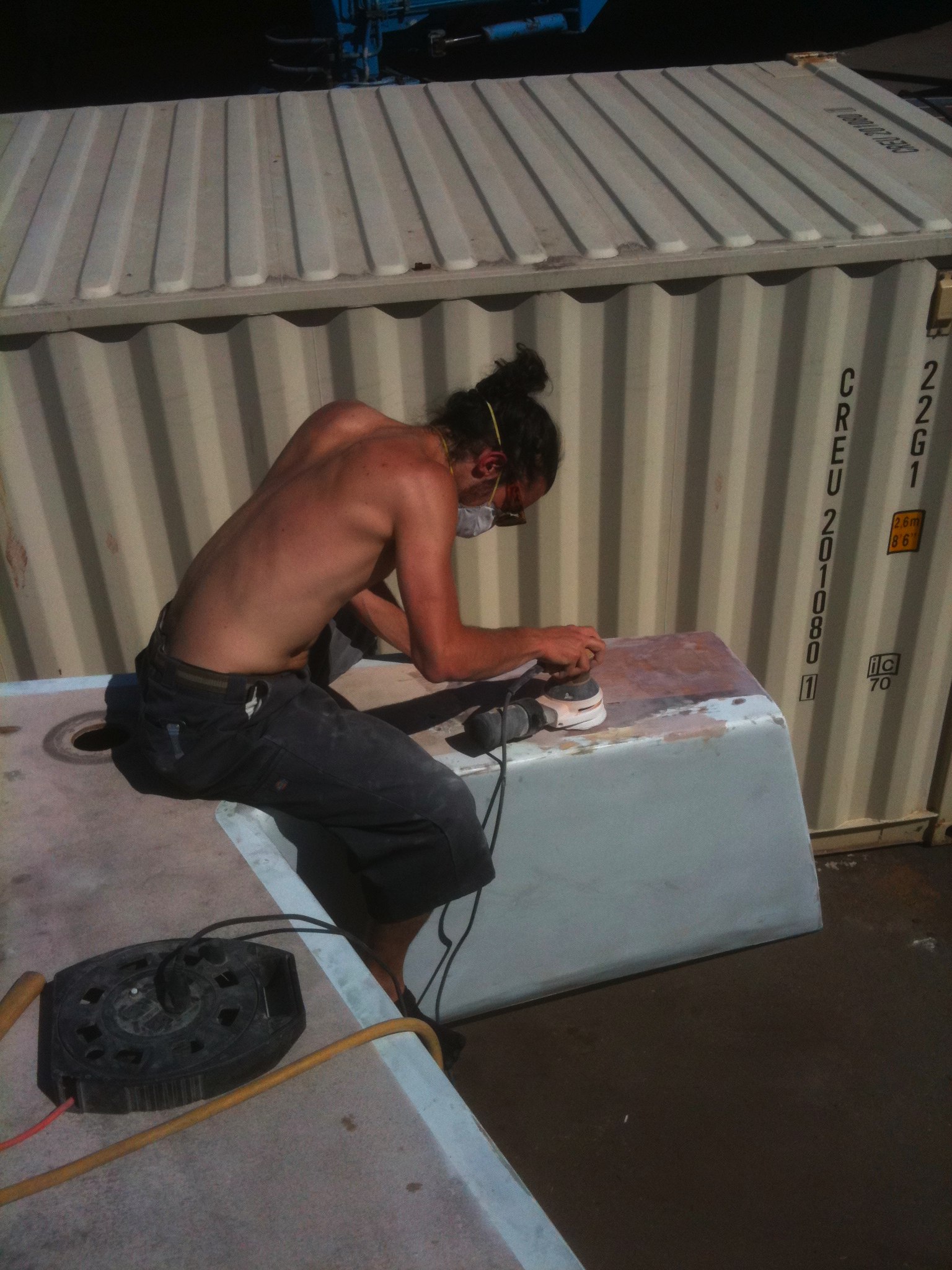
Trent sanding the starboard ama stern
I actually managed to pull Trent away from his insane summer schedule of school, work, and conference preparation. I think this was the only day he took off from his SIGGRAPH submission deadline…
Carrie patching the main hull
Carrie also made it out several times to help out with the labour – though her biggest contribution by far was the loaning/renting of her Ford Bronco for weeks at a time, without which many of the jobs could simply not have been done. We must have made the trip to Home Depot two dozen times.
bottom paint completed!
This photo shows the bottom of Tie Fighter in her ‘dress black’. The grey epoxy barrier coat first received a coat of red antifouling paint, then a coat of black – this way we tell how much of the antifouling has worn off just by the color of the hull.
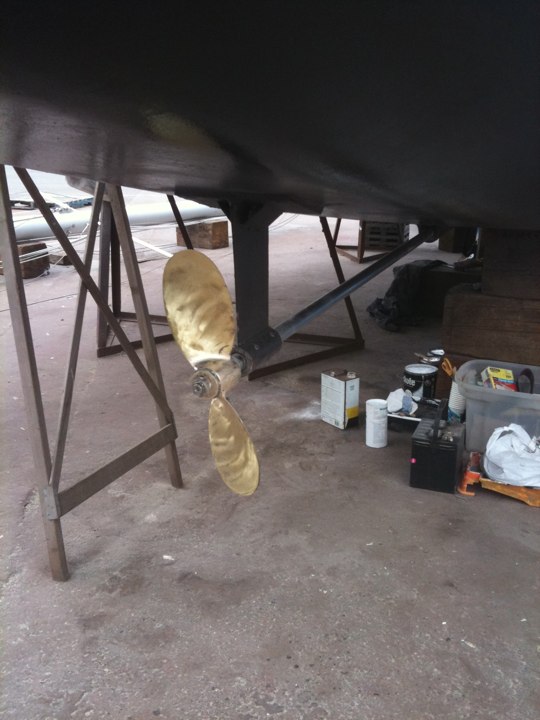
propellor ground down and shiny
The propellor, after having years of barnacles polished off with the angle grinder. Two large shaft zincs were later attached. I would have liked to swap out the propellor with a folding one, but we were unable to find one of the appropriate size and pitch within my price range while the boat was out of the water.
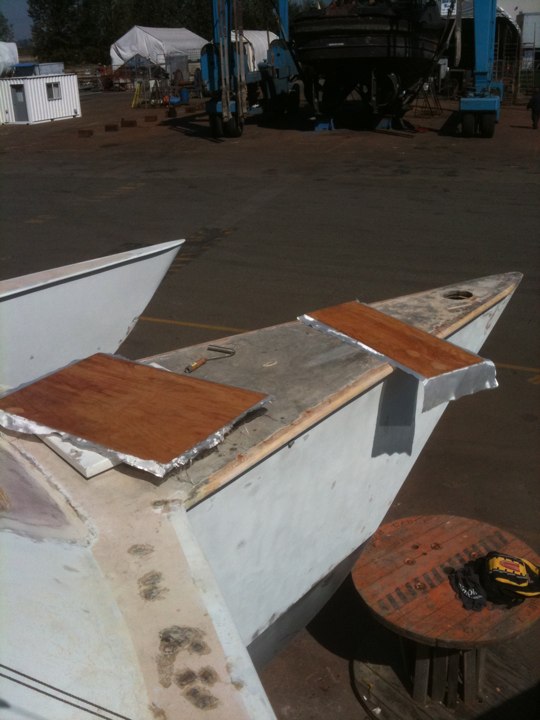
bow rail rebuilt and complete
This photo shows the newly-repaired bow rail – the brown strip at the top of the hull, basically the edge of the deck. The rail was rotted when I purchased the boat, and was one of the first things I attempted to repair in the summer of 2009. In the year following, I learned so much more about woodworking and fiberglass that I tore out the previous year’s repairs and re-fixed the rail… properly this time. 🙂
centerboard damage repaired
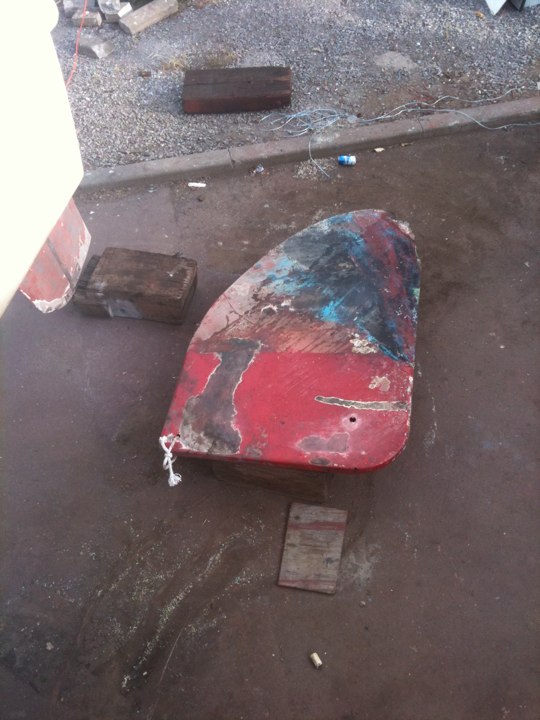
This is the centerboard, tilted up so that the water inside could drain, while the fiberglassed repairs to the leading edge cured. You can see the multiple layers of barrier coat and antifouling paint, as well as the spots where the paint and even the fiberglass had worn completely through, exposing the wood underneath.
hack, slash, etc
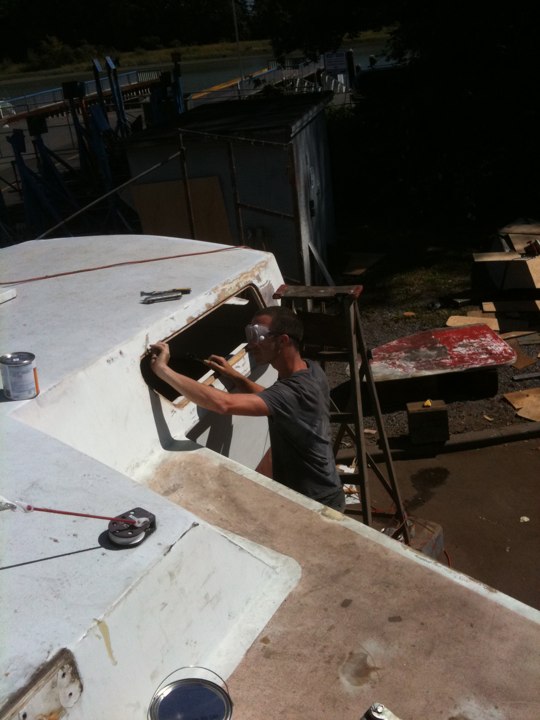
Another “tiny patch of rot”, at the base of the forward window. We learned pretty early on that it’s far simpler to take out an entire panel than it is to try to patch a section at a time. This was probably my favourite repair of the summer – by this point I had gotten the hang of the repairs, and this one went smoothly and very quickly, probably four days from start to finish.
The nasty part is that all of the dust you can see on the right side of the photo is powdered fiberglass. I always wear respiratory protection when working with fiberglass, but there’s just no way to keep the dust off of your skin. Taking on a job like replacing this window frame is resigning oneself to at least a week of itching.
rot in the aft cabin
Yet another “little patch of rot”… this one has never actually been finished, in fact. I still have to cut the replacement board and fit it into place. One of these afternoons…
front window repairs ongoing
The forward window fiberglassed in and partially faired – the next few steps are just adding fairing compound (epoxy thickened with a talc-like filling powder), spreading it out as smoothly as possible, waiting for it to cure, then sanding it down until the repairs completely disappear.
removing the space invader
As a symbolic first step towards painting the boat, my signature ‘space invader’ stickers had to be removed. I have a few more of the stickers, and eventually they’ll be re-applied, but for now this was the end of the first chapter in the book of Tie Fighter.
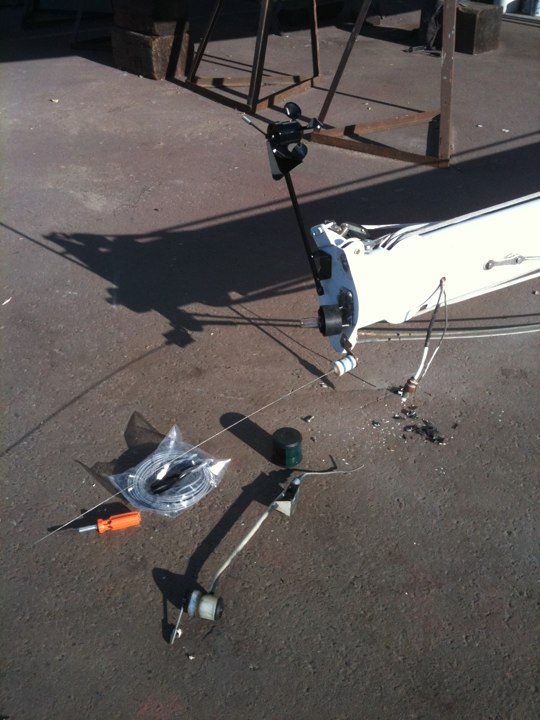
masthead upgrades
The mast-head instruments never really worked. More specifically the wind speed indicator and the apparent wind indicator were completely smashed; you can see them lying on the ground in this photo. I looked into modern replacements, but a set of modern instruments can easily run well over $2000! I tracked down the company that made my instruments on the internet, and though they no longer make sailing instruments, they still had replacement parts in stock. A set of replacement masthead instruments ran me about $350. I also took this opportunity to replace the masthead ‘tricolor’ light with a combination tricolor and anchoring light.
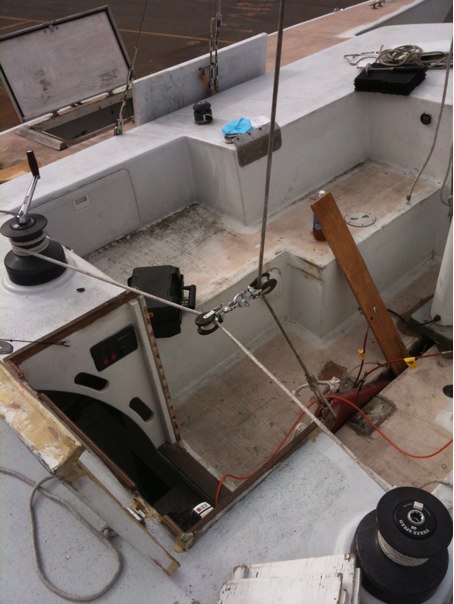
cockpit floor started
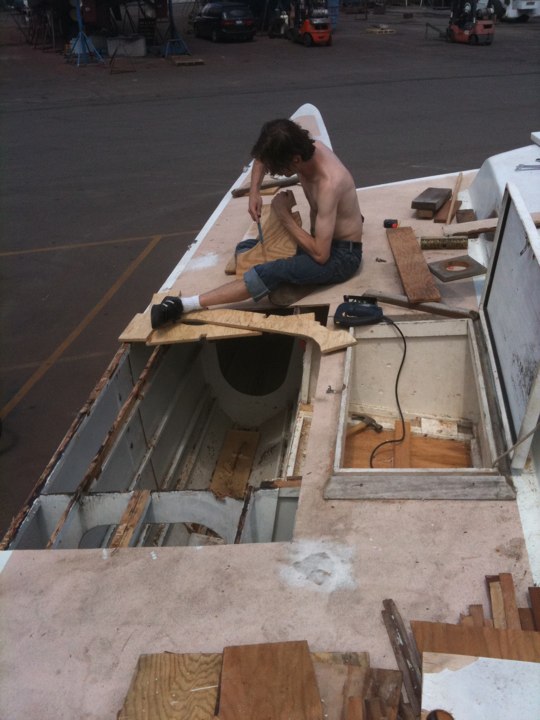
The largest and most scary repair was the centerboard trunk – we had found signs of rot in the trunk walls, the sides of the housing for the centerboard. This section is often referred to as the “backbone” of the Searunner trimaran, and rot in here would eventually destroy the boat completely. I left this job for last, so that I would gain experience from all the other repairs and do the best job possible. The first step to fixing the centerboard trunk would of course be to remove the sections of the cockpit floor that had also shown signs of rot and would need to be replaced, and to gain access to the top of the trunk itself.
cockpit floorboards drying
The new cockpit floor would be exactly like the old cockpit floor – 3/8″ marine-grade plywood, soaked in epoxy thinned with acetone and fiberglassed. This would be a very high-traffic area, completely exposed to the elements for many years to come, so we took our time to make sure that the replacement boards would done perfectly.
DR painting the port ama
While I worked on the cockpit, I had DR painting the inside of the port ama. This was very possibly the harshest job of the summer, and DR was slightly more suited to the task than I, having a somewhat leaner frame than I as well as significantly more painting experience. I did not envy him the task, but he did a really great job on it.
James scraping the windowsills
In mid-July I had another friend come on nearly full-time to help with the boat; my friend James began staying at the boatyard with DR and I, and he proved to be a hard worker. Here he is scraping Sikaflex 291 out of the window frames… Sikaflex is a marine adhesive and sealant that stands up to pretty much anything. There’s a saying in the boating world: “That which Sikaflex and the Lord hath brought together, let no man tear asunder!”. Foul, foul stuff, nearly impossible to remove!
cockpit floor fully removed
The biggest part of any boat repair job is the removal of the old materials – at some point we discovered the new Dremel ‘Multi-Max’ tool, which proved to be a magic wand for these sorts of repairs. In this photo you can see three of the four sections of cockpit floor removed; the fourth didn’t show any signs of rot, so we left it in place.
Also in this photo you can see the beginnings of the centerboard repairs! To my huge relief, the rot in the centerboard trunk was not very extensive, and we were able to cut out the rotted parts, soak the non-rotted exposed wood with propylene glycol to kill any remaining rot bacteria, soak it all in acetone to dry it out, brace the boards with fresh, sealed marine-grade plywood, and then finally fill the resulting gaps with epoxy thickened with powdered adhesive. I am confident that the repairs are stronger than the original construction.
DR as a proud spaceman
Dan Ross completed the painting of the port ama, but with another upcoming heat wave staring us in the face, we decided that it would be better to have the boatyard labourer do the other ama.
cockpit floors installed and filletted
The cockpit floors went in smoothly, and sanding would soon begin!
James sanding the aft cabin
With a heatwave under way however we took any opportunity we could to work ‘indoors’ or underneath the boat… anything to stay out of the hot sun! The days were so hot that by noon we wouldn’t be able to think straight, and after a few near-misses involving power tools we decided that it would be best to try to take it a little easier during the hottest parts of the day.
rebuilt mast step
The former mast step had been completely destroyed by rot, so I manufactured a new one by laminating four layers of marine plywood together with epoxy and then fiberglassing the whole thing over. I do not expect to ever have to replace this part again!
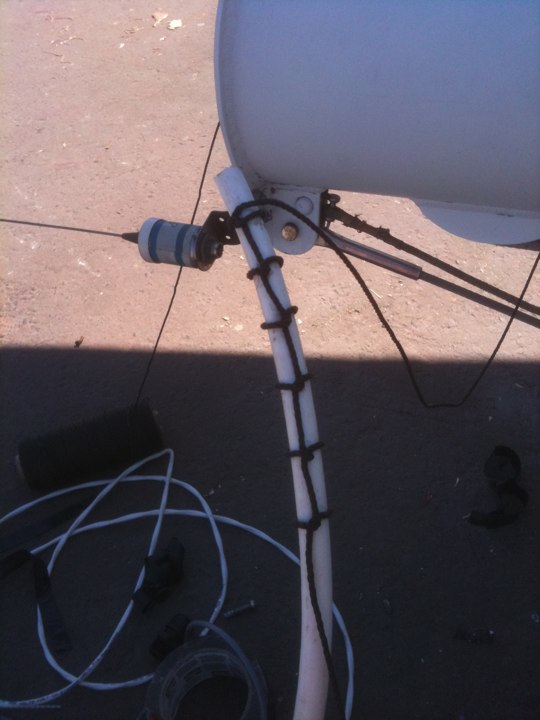
the redundant string of knots
While the mast was down I decided that it would be wise to replace all of the internal wiring as well, and so over the span of two days I dragged over 250 feet of new wiring through the length of the mast, using tarred sailing twine given to me by my friend Kym Rich. This photo shows the knot used to secure the thick coaxial cable prior to dragging it through – if the knot were to let go, getting the cable through would have been a nightmare! This knot was subsequently covered in duct tape, and the system worked perfectly.
Jen and Emerson removing chainplates
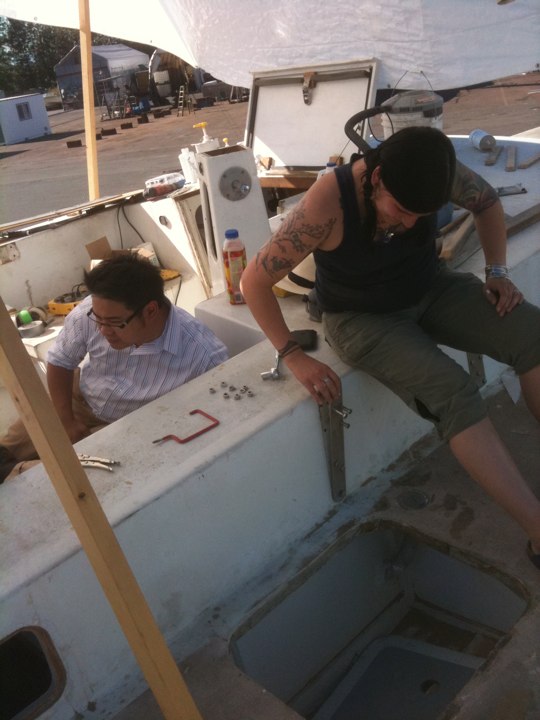
I had many visits from friends and family during this month. I tried to take photos each time, but I often failed and/or forgot. Here is my friend Emerson Tan and my baby sister Jen – five months pregnant in this photo – helping to remove chainplates.
centerboard faired and polished
The centerboard continued to be a project, one that could often be worked on during hot periods of the days, and so many hours of grinding and patching later it was nearly complete. This photo shows the board cleaned and shining in the sun.
Chad Taylor sanding the starboard ama
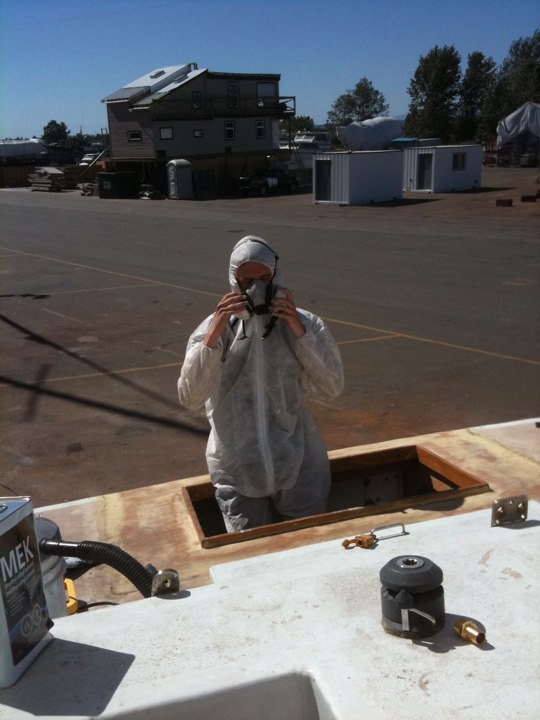
Prior to painting, all of the former anti-skid paint had to be removed. Anti-skid is paint that has a rough texture – often it’s as simple as adding regular beach sand to the paint, but in the case of my boat it was a little more uniform. Sanding the anti-skid proved to be incredibly time consuming, and using the angle grinder was delicate work that often caused scarring of the fiberglass underneath. In a stroke of luck, we discovered that methyl-ethyl-ketone (MEK) solvent dissolved the antiskid paint, and after flailing for days with sanders and grinders, Chad Taylor and I took off all the antiskid in an afternoon with solvent and hand scrapers.
port ama stripped of all antiskid
This photo shows the stripped wings, ready for priming and painting. Or at least we thought so, but as it turned out we had many days of sanding left before we could paint…
brightwork!
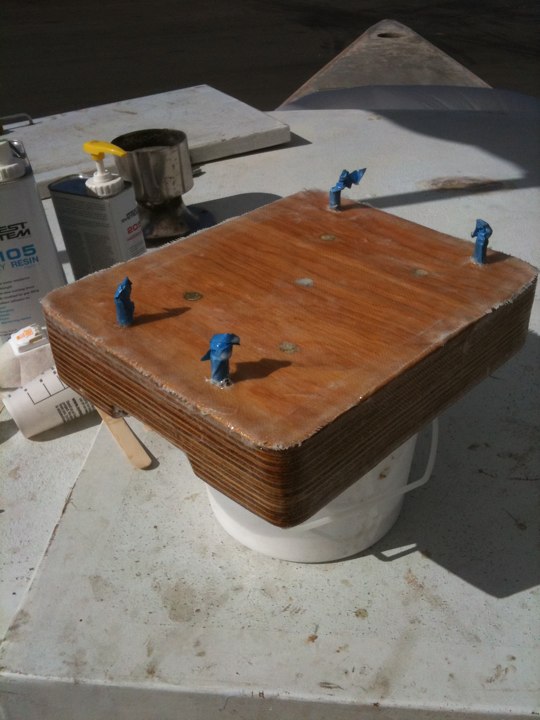
The hatches on Tie Fighter stand up about two inches off the deck, which is more than enough to catch on a wave coming over the decks. A big enough wave could tear a hatch open, which could end pretty badly under rough conditions, and so each hatch has a pair of wedge-shaped blocks of teak to deflect those incoming waves. I had gone to one of the boatyard shops looking to purchase a little block of teak for the top of the binnacle, and they offered to do all of my brightwork for not much more! The block of teak I purchased – the square piece at the top of the photo – was $40 finished, but to have them refinish all of my teak was only another $20, so I jumped at the chance.
completed crossbrace
Another “tiny spot of rot” was at the top of a very important bulkhead in the forward cabin, where the stay for the staysail attached. The former attachment hadn’t been sealed well, and a leak had been patched over from the inside… which means that the leak itself wasn’t repaired, just masked. A large chunk of the bulkhead had to be removed, and the repairs had to be *strong* – this four-inch thick laminated plywood brace was the final answer.
crossbrace installed
The crossbrace was carefully sized and finally bolted into place with another twelve 1/4″ bolts and lots of thickened epoxy. This marked the end of the rot repair projects!
James sanding the aft hull
Now that the repairs were pretty much complete, the next stage began in ernest – sanding and fairing every square inch of the boat, in preparation for painting. The sheer magnitude of this task was staggering – painting a large sailboat is a huge task, but painting a large trimaran is three times as much work!
Jesse sanding the port bow
Around this time, my friend Jesse came out to start helping with the boat repairs as well. Jesse brought his experience working at an automotive body shop to the table, and his attention to detail made a huge difference in the final project. At this point, each day I expected the boat to be finished “within a week”, and each week I realized that it would be at least another week of hard labour before we’d be even close to finished.
the crew hard at work
The end of July found us still hard at it; I was beginning to lose my confidence, and my wallet was significantly lighter than I had expected it to be at this point, but I was still confident that the end was nearing and that I’d yet have a great summer sailing adventure. At the very least, I’d have a few hot summer nights sitting at anchor in English Bay surrounded by friends, making music on the water, right…? Little did I know there would still be another solid month of work before the boat would even be back in the water, and another two months after that before she would sail away under her own power…
A particularly poignant lesson I’ve learned in the past two weeks – well, technically I had already learned it once twice this summer, but apparently I’m either a sucker for punishment or a sucker for a “deal”. The lesson is that – to borrow from Robert Asprin’s ‘Myth Adventures‘ series – when you think you’re getting a deal from a dock rat, you had better count your fingers, then your limbs, then your relatives.
“Dock rats” are people who live in the boatyard or on the dock, picking up cash contracts wherever they can. Dock rats who charge cheap rates for carpentry or painting or engine work often do because they’ve got addiction problems, socialization problems, or are just straight-up incompetent, preventing them from working for reputable companies or starting their own. In some cases it’s a combination of all three!
valve cover, showing the damage
Anyhow. I was bitten three times at Shelter Island, hiring dock rats for labour – there were at least another three times that the work I hired them for was of excellent quality, but one carpentry job was botched utterly, one painting job went sour, and now finally my engine repair work has gone south. The technical version? When the guy reassembled my engine after replacing the head gasket, he didn’t tighten down a particular lock-nut properly, and within a couple of hours of use the engine vibrated the nut loose and eventually fired a push rod up and straight out the top of my valve cover!
On a good note, despite the fact that the engine is currently not running while I await delivery of the parts from Toronto (parts cost: $15. “overnight” shipping: $85. ouch, but it beats waiting two weeks…), I feel very, very good about the engine! When we removed the head to change out the head gasket, we found that whoever it was that last changed the head gasket actually installed the wrong gasket for the engine!
I’m sure 95% of you have no idea what it means to have the wrong head gasket installed – I didn’t know until very recently. The short version? The gasket was completely blocking the passages for the engine coolant, which finally explains my overheating symptoms. Ah HAH! Finally, a big, glaring reason for the problem that’s been plaguing me for a solid year!
"Two dollars. No receipt."
The repairs from here will be pretty easy. I’ve had the main part done already; finding a guy to weld a patch into the cast-aluminum valve cover. This wasn’t a problem in a blue-collar fishing town – asking around at the marine stores resulted in a list of seven local guys who could do the job, sorted by price and quality of work. I chose a guy near the center of the list, and when Miya and I found him, he barely said three sentences to us from the time we explained the problem until the repaired piece was back in my hands. I asked how much he wanted for his time, and he charged me a whopping two dollars.
The rest of the repairs I think I can handle myself, there’s not much to it. I’ve picked up a set of feeler gauges; basically a set of strips of metal, each one a specific thickness. I’ll use those to carefully adjust the rockers on the top of the engine to their specific gaps, and with any luck the engine will fire up and run smoothly. I will still eventually have to convert the engine back to fresh water cooling, but I’m pretty confident that I can do that myself some weekend.
*sigh*. Well, engine repairs aside, I am overjoyed to finally be back at anchor! Miya and I limped into Steveston Harbour on Saturday night and we’ve spent the past few days anchored across from Steveston Landing, which is a lovely, quaint little “seaside boardwalk town”. There are probably two hundred fishing boats at the public docks, then a fisherman’s wharf market flanked by retirement condos on all sides. The first time I visited this neighborhood was a few months ago with Ernst, dropping off my diesel stove at Mariner’s Exchange, a consignment marine store – he mentioned that Steveston Landing was a really nice place to spend a day with the significant other, wandering around the docks, taking in the sights and having a nice meal.
Tie Fighter at anchor in Steveston Harbour
One milestone that might not seem like much to the casual observer but that really meant a lot to me – last night was the first night spent under the newly-installed LED anchor light – a legally-required white light at the top of the mast. No big deal, right? In the time I’ve been living aboard I’ve noticed that very few of the anchored boats have their anchor lights on at night. As a result a lit anchor light at night has come to mean to me the difference between a well-appointed, properly-maintained sailboat under the command of a skipper with a good attention to detail and a… oh, I don’t know. An unoccupied boat? A derelict vessel? A scofflaw? I have always wanted to be one of the boats with their anchor light lit up at night, but between electrical problems and battery issues and just plain not having the light at the top of the mast… I haven’t ever been. If I can help it, I will never spend another night at anchor without my light aglow.
The plan from here? When the parts arrive, I will finish the engine repairs and Miya and I will head back to False Creek for a few weeks. We’re hoping to sail on Saturday; we’re approximately 20nm from home, and if we make decent speed we can be back in Vancouver in about four hours.
It’s been six months since I’ve updated my blog, and much has changed. So much, in fact, that the sheer amount of things I have to write about has been preventing me from writing at all! I’ve resigned myself to the fact that many of this summer’s great adventure stories will have to remain untold, and that I will just have to tell the biggest story – and in the spirit of ‘worth a thousand words’, I think the story is best told as a series of photographs, with a descriptive paragraph for each. There are eighty-six photographs in total, and that’s after having culled and cut and edited out well over half of them. Most of these photos are lower quality, all that remains from my iPhone’s ‘Facebook’ application.
The short version: I planned to haul Tie Fighter out of the water for a two-week intensive repair and paintjob session, and those two weeks turned into a grueling sixty-five day slog, working ten or more hours per day in the hot sun with a total of five days off over more than two months. Fortunately the weather cooperated, if you count blisteringly hot sun as cooperation…
Without further ado, I present to you “What I Did On My Summer Vacation”, the June edition. If you’re reading this on Facebook, I strongly suggest you visit my main blog site (http://www.disengage.ca) for the original formatting.
Ernst at the helm
Given the ongoing problems with my engine overheating, I figured it was probably prudent to enlist some help with the travel from Kitsilano up to the boatyard that I’d be working in, Shelter Island Marina in Richmond, BC. They were chosen because they are the only boatyard in the lower mainland with a travelift capable of hauling out a boat the width of Tie Fighter!
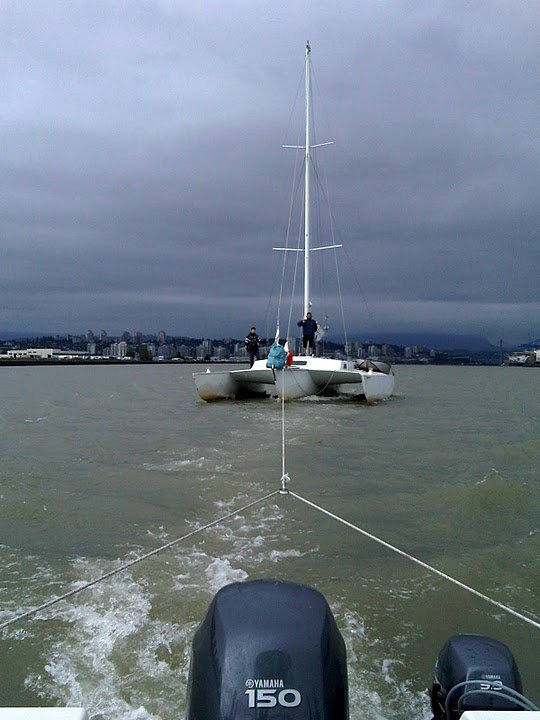
towing Tie Fighter behind the Foulkeswagen
My friend John Foulkes offered to give me a tow up the Fraser River with his powerboat, and so Ernst and I sailed Tie Fighter out around UBC and to the river mouth, then attached a line to John’s boat (the Foulkeswagen) and headed up the river. Aside from a near miss of the banks during a daring coffee-relay mission between the two vessels, the trip was peaceful and uneventful.
approaching the lift
I spent the night on the Shelter Island docks, then in the morning I motored up to the lifting dock…
travelift lifting Tie Fighter out of the water
…where I was lifted up…
out of the water
carrying Tie Fighter across the boatyard
…carried across the boatyard…
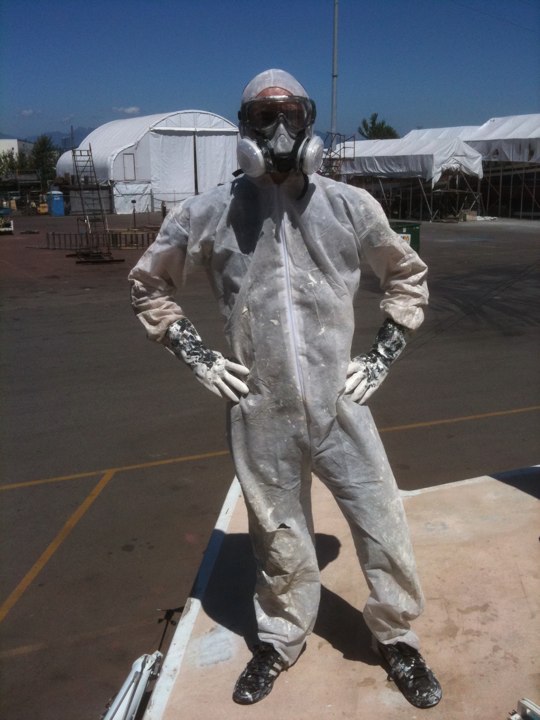
washdown guy in hazmat suit
…powerwashed, and…
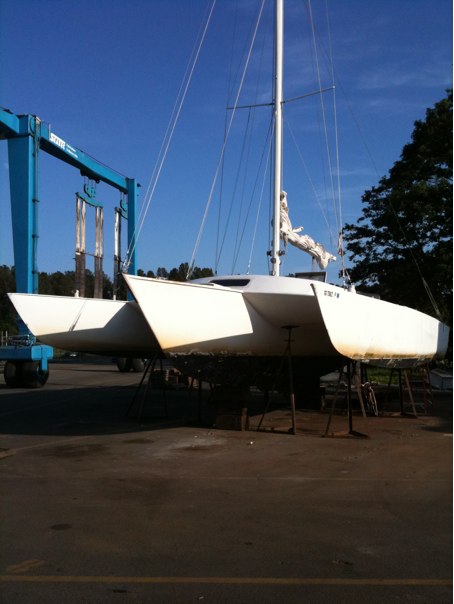
Tie Fighter blocked and ready for work
…finally set down gently on metal stands, ready to be worked on.
At this point I honestly did think that I’d only be out for a total of two weeks, but everyone who asked about it laughed when I told them my schedule and predictions of how long it would take. One guy, a fellow geek, actually recommended I take all my predictions regarding time and money to be spent, add a worst-case scenario, and then multiply it all by ‘pi’. Strangely his predictions were the most accurate of anyone.
stuck centerboard, meet physics
The first task was to remove the centerboard, though of course it didn’t want to come out. At some point, some previous owner hit some rocks and damaged the fiberglass bottom edge of the board – the wooden centerboard absorbed seawater and swelled up, causing it to stick in the centerboard trunk. Two days, a lot of rocking, some serious leverage provided by halyards and block-and-tackle, and a bottle of extra virgin olive oil later… she came out.
the centerboard finally out
Six hundred pounds of centerboard doesn’t move around too easily! Ugh, three different layers of anti-fouling paint, old fiberglass, wood fibers and several years of marine growth – this piece of wood was foul. We drilled a bunch of drainage holes in the board and propped it up on wood blocks “for a few days”. Little did we know, it would be there for almost two months.
One of the first major projects was to repair a “tiny, little 6-inch spot of rot” in one of the port ama bulkheads. Of course, we quickly learned that as soon as you can spot any rot, there’s a lot more that you can’t see… and the project turned into a bulkhead, support beams, an inside panel and several feet of decking!
DR tracing out a new bulkhead
My close friend Dan Ross spent a large portion of the summer out in the boatyard with me, helping to repair the boat. His work ethic and good humour kept me both motivated and sane through the long, hot days on the asphalt.
DR fitting the replacement bulkhead
In the photo above you can also see the line locker, the open hatch on the right. Originally this had been a locker for a life raft, accessable from below the wing should the boat ever capsize… but of course, the hatch wasn’t installed well, and subsequently it rotted. We removed the hatch and built up the locker as a proper watertight line locker, by replacing about fifteen square feet of the underside of the wing, then building a new floor into the locker over top of that.
port ama hatch rebuilt, awaiting fiberglass
Miya on the starboard bow
During this time I also had other friends visiting and helping quite often – here’s a pic of my lovely girlfriend Miya working on the starboard bow. At first we tried to remove the old anti-skid paint with sandpaper and then with an angle grinder, but the sheer amount of work to do so was staggering. In the end, we found that methyl ethyl ketone (MEK) was the answer – the anti-skid paint dissolved under the solvent!
Miya, Teak and DR pulling up the mast
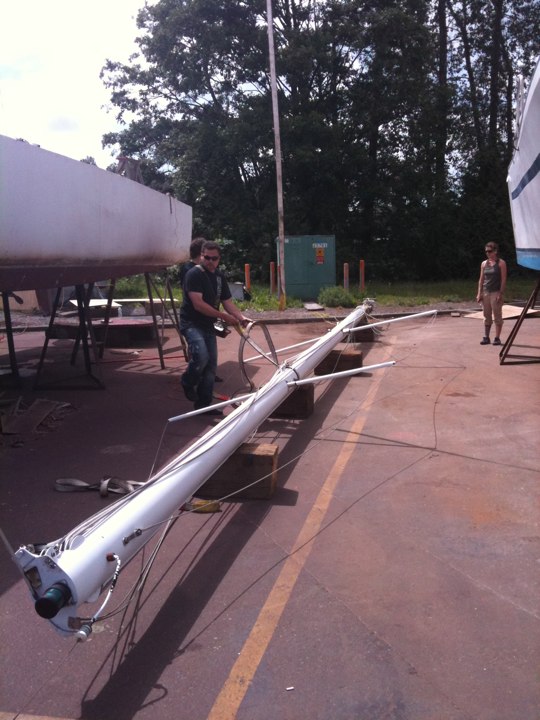
We also removed the mast and rigging, both so that I could inspect and upgrade the mast head equipment and so that we could get access to the centerboard trunk, the largest and most complicated rot problem of all…
the mast on the ground
lots of rot in the mast step!
Above you see the mast step, which essentially collapsed as soon as I applied a little pressure to it. I’m very fortunate that it never collapsed on me while I was at sail, though I’m pretty sure that I would have had problems if I’d left this project for another year.
the rain cover built and installed
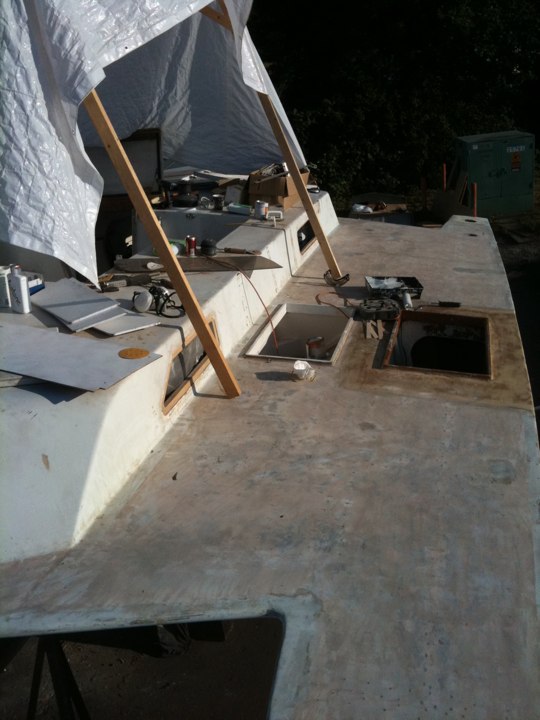
As the Canada Day weekend approached, bringing June to a close, the weather forecast showed a prediction of rain. With a quick run to Home Depot for lumber and a tarp, we built a rain cover over the worksite – which had the side effect of giving us some much-needed shade on what would prove to be the hottest days of the summer.
And so ended the month of June. I’ll try to add the subsequent posts, with the photos from July and August in a timely fashion, but my world seems to be accelerating currently, so no promises. 🙂