Soooo, once again I’ve been too busy to update the blog on anything approaching a regular basis, and now I’m left with a tonne of things to post about.
It’s currently 7am on a Saturday morning, and I’ve been driven out of bed by the noise of dozens of little fish hurling themselves out of the water and at the side of the boat. Currently we’re surrounded by hundreds of seagulls, pelicans and a few sea lions all feasting on what apparently is a huge school of these acrobatic little fish. WTF, nature. I’d prefer another couple of hours of sleep, but the coffee pot is on the stove and I have a list of projects to work on today, so I guess an early start isn’t such a bad thing.
(update: it’s now three weeks later and we’re just about to leave SD, and I’m *still* trying to get this post finished. switching over to the “gallery” format again to save time.)
(update #2: it’s now almost a month later again, and we’re in La Paz, Mexico with a billion more stories to tell so I’d better just get this one finished as quickly as I can…)
the new studio
I’ve actually made some progress on the studio front, something I’ve been trying to figure out since moving onto the boat. I picked up a pair of decent headphones and a little technological miracle, the Focusrite VRM Box. This box simulates the sound of sitting in a tuned recording studio (or bedroom studio, or even a living room) in front of a user-selectable range of different speakers. Sure, it’s not really the same as my previous techno studios, but it’s 90% of the way there – and for a boat that’s pretty incredible.
With a reasonable monitoring setup, and finally having a laptop capable of handling large audio files, I finally got around to putting in the hours and hours of editing needed to launch the Sequential Circus Podcast! This is big news; forty-five high-quality recordings of original live electronic music online so far, with more to come soon. It’s about time, too – we’ve only been talking about launching the podcast for… oh, almost five years now. The next show, Sequential Circus 10, is coming up on January 21st, so if you’re in Vancouver you should definitely come check it out.
Cousin Harald visits, though we don't get to see him.
San Francisco was lovely, and to be honest I could probably have happily stayed there indefinitely. The energy of the place, the politically-charged, creative, outgoing flow of it all spoke to me. It was fascinating how many places were familiar to me from television and movies. Getting to spend time with so many people for whom activism and productivity and creativity were more ways of life than dinner-table conversation topics was incredibly inspiring! It seemed like everyone I met had a grand project that they were working on, that they were passionate about, that they wanted to share – by contrast, in Vancouver it often seems like people downplay their interests, as though it weren’t cool to be working on something big, or maybe that it wouldn’t be polite to be excited about it. Strange!
mailboxes at the Sausalito anchorage
We wore out our permits at the two SF anchorages and moved the boat across the channel to Richardson Bay in Sausalito, where we anchored near the ferry terminal for a few days. Despite very little protection from the northeast, with some fortunate weather it was quite calm, and once we managed to pick up a free wireless network nearby and got a lot of work done as well. Sausalito is very pretty, with hundreds of boats on mooring balls and a very laid-back atmosphere – it was clearly a community of artists and ex-hippies. This photo shows a couple of dozen mailboxes near a dinghy dock, each one painted brightly with scenes of waterways and landscapes, each addressee a live-aboard sailor on a mooring ball in the bay nearby. What a difference from Vancouver, where live-aboards at anchor are often seen as vagrants or ‘floating homeless’! In Sausalito, live-aboards are clearly a respected – or at least tolerated or even acknowledged! – part of the community.
a giant baby sculpture in Sausalito
Just another example of the kind of place Sausalito is – this is a giant baby in the back of a pickup truck parked behind a marine electronics store.
Miya sewing the headsail
Miya remains pleased with our acquisition of a Sailrite Ultrafeed LSZ-1 sewing machine, a rugged bit of gear that can sew through something ridiculous like seven layers of leather at once. We had immediate use for it, having torn our headsail on the sail down from San Francisco.
showing off the repaired jib
The second sail repair, after the mainsail was patched up, was the 150 Genoa headsail, which I had torn the grommet clean out of while single-handing near Sidney, BC, back in 2009. I had reached 8.5kn on an absolutely gorgeous day when suddenly there was a BANG from the rigging, followed by some flapping… Miya added a new sailmakers thimble and some nylon strapping she got from a sail loft in Sausalito.
leaving Sausalito!
We took on a new crew member – Aylan Lee, whom we met in our Wilderness First Responder class in San Franciso, joined us for the sail from SF to San Diego. Aylan was working as a river rafting guide in Washington State, but given that this is the off season for rafting, he was seeking an adventure and thought perhaps sailing might fit the bill.
sailing out past the Golden Gate
We left SF as the sun was going down, and as we cruised out under the Golden Gate and into the open ocean, the moon rose behind us. We were lucky to have the full moon for most of the trip, though each night after moonset the world was incredibly dark, with only the light of the stars to see by.
Aylan's first morning at sea
Aylan acclimatized quickly, but the first night was cold and damp and windy and when we woke up he had a look on his face like he was wondering if he had made the right choice or not, coming out here in the big blue with some people from his first aid class!
lunch on the ocean
The difference having a third crew member was immediately noticeable, and we found ourselves better rested, with a lot more energy and a tonne more free time to hang out with one another, as well as being better fed and generally in better spirits.
Aylan on watch
By day three, Aylan was quickly becoming a competent sailor – I awoke to find that the wind had risen during the night, but he’d handled it just as we’d taught him, tying in reefs and taking down the yankee to avoid being overpowered. Good show!
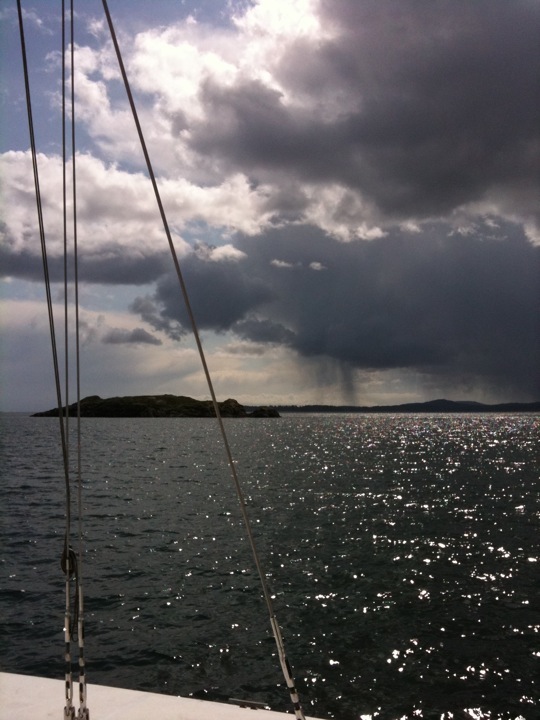
sun with rain on the horizon
After the first few drizzly days, the weather was lovely! With a hundred miles of sea room to spare, we were able to see rainstorms from quite a distance away and adjust our course accordingly. At least, we could during the day – at night we had a harder time despite the full moon.
Aylan on watch
The crew swiftly fell into a rhythm, with our watch schedule working out to being Miya on from 8pm – midnight and again at 8am – noon, my watches from midnight until 4am and again from noon until 4pm, and Aylan on watch 4am-8am and 4pm-8pm. With eight hours between our watches, we all got plenty of sleep, which made for a much happier crew – I have to say I didn’t envy Aylan’s having to wake up at 4am, but I did envy the fact that he got to see the sunrise and sunset every day.
leaving the Channel Islands
We had a bout of strong winds just as we approached the Channel Islands, so as we screamed past San Miguel island at 8+ knots, we cut the wheel to starboard and dropped the anchor for the night in a protected bay. We were woken early by hundreds of sea lions yowling on the nearby shoreline, and we were back on the road again by 10am.
Aylan taking a mid-afternoon nap
Afternoons became the time to hang out and socialize, which worked out well for me as I could expect to have some company on my noon-4pm shift. The last few days of the trip, once the novelty of sailing had worn off and the realization that off-watch there’s really not that much to do, naps became happily commonplace.
San Diego, summed up in one photo
We arrived in San Diego! What a strange city – the photo above shows a brigantine sailing vessel that regularly arrived in the harbour and challenged the Lady Washington with cannon fire. In the background you can see not just one but TWO aircraft carriers.
the whisky selection at the Aero Club
We celebrated our first night in SD by meeting up with some friends of Aylan’s and heading out for some drinks. If there’s one thing that a city of military and snowbirds does well, it’s drink – the bar in this photo must have had 400 different brands of whisky!
RIP little zodiac
The carefully-regulated San Diego anchorages made it a lot more difficult to row back and forth to the TIE Fighter, and so we spent a lot more time in the zodiac than usual. The travel and sun took their toll though, and the zodiac began to come apart at the seams. You can see the hand pump in its habitual place at the stern – voyages of more than five minutes began to require bailouts mid-trip.
wind generator installation
After much dancing and negotiation, our KISS Energy wind generator finally arrived at Downwind Marine! Another few hundred dollars for a a pole-mounting kit and we found ourselves finally generating electricity, even after dark.
power generation
With both wind and solar power contributing to the house bank charging, we found ourselves having to use the Honda EU-2000i gasoline generator less and less – though still probably two to three times per week, which was a big disappointment. I guess the January sunshine in San Diego just wasn’t enough for our electrical needs, and the anchorage was a little too sheltered to pull in any serious amperage from the wind turbine.
a pelican checking us out
A lovely part of San Diego for me was the proliferance of my third-favourite bird, the noble pelican. Nothing makes you believe the theory that dinosaurs evolved into birds quite like the long beaks, large wingspans and creepy-good flight ability of these birds.
the black-crowned night heron, not my photo
My second favourite bird was also new to me in San Diego, the Black-Crowned Night Heron.
Unfortunately, I couldn’t take a decent photo of the heron that chose the starboard bow of the TIE Fighter as its nightly perch, hunting fish in the teeming waters of the bay. The herons don’t have much of a neck, so they constantly look like they’re skulking around… the one that visited us every night looked at me suspiciously (accusingly?) every time I went outside to change cabins in the dark. We had many a short conversation, though I never figured out if he/she was actually interested in being friends.
My favourite bird is, of course, my baby sister’s daughter, my niece Wren.
watermaker installation nearing completion
One HUGE success for the TIE Fighter was the completion of the Spectra Ventura 150 water maker install! This took me a long time, and though I was able to finish it before we finally left San Diego, it required a swim to install the 5/8″ through-hull fitting. I thought I’d be able to handle the swim without my wetsuit, but after jumping in I quickly changed my mind.
With the water maker, now we can make our own drinking water from sea water. This is exactly the sort of thing we’ve been working towards all this time – with the electricity coming from solar and wind, and the water coming from the ocean (by way of the electricity we just made), we are yet another step closer to self-sufficiency.
Christmas on the s/v TIE Fighter
Christmas and New Years came and went without much fanfare – Miya and I spent a couple of nights in a hotel downtown to celebrate, enjoying hot showers and poolside drinks, albeit slightly chilly ones. Our Christmas tree was, for the second year in a row, a rosemary bush, and Miya made hearty rosemary bread to ward off the chilly nights.
We are safely anchored in Coos Bay, Oregon. After only four days at sea, we ran for cover to avoid some forecasted rough weather – 45kn winds forecast from the southwest, which would make for a very difficult upwind sail. A part of me feels a little like the typical cruisers described here in John Vigor’s blog post “Oregon’s Siren Lure”, but at the same time a big part of being a good captain is knowing the limitations of yourself and your crew. Four days was an excellent introduction to offshore sailing, and now that we’ve waited out the weather we should be leaving tomorrow at around 10am.
rough waters at the mouth of the Juan de Fuca Straight
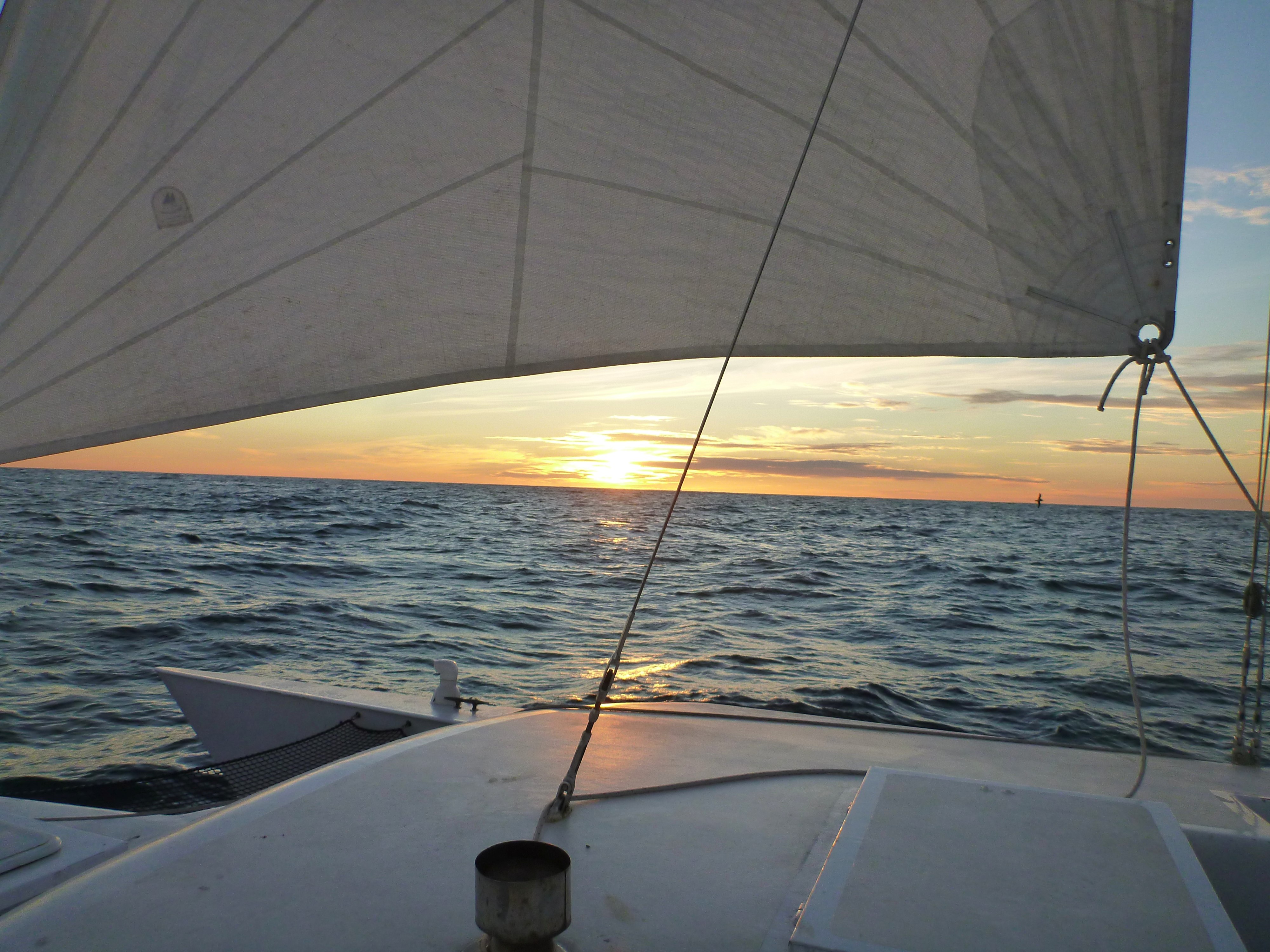
After a very late departure attempt which turned into a false start, we returned to our anchorage for a nights sleep, re-packed up and finally left Neah Bay at around 9am on September 28th. We motored TIE Fighter out to the buoys at the mouth of the Juan de Fuca and then, with no small amount of excitement, past the buoys and onward into the open ocean. The crosswinds at the mouth of the Straight were quite fierce, and the ocean currents, upon meeting the Straight currents, whipped up some short, steep waves that threw spray straight up into the air only to be yanked sideways by the wind. The view of the choppy waters framing the peninsula in the mid-day sun was wild and magical, one I will not soon forget – it was as though Canada came down to see us off.
rounding the Olympic Peninsula, onward into the Pacific Ocean
Fortunately, upon rounding the peninsula the waters became a lot more calm and predictable – we still had waves of five to seven meters in height to deal with, but on the ocean the height of the waves doesn’t matter nearly as much as the frequency. Two-meter waves at five seconds is an awful lot less comfortable than five-meter waves at twelve seconds! With the longer period the entire boat would slowly rise and fall, staying nearly level the whole time – quite a difference from the rough low-fetch coastal waters of the Georgia Straight, where the short, steep waves in stronger weather conditions would toss TIE Fighter around like a cork.
flying the two headsails wing-on-wing
Once we got around the bend, it was smooth sailing. We put up the sails in a wing-on-wing fashion, with one sail on each side of the boat – this is only possible when travelling directly downwind, and is actually a lot trickier on the ocean than I expected; usually TIE Fighter is very stable, but with larger waves we had to deal with a lot more of a twisting motion of the hull, which combined with the light 10kn northerly wind made it much more difficult to keep the sails full.
The first day was the best of the winds for trying out our spinnaker, but given that I’ve never actually flown a spinnaker before, and Miya is just now learning how to sail, I didn’t think it was the time to jump right in there. Soon enough I’m sure we’ll have time and appropriate weather, and then we’ll see just how interesting downwind sailing can be… apparently the combination of the light weight of a cruising trimaran like ours and a large, lightweight parachute sail adds a whole new dimension to sailing in trade wind conditions. Lin and Larry Pardey have been quoted as saying that 60%-80% of all ocean sailing is in winds of less than 15kn, so sooner or later we’ll have to master the art of spinnaker sailing.
the sun sets on our first night on the ocean
We lost sight of land around 6pm, knowing that it would be days before we’d see it again… of course we couldn’t have known at the time that we’d be seeing landfall in Oregon rather than California. Sundown brought trepidation; neither of us had any prior experience with open-ocean sailing, especially in pitch darkness, and the winds rose in intensity through the night. Thankfully we had the foresight to tie in a reef before the sun went down fully, and the cutter sailplan makes reducing sail a fairly straightforward task: if the wind starts to rise, just take down the yankee and sail under main and staysail alone. I rigged up a downhaul line on the yankee before we left Vancouver, so under duress nobody even has to leave the cockpit to pull down the forward-most sail.
The night was long and windy, and despite our carefully-laid watchkeeping plans, we both ended up staying awake far longer than we’d have liked.
reading on afternoon watch
Our watch schedule was as follows:
10:00 – 13:00 : Drew
13:00 – 16:00 : Miya
16:00 – 19:00 : Drew
19:00 – 22:00 : Miya
22:00 – 04:00 : Drew
04:00 – 10:00 : Miya
…so basically one six-hour shift at night and two three-hour shifts during the day, each. We figured this would give us at least one decent sleep at night, and time to nap during the day as well as some time to actually spend together. In the future we will probably consider taking on another crew member for longer passages, so that watches could be pared down to four hours on, eight hours off.
Miya with the albacore tuna she landed!
Regardless, I sent Miya to bed for a few hours of sleep. She awoke at around 10am and took over the helm, sending me off to bed… but I hadn’t even been asleep an hour when she ran in to wake me up. I awoke immediately, sure that something had gone horribly wrong, but she said
“I caught a fish, and it’s too big to land by myself, I need your help!”
Well, who can argue with that? I grabbed the net and she pulled her fishing line – a thirty-meter section of 8mm white nylon rope tied to a cleat, with a three-meter steel leader and a large white spoon lure – up to the boat. The fish proved to be an albacore tuna that we measured at just under a meter in length, and though we didn’t have the ability to weigh it we estimated it to be around 10kg – Miya had a hard time holding it up for photos!
Now, it’s worth noting that Miya is a ‘moral vegetarian’; she chooses not to eat meat on the grounds that factory farming practices are unsustainable and cruel, and that if everyone on the planet ate meat like North Americans do we’d be in a famine in no time. That being said, she will eat meat that she’s killed herself, and this tuna was no exception – she did the catching and slaughtering all herself, all I did was help to get the fish up onto the boat.
Things we learned about tuna from this experience:
Tuna travel in large schools, and when feeding they surface in great numbers, the water essentially boils with them!
Tuna have a lot of blood, and blood that isn’t immediately dealt with gets quickly much more difficult to clean up.
Cleaning a tuna isn’t that much different from cleaning a river trout, just on a (much) larger scale.
Our knives need sharpening again. The filet knife especially needs to be kept razor sharp, and possibly replaced with a knife of better quality.
Tuna have a lot of meat, and though we can eat a lot of tuna at once we need to figure out better ways to preserve the meat; our initial attempts at tuna jerky were not as successful as we’d have liked.
welcome sunrise after a rough night
We began to fall into a rhythm of watches, as the weather slowly shifted from sunny with light northerly winds to cloudy with gusts and finally to rainy with shifting westerlies. The rain made for less comfortable watches, and we spent most of the third day holed up in the aft cabin watching movies and keeping dry, poking our heads up every few minutes to look for other boats – though apparently 70nm from shore is not the preferred route for container ships nor fishing boats, so we didn’t see another soul for at least twelve hours.
The weather slowly grew worse, and though I’ve considered myself somewhat resistant to seasickness, between the lack of sleep and the diet of mostly-tuna for the past day, we both began to feel the effects of staying inside and watching movies. There’s nothing worse for motion sickness than to remove yourself from any visual indication of movement!
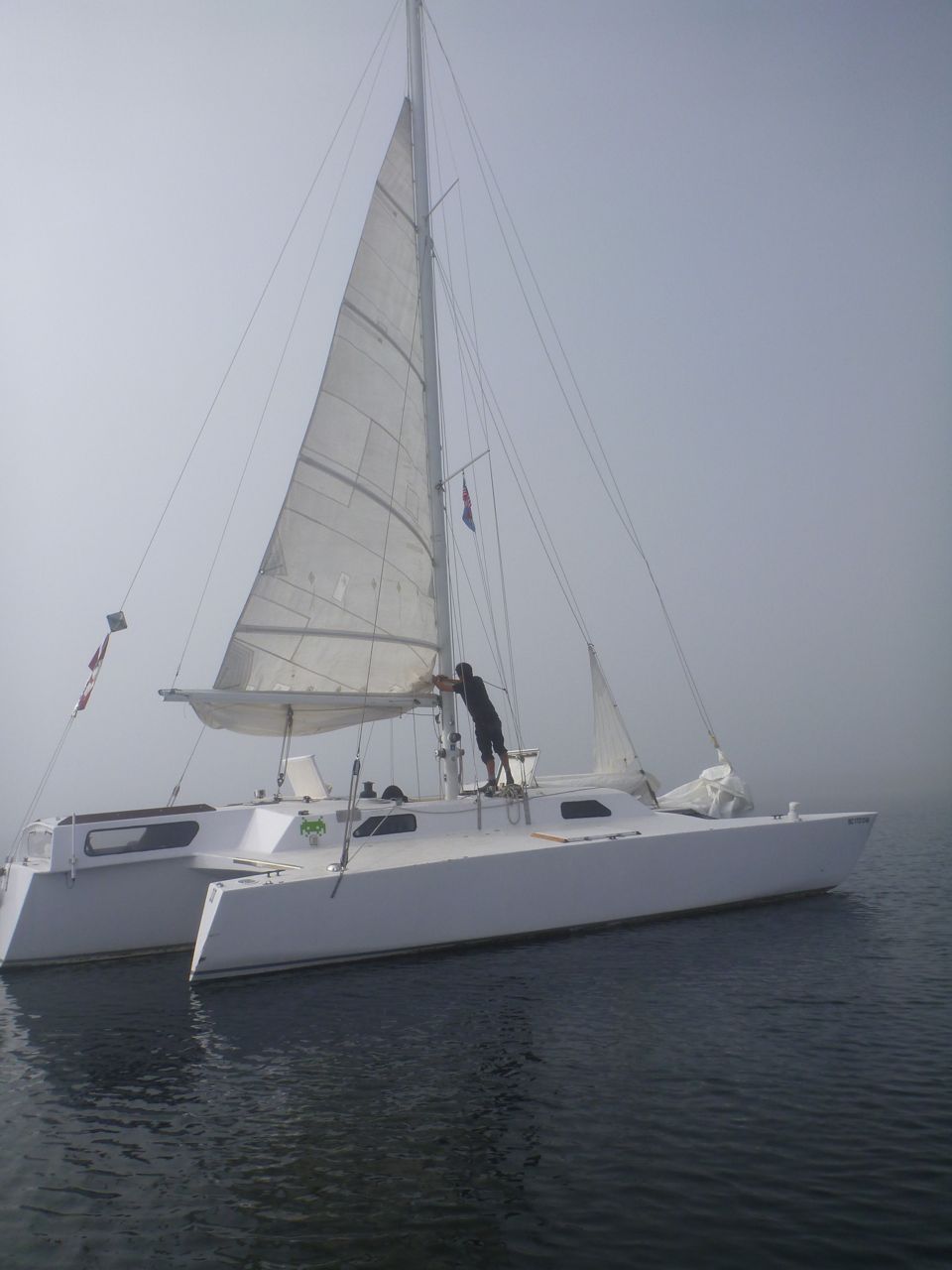
tying in a second reef while the mainsail is down
We continued to reduce sail as the wind rose in intensity – at one point we were seeing what we assume were 30kn winds sustained, with gusts much higher, but without a proper wind speed indicator we don’t have a way of truly knowing. Our only real indicator is that we know that somewhere around 25kn, the wind will blow the forward cabin hatch closed, and so if we’re going in and out of the forward cabin in high winds we have to be careful not to catch a cabin hatch to the head!
For a good few hours we were down to just the staysail – which is an extremely heavy sail made from reinforced dacron, smaller and stronger than the storm jib on most sloops. I have to admit I was impressed with TIE Fighter’s handling of the stronger winds. I’m sure we could have run through the harder winds with a double-reefed main, but because of her full battens and aging sail track it is difficult to tie in the second reef without putting the boat head-to-wind, and as we were making 4kn under staysail alone we were happy to have the extra insurance against sudden gusts. For a while we had a problem with Steve, the autopilot, wherein his belt was slipping on the steering wheel and causing us to not turn as much as he’d like – but it turned out to just be a tension issue, quickly remedied.
a rough night of weather results in a torn mainsail
The winds died down to a steady 15-20kn, and we ran a double-reefed mainsail through the night without much incident – but even with the reefs in, by Saturday morning we noticed that a large tear had appeared at the head of our mainsail. We still haven’t gotten around to sewing it up, hopefully tomorrow I’ll get a chance to tackle it while we motor out past the Coos Bay Bar. TIE Fighter came with a ‘ditty bag’ of sail repair materials, needles and tape and the like, and I am pretty confident that the repair can be made in fairly short order.
Still, by Saturday afternoon we found ourselves within 30nm of the Oregon coast, and the weather reports coming over the VHF radio were somewhat grim: 25kn-35kn sustained winds with gusts of 45kn-50kn, all coming from the southwest. If we had a few hundred miles of leeway to the east and a well-rested crew with strong stomachs we could have easily sailed through… but to sail from our position would require turning around and running back up to the northwest for a day or more, then turning down southerly again – it wouldn’t so much be sailing through the weather as just sailing the weather. A hard look at the charts showed the port of Coos Bay barely 30nm directly to the east, and so after much deliberation, we decided to head in to land to wait out the weather.
collapsed on the aft cabin roof, exhausted
We made it into the bay at about 2am on Saturday night, anchored in the dark and fell into a deep, deep sleep. In the morning we checked in with US Customs to let them know that we’d made landfall, then took the zodiac over to a nearby marina for showers, fish&chips and beer. Since then we’ve been carefully watching the weather, resting up and getting work done both on boat and dayjob projects. The nights have been cold, and we’ve had to run our diesel furnaces several times just to keep the boat comfortable – we’re definitely looking forward to warmer climates!
I have to say, I found offshore sailing to be exhilarating, to the point where I can begin to understand a little of what must go through the mind of someone like Bernard Moitessier. I think it would have been very different if we’d had someone with any prior ocean experience onboard, but I’m happy to have jumped in with both feet and learned it as we went. We’re very lucky to not have had any major problems, be they boat- or crew-related, knock on wood. I certainly feel more comfortable now with the boat as a functional, ocean-going sailing vessel, rather than just a floating apartment, and Miya is showing leaps and bounds in her progress as a competent sailor.
Our weather window has once again opened; tomorrow we leave offshore for the second time, with our next landfall planned for San Francisco in four or five days.
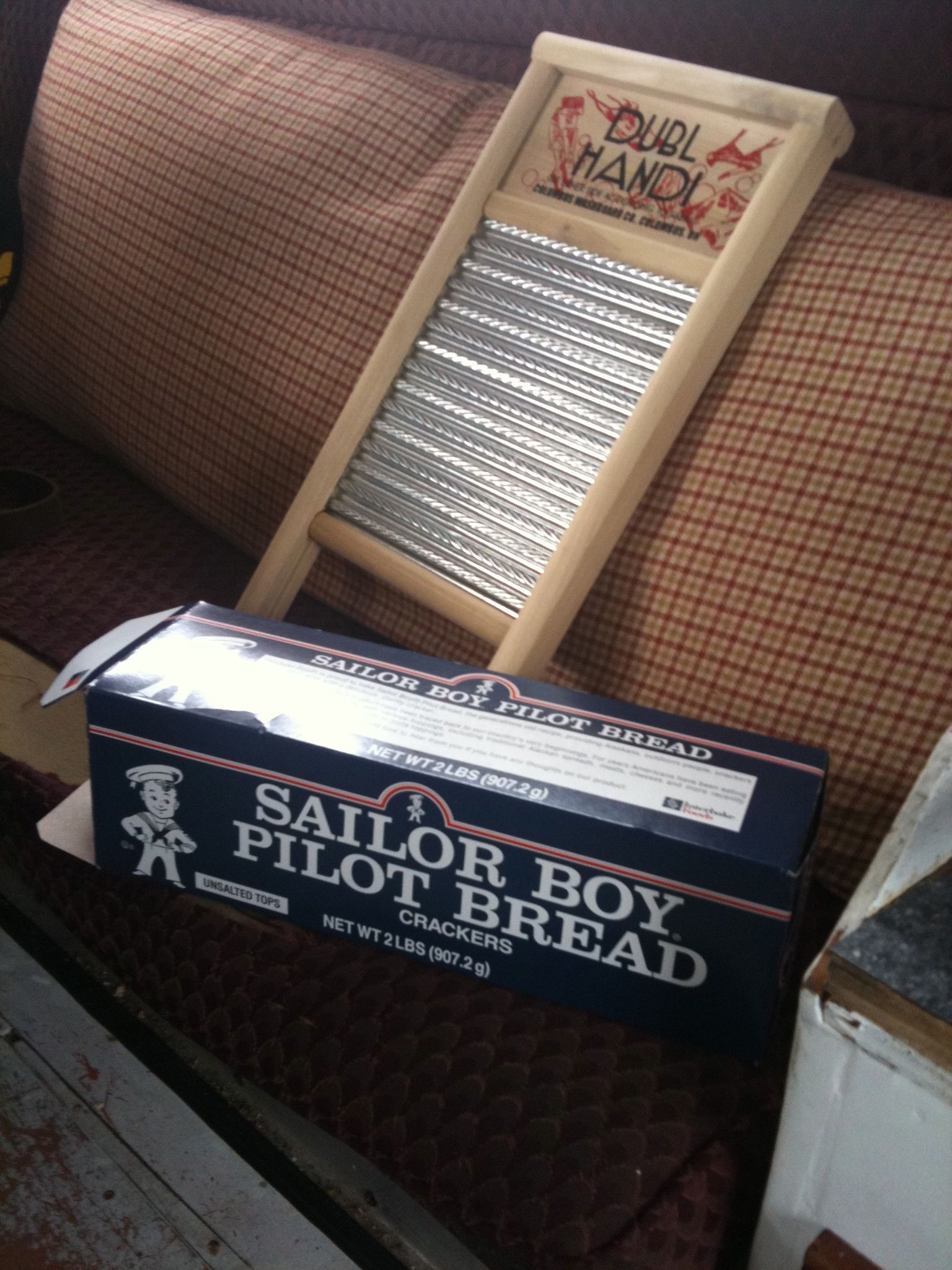
scraps of life in Neah Bay; a washboard and genuine hardtack!
Lovely and quiet as life in this tiny, remote coastal fishing village has been, after eleven days it’s somewhat of a relief to finally pack up the boat and prepare to leave Neah Bay for the open ocean. The NOAA weather forecasts for the next few days show a favourable window, with the gale-force southerly winds that we’ve been experiencing for the past week subsiding and slowly giving way to gentle northwesterlies, which combined with the dominant currents should give us a safe and quick offshore passage south to San Francisco. We have enjoyed it here, but we’re looking forward to being back in an anchorage with easy access to more modern amenities than a rustic general store – and somehow nobody managed to mention the fact that Neah Bay is a “dry community” in any of the cruising guides! I can’t wait to have a frosty pint at a yacht club bar in SF.
The sprocket for the steering system came in with unbelievable swiftness – funny how parts shipped from the US to Canada always seem to take a few extra days, while shipping this hunk of metal from Canada to the US took less than twenty hours from the confirmation email! With the help of our new local diver/fisherman/handyman friend Daren Akin, we had the sprocket cut to fit and installed in a matter of hours, and since then the steering has been working far smoother than before.
howling southerly winds, all day every day
The weather has been the most stressful part about living in Neah Bay; the return of predominantly northwest winds comes as a huge relief as we wondered whether or not we’d missed our window to head offshore this year at all. For the past few days the winds have been howling day and night – during the day we seem to get gusty winds in bursts of about a half-hour of 25kn winds every two hours, but after dark the winds have been rising to much higher. Strangely, it seems like the only time we’ve seen really strong winds – 35kn-40kn – has been at 4am… for three days in a row now.
I’ve been trying a new technique; anchoring from the stern instead of the bows. The benefit is that the TIE Fighter tends to swing less at anchor, less “sailing” far to the left and right with the wind – but I can’t really take credit for that. The real reason is that I installed the fancy Wi-Fi antenna to the side of the aft cabin, and apparently once the cabin sides are wet from rain there’s no passing a Wi-Fi signal through them. We have to have the boat faced to present the Wi-Fi antenna at the marina a kilometer or so away if we want a signal!
The downside of this stern-anchoring trick is that I have never had to handle a dragging anchor from the stern before – the engine starts just fine, but with an anchor line off the back I would have to be very careful not to back over the line; in an anchor-dragging situation, wrapping a line around the propellor shaft could be disastrous! Combined with the howling winds and rains and utter darkness of the night, I’ve had a rough time sleeping, even with the anchor-drag alarm set on the Garmin GPSMap76cx on the pillow beside my head. I’ve left a second anchor rigged on deck, ready to throw over the side at the first sign of dragging – but to my surprise and relief, the Fortress FX-37 anchor has held through the worst of it, without giving a meter!
Miya trying to bring in a ling cod
We’ve taken advantage of the few days of the fall sun non-rain of the Pacific Northwest to relax, nail down some final boat-readyness projects (at least one project is now literally nailed down) and to explore the areaaround Neah Bay. Yesterday we hiked the little island that marks the entrance to the anchorage and explored a huge, partially submerged barge at the western end of the bay.
Mostly though, we’ve been working through stresses, finding our centers and getting our heads ready for the upcoming step; arguably the biggest step we’ve made so far.
Tomorrow we leave offshore. Within the next ten days, we’ll arrive in San Francisco.
Well, we’re away. We left on Monday September 12th 2011 as planned, leaving Vancouver about ten hours later than expected but making good time across the Georgia Straight, spent the night at the mouth of Porlier Pass and motor-sailed the next day down to Cadboro Bay just east of Victoria. We crossed the Juan de Fuca on Wednesday, cleared customs and spent two days in Port Angeles, then motored on up the Juan de Fuca arriving in Neah Bay on Friday night. The weekend was spent carefully watching for a “weather window”, in which we could set out with six to ten days of reasonably good weather to look forward to… but then I made an expensive mistake.
We’ve entered another one of these infuriating “hurry up and wait” scenarios, as a result of my carelessness while working on the steering system. I was removing a sprocket when it got away from me and clattered down the centerboard trunk and into the ocean. Given that we’re anchored in soft mud in about 10m of water the chances of finding a heavy 10cm chunk of dark bronze were pretty slim, but we had a diver go down twice to look anyway. The replacement part is on rush delivery from Ontario and will hopefully arrive in the next few days.
The big question now is whether or not we’ve missed our weather window to head out into the open ocean, or whether the big storm winds of October and November are upon us. Traditionally, the end of October is the absolute cutoff time for heading out on an offshore passage south from the Pacific Northwest, but what with the changing weather patterns of the past couple of years it’s anyone’s guess.
Too much has happened lately to give a full rundown, so I will return once more to a pictorial style of blogging; here are a few snapshots of life over the past few weeks..:
Chad Taylor and Dan Ross jamming on the bows
During the last weeks leading up to the final departure, we spent as much time as possible hanging out with friends, enjoying what little summer Vancouver had to offer up this year. With so many projects to complete, perfect moments like this were rare but treasured.
installing spreader lights, repairing the steaming light
Most of the boat projects were one-man jobs, but Miya had to winch me up the mast several times for minor repairs. The next time we haul out I will likely run a few more wires up to the masthead; it’d be a much better place to mount the Ubiquity Bullet router and high-gain wireless antenna than the current location on the aft cabin roof, for instance, and someday I’d like to mount a webcam up there as well.
Jared and Thu departing on S/V Resolution
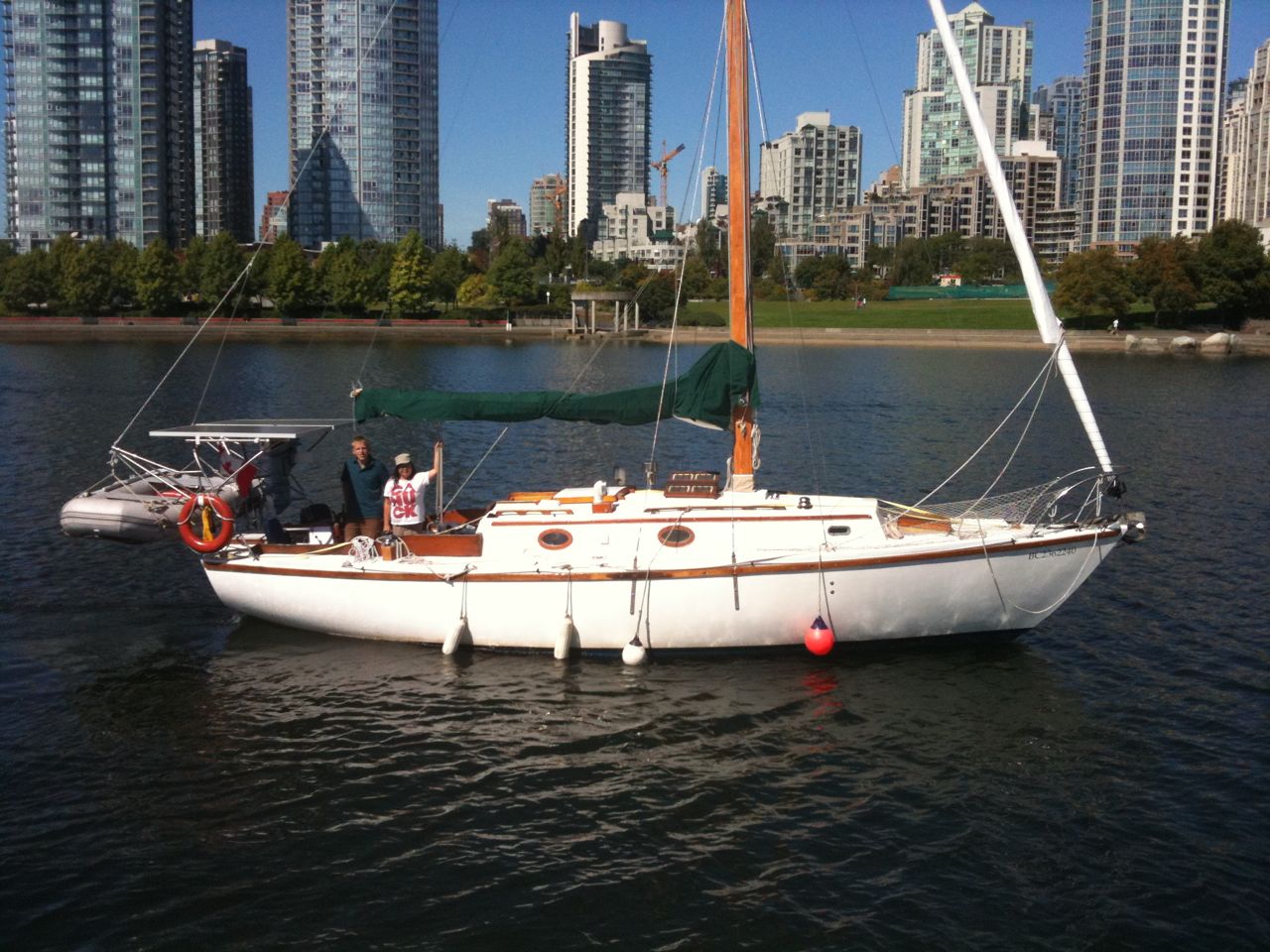
Our friend Jared has been working on his boat ‘Resolution‘ for the past year or so, and left about ten days before we did for San Francisco. He’s taken a few different routes than we have; going with a smaller monohull for instance, installing davits and monster solar panels and choosing a SatPhone instead of radio communications. It’s been very interesting to watch another geek take on the challenges of living aboard on his own terms.
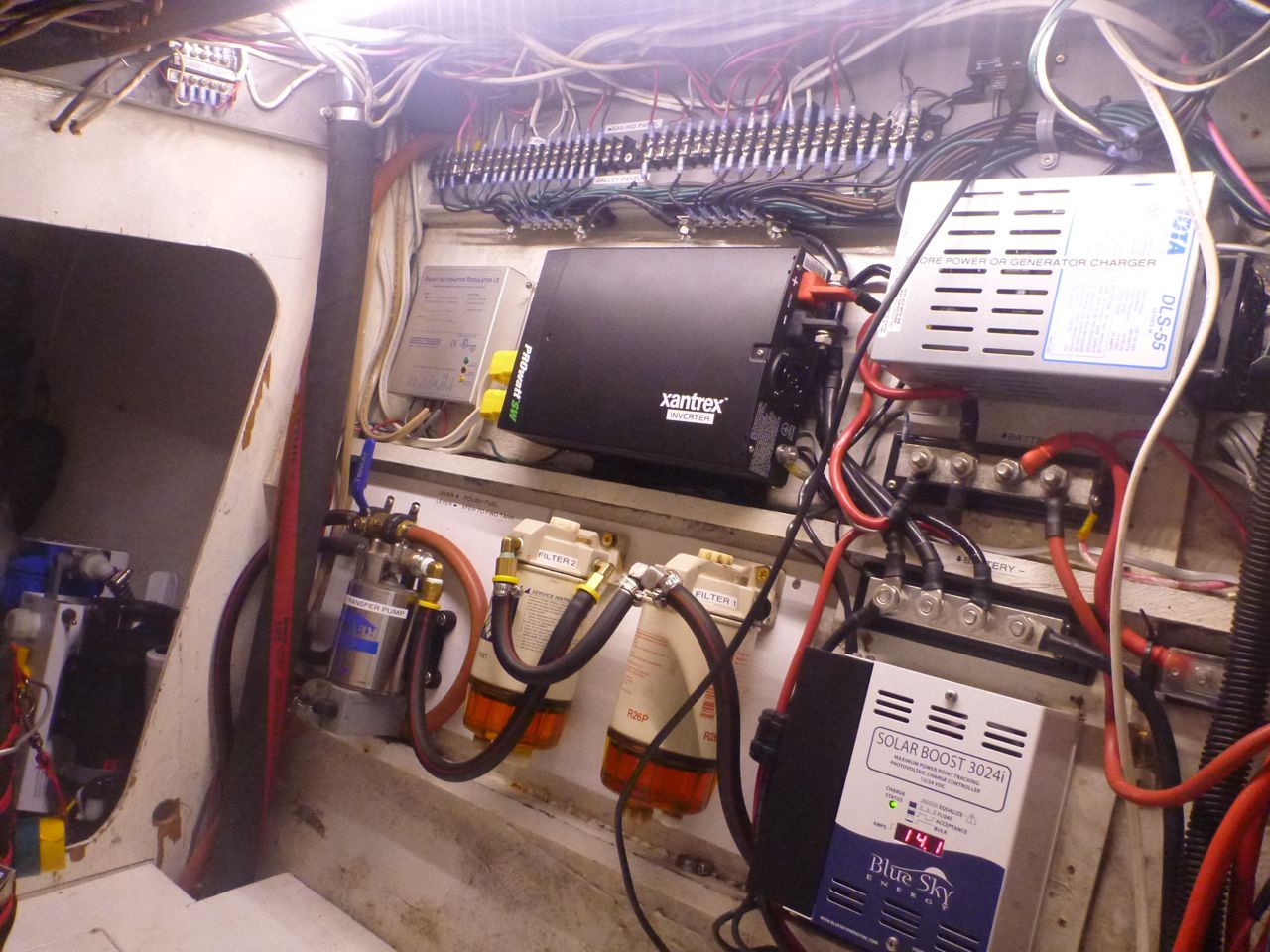
electrical room overhaul completed!
I’ve finally gotten the electrical room into a state that I can consider “finished”. New features since the last photos – a smart alternator regulator on the far left, and a homebrew fuel polishing system on the bottom left, comprised of a pair of Racor diesel fuel filters and a Reverso fuel pump. The polishing system should help keep our engine Maude healthy even in the third world, where fuel quality can be questionable at best. Incidentally, since the last cooling system overhaul she’s been running like a top!
On the extreme left you can see a little piece of the yet-to-be-installed Spectra Ventura 150 watermaker; the next compartment over houses our water system, and that project will be a fun challenge I’m sure… it will require a haulout to finish as the watermaker will need two new through-hull fittings, one for seawater intake and one for brine discharge.
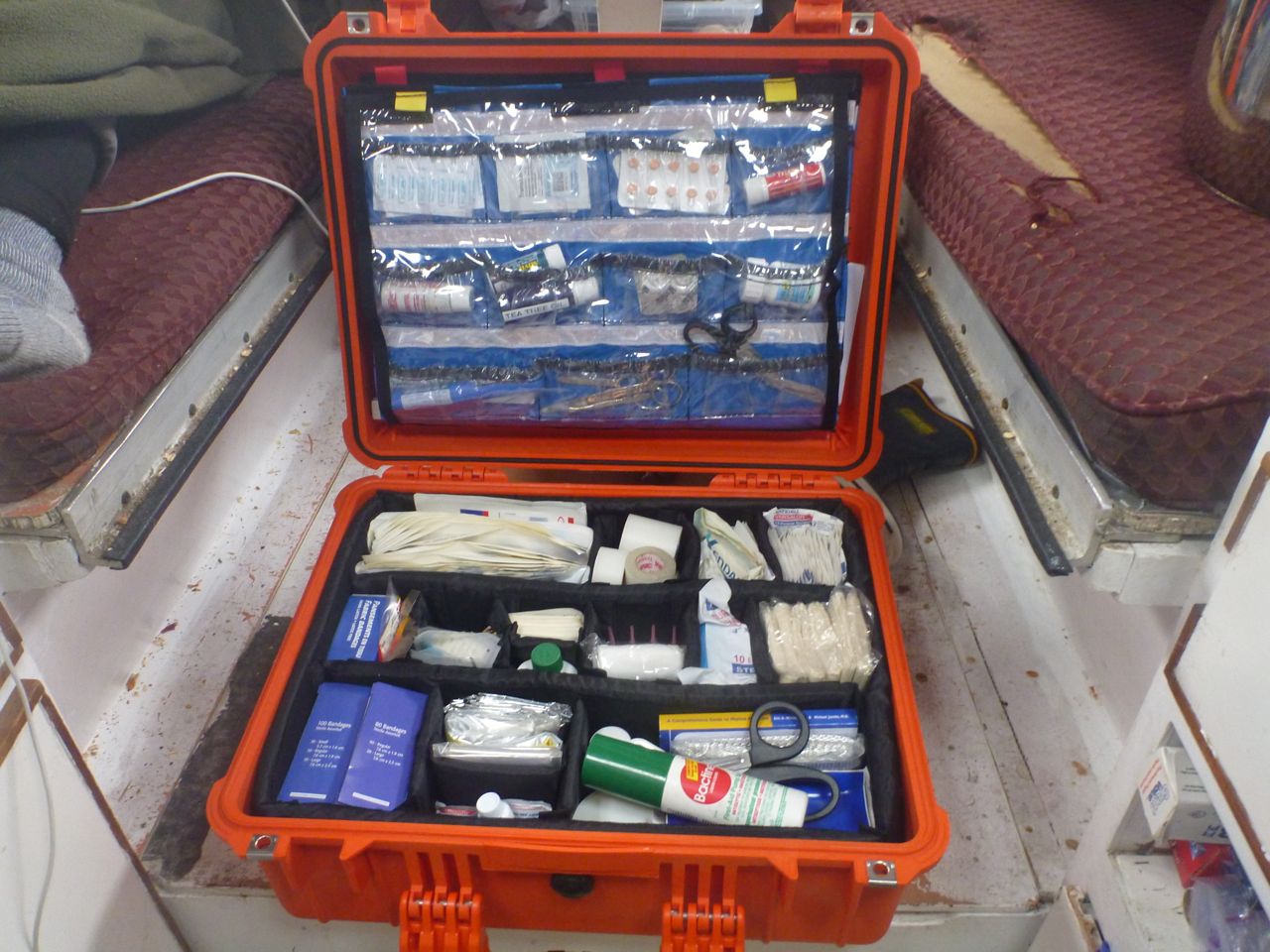
first aid kit, populated
If you’re planning to head offshore, you’d best be prepared for whatever may come to pass – and the first-aid kit on TIE Fighter was not exactly anything to write home about. Taking careful notes at both a Red Cross First Aid course and a pair of Bluewater Cruising Offshore First-Aid seminar, I assembled our new kit into a bomb-proof Pelican 1550EMS case which should survive anything that we throw at it. The kit contains everything from happy-face bandaids to hardcore prescription antibiotics and injectable painkillers.
An awesome first-aid kit is only half the battle though; Miya and I have enrolled in a Wilderness First Responder first aid course in San Francisco in October, which is an intensive 80-hour course covering emergency first aid in remote scenarios where professional help might not be coming right away.
the middle of the Georgia Straight at sunset
Once we finally got away, the stress of getting ready to leave didn’t fall away as easily as planned. We were off, for sure, but tensions ran a little high while we adjusted to the new state of being. The first night we pulled into an anchorage in the dark, and currents and tides and deadheads made the situation questionable, but once the full moon rose everything came into focus. Waking up the next morning everything was much clearer.
freezing on watch
Neither of us were prepared for the realities of sailing in September; I think we were both spoiled by the 29º temperatures in Vancouver the days leading up to the grand departure. All of our winter clothes were packed away in tupperware containers in the amas, but those were quickly pulled out as it became apparent that gloves, hats and scarves would be necessary. We are very glad to have high-quality foul weather gear, and look forward to soon sailing in warm waters.
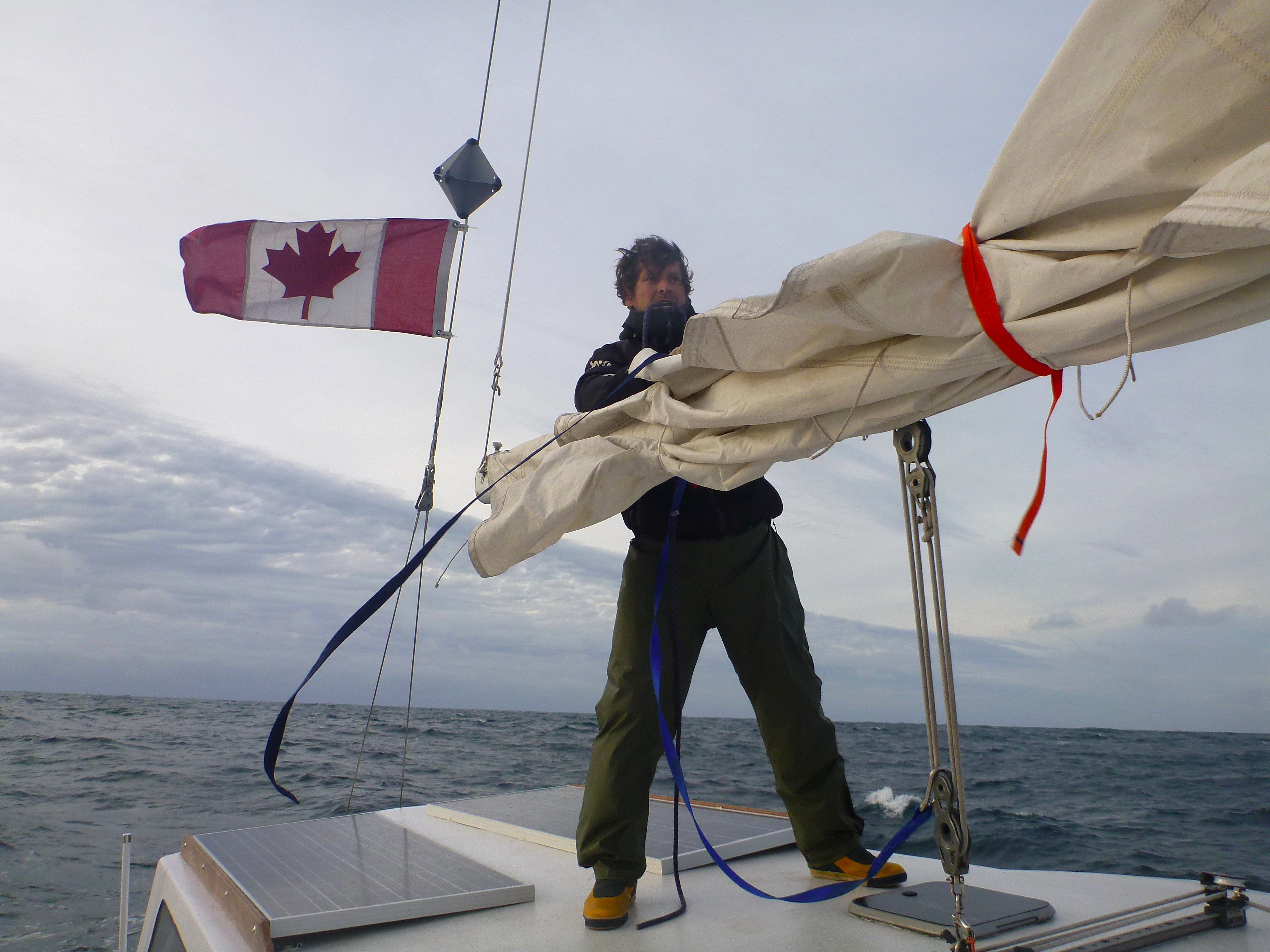
raising the courtesy flag
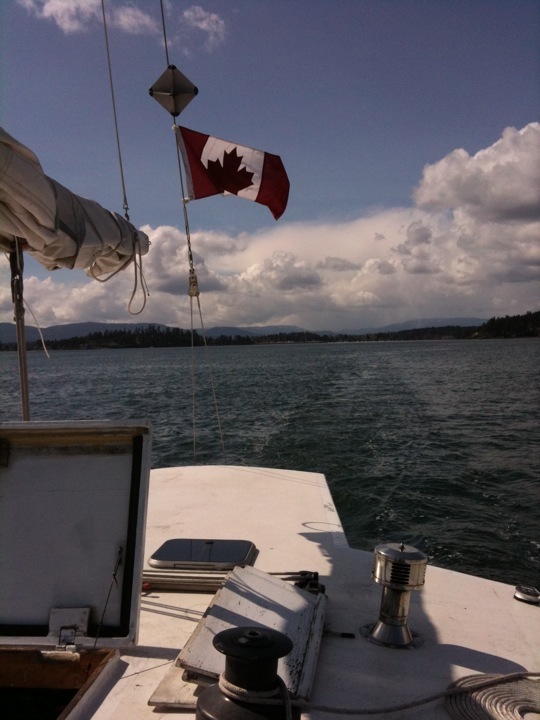
Before clearing customs into a new country, a vessel should fly a yellow flag – the symbol for the letter ‘Q’, or ‘quarantine’ – to indicate to the port that the vessel has not yet cleared customs but intends to. After clearing customs, the yellow flag is replaced by a flag of the country being visited, known as a ‘courtesy flag’. Raising the courtesy flag of the US is something I had been looking forward to for a very long time, as it marks a huge milestone in this adventure!
morning in Neah Bay
Neah Bay, at the tip of the Olympic Peninsula, is the last safe harbour before heading out into the open Pacific Ocean. It is a small Makah indian reservation with a population of about 700 people, but we are still able to steal internet access from several open wireless networks using our high-powered antenna and router. The bay is wild and beautiful, with loons calling in the night and thick fog rolling in regularly.
surface analysis for the eastern pacific ocean
This is a ‘weatherfax’ transmission, retrieved from the internet. This is basically our window into what’s going on weather-wise on the open ocean, and once we have a working HF ham radio rig on the boat we should be able to pull down these images for free from wherever we happen to be on the ocean. Learning to interpret these images is a steep learning curve, but once you get past a few key hurdles the information becomes somewhat fascinating.
One of the things I’ve enjoyed most about moving onto the ocean is the amount of knowledge about the world around me that I’ve been forced to learn – it boggles the mind that the tides move in and out with such regularity, yet mere meters away from the ocean Vancouver has a half a million people who have no idea what phase the tide is at any given time. Similarly, I feel like I’ve been living with the weather for my entire life, looking up at the sky without having the foggiest (heh) idea what I’ve been looking at. The more I learn about how weather systems function, the more I want to know!
working on the reefing systems
While we wait for the weather to change to a more favourable window there are dozens of small projects that didn’t get finished before we left Vancouver. In this photo I’m working on the reefing system; a series of ropes and pulleys and hooks that helps to get the main sail “reefed”, or shortened by a third – or two thirds – in case of heavy winds. Now complete, the improved reefing system will help us to sail even when the winds blow at gale force or higher.
out in the zodiac with a local diver, gps in hand
When I dropped the sprocket from the steering system into the ocean, I essentially paralyzed us; we can’t steer at all. We’re not only stuck in Neah Bay, we’re stuck right where we’ve anchored until we can replace the part or work around it somehow. Miya walked the local docks looking for a diver, and to our luck the first person she talked to offered to dive for us. Daren Akin, a local diver, went down twice to try to find the part – sadly he was unable to locate it, though the attempt was greatly appreciated!
I cannot believe I did this. I really need to rewire my brain to assign more importance to small bits of hardware when working over a big hole that leads to oblivion. You’d think I would have learned that lesson from my bicycle.
Miya playing Nintendo on a rainy afternoon
So now we’re stuck, with most of the projects out of the way and a boat fully stocked and ready to travel. The delay has been a blessing in some ways, letting us finish up work that we hadn’t had time for and giving us a chance to catch our breaths and adapt to the new realities of life on the road, to sleep in and prepare for the monster ten-day marathon sail down to San Francisco.
Soon the company in Ontario from whom I’ve purchased the replacement part for the steering column will send me the tracking number for the UPS shipment, so that I might have a better idea of when we’ll be out of here – but until then, we remain at anchor.
I’ve been neglecting the blog, which is something I need to remedy. In my defence, I’ve been very very busy. So, in lieu of posting the ten or fifteen posts that I should have been posting all along, I’ll have to just get the queue out in a very condensed fashion.
Returning to the format of the ‘What I Did On My Summer Vacation‘ series of posts, here’s a rapid-fire “clips show” of the last two months.
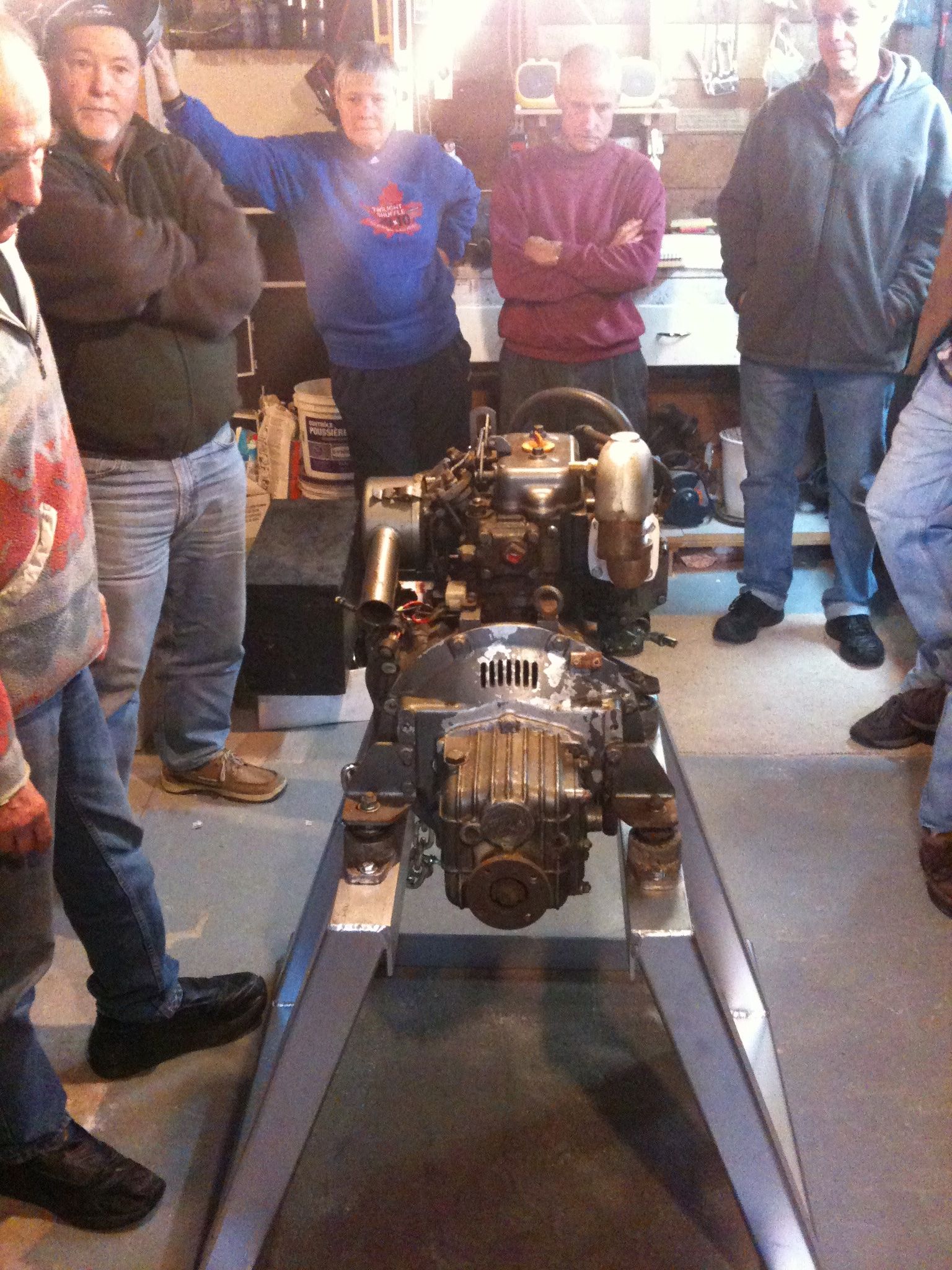
staring down the barrel of a yanmar diesel
I started and finished a two-week class in ‘Advanced Diesel Engine Maintenance’, in which we tore the above Yanmar 2QM marine diesel engine completely apart and put it all back together. I’ll probably never take the camshaft out of my Yanmar 3HM, but at least now I’m pretty sure I could if I absolutely had to.
notice to move from the Kitsilano anchorage - click for higher-res
This one warrants a blog post of its own – but then again a lot of these pics do. This is a formal ‘Notice To Move’ from the Vancouver Port Authority, as delivered by the VPD while I was sitting safely and soundly at anchor just off Kitsilano Beach. The officer explained that everyone was getting these notices as an advance move, so that if the Port Authority decided at any point to tow boats out of the harbour and impound them, they could do so without warning. He also explained that the notices were the result of meetings between the City of Vancouver Parks Board and the Port Authority, over just who’s responsibility it was to pay for the cleanup of Kitsilano Beach after anchored sailboats were blown ashore and wrecked in windstorms.
What really bugs me is that since then, talking with other liveaboards here in False Creek, it would seem that this notice was only delivered to abandoned or unattended/derelict vessels left out at the anchorage, and that I was the only liveaboard sailor to receive a notice. Strange, especially since I feel like I’ve proven myself to be a responsible and conscientious mariner, and I have never been blown ashore.
The notice says that I am anchored without having seeked permission to anchor, but as of now the Harbour Master has still not replied to my email requesting permission to anchor. I really do hope that this notice is the first and last interaction I’ll have with the Port Authority, but I can’t help feel a bit of foreboding.
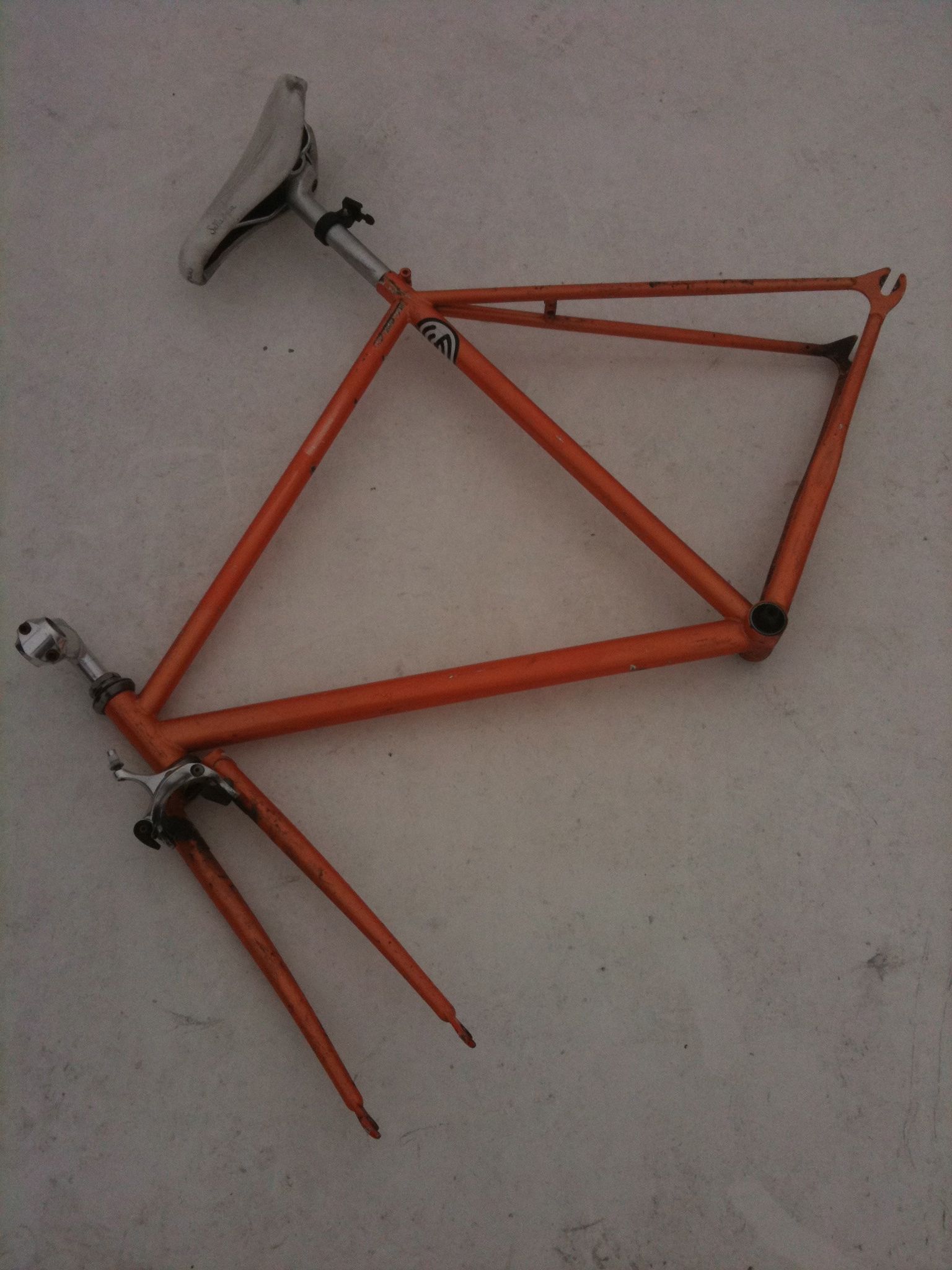
goodbye, creamcycle. you were a good bike.
In my ongoing quest to simplify and minimize my life, I finally realized that my beloved bicycle just doesn’t fit “indoors”, and storing the Creamcycle outdoors all winter was slowly killing her. There’s room for a bike in the starboard ama if I arrange things very carefully but that’s a lot of valuable storage space taken up, especially with the prospect of Miya also having a bike aboard. After much research, I decided that the path forward would be to purchase a Montague Boston folding bike, and migrate all of my pro-grade components from the Creamcycle over onto the Boston frame, and vice versa, and then sell the result on Craigslist. More on this soon.
snow drifted up against the generator
February 26th 2011 brought the first and last big snowstorm of the season. This pic is a little difficult to make out, but if you look closely you can see the snow drifted up nearly over the cabin window, with a melted/windshaped cutout around the Honda EU2000i generator, wrapped here (as always) in a white tarp to keep the weather out.
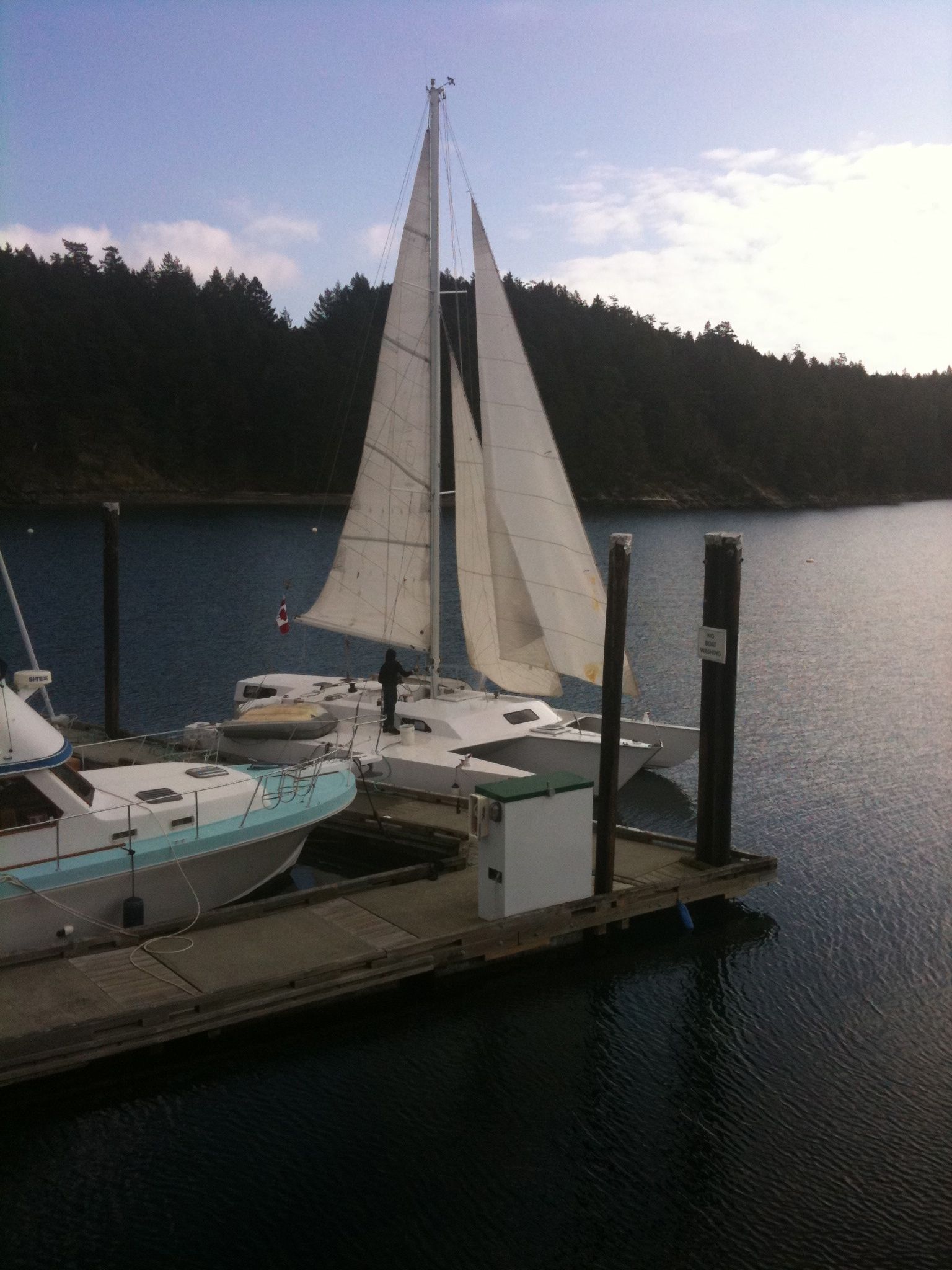
March 4th was my 35th birthday, and we celebrated by sailing the TIE Fighter across the Georgia Straight and over to Pender Island for a weekend-long multi-birthday party with twenty or so friends in a mansion on the highest point on the island. Seriously swank – a hot tub on the roof, and 360º view of the Gulf Islands!
Miya took this video at a particularly stressful moment during the journey across the Straight – we’d had lovely 10-15kn winds coming out of English Bay, but as we rounded UBC the winds jumped to 20-25kn and we struggled to reef the mainsail, which wasn’t rigged properly for reefing. Shortly after we succeeded, we suddenly lost steering…
The rest of the trip got steadily worse, and by the time we arrived at the west side of the Straight the wind was blowing a steady 30kn with pouring rain and 3m waves occasionally breaking over the decks. We arrived shortly after dark on Friday night, exhausted and happy to be somewhere warm and dry – I don’t think my boots dried until Sunday.
DR spraying the sails down with fresh water
We moored the boat at Otter Bay for the weekend while we relaxed at the mansion. This pic shows Dan Ross spraying down the sails with fresh water, after being soaked with seawater. You really shouldn’t allow sails to sit with salt on them – the salt attracts moisture from the air so the sails will never really dry out completely, which is really bad for the lifespan of the sails, not to mention the probable cause of the large rust stains visible on the headsail.
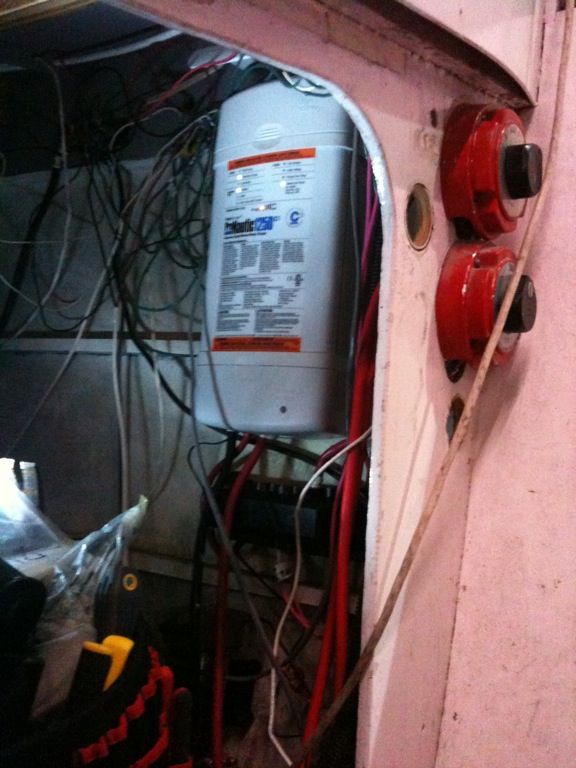
new battery charger installed!
I picked up a brand new modern battery charger for a little under half price on Craigslist and installed it, finally taking control over the charging of my batteries! Prior to this I had been charging the batteries directly from a 20a DC-DC converter, which is effective but inefficient, and very very hard on batteries. With the new ProNautic C3 50a charger, my time to fully charge the batteries dropped from seven hours to just under three hours. Take note of the mess of wires in the background – this was taken after I had already pulled two full laundry baskets of unused wiring out of the boat. Apparently at least one of the former owners of the TIE Fighter had rewired the boat, but hadn’t bother removing any of the old wiring!
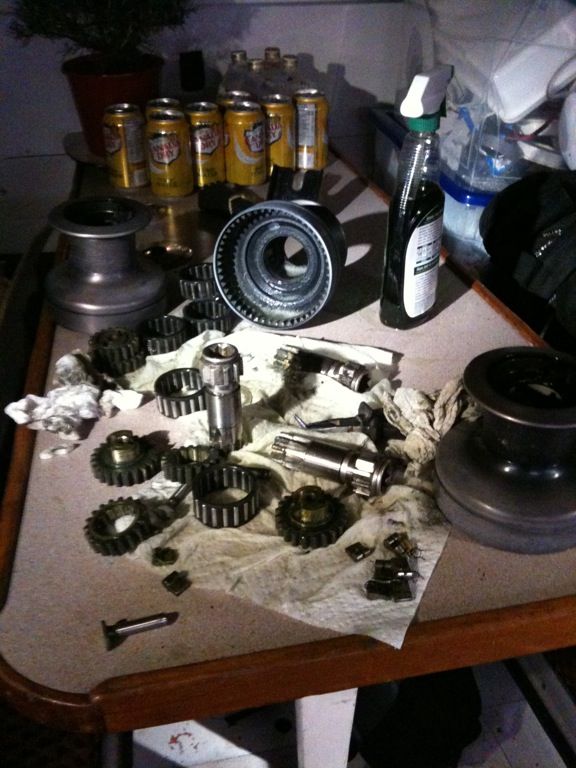
winch maintenance begins
One thing I noticed during the Pender “sea trials” trip was that the winches on the mast had begun slipping. I’ve owned the boat for over three years now and have never serviced the winches, so maintenance was definitely overdue. I had dropped Miya and DR off at Swartz Bay, and TIE Fighter was now anchored in Sidney, BC, so I had my evenings free to work hard on boat projects. Servicing winches is messy work but quite introspective and satisfying, much like I imagine cleaning a rifle must be. This pic shows three of the mast winches disassembled and my first experiments with using ‘Simple Green’ to clean the components. Result: ‘Simple Green’ does not effectively clean winch components.
the daily ritual
Being anchored in a new place makes me quickly slip into a comfortable routine. I finally got around to repairing the broken Bodum hand-crank coffee grinder that I purchased last fall, and this pic shows my morning ritual in progress – a pot of steel-cut oatmeal and quinoa on the galley stove, with a Bialetti ‘moka pot’ of coffee percolating beside it, lit by a sunbeam.
new day tank, visible (barely) way in the back
Yet another project that I’d been putting off; the aft cabin furnace needed a day tank. The hard part about diesel furnaces is that they need to be supplied with diesel fuel at about 3psi – this can be achieved with either a small electric fuel pump, or with a gravity feed from a tank stored at least four feet above the fuel intake. The problem is that as far as I can tell, very few companies make a diesel tank with an outlet port at the bottom of the tank! After researching the costs of having one manufactured (about $300), I found this water tank, rated for chemical storage, at the wonderful Sidney Boaters Exchange for a whopping $8.00. Another $6.00 in parts, fittings and tie-downs and I was in business!
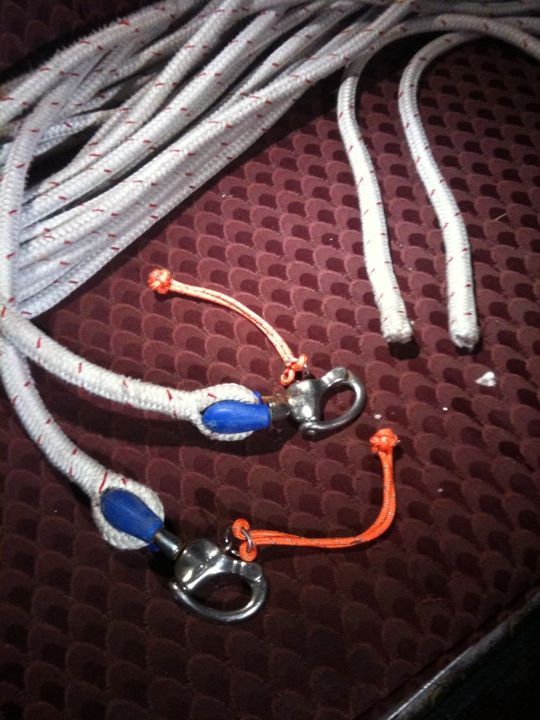
more splicing - the headsail sheets are now 340% better.
Evenings over the next two weeks were slow and quiet, so I got a few chances to move away from the “needs” projects a little and onto the “wants” projects. Here’s a pic of the snap shackles on the headsail sheets spliced into the sheets instead of tied in with bowline knots, and the bitter ends of the sheets backspliced. This is not only faaaaaar more attractive, but also much smoother for tacking as there is less to catch on the inner forestay while the headsail slips across.
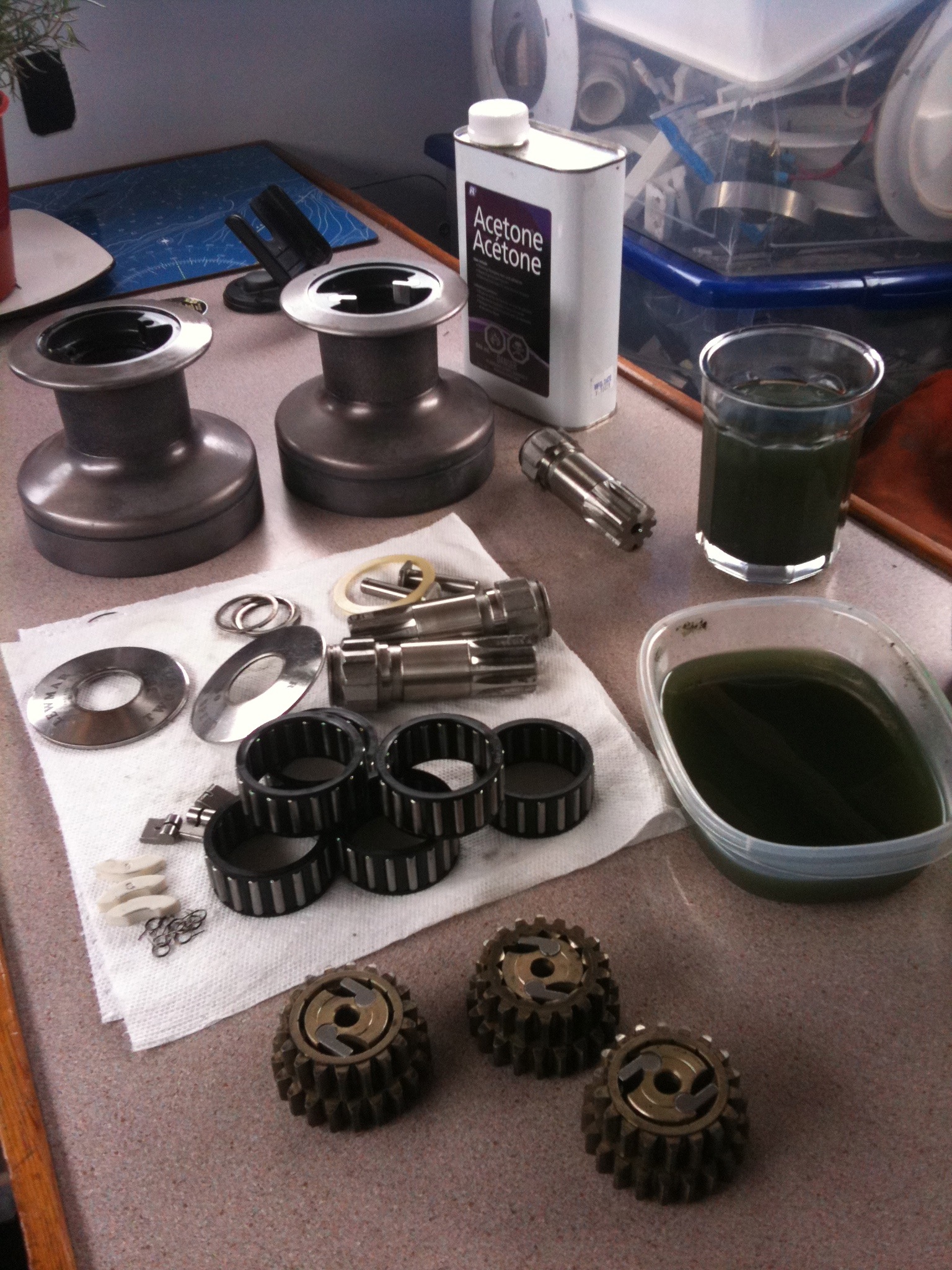
winches, cleaned
More detail on the winch servicing project; the acetone in the back proved to be a failure as well. At some point a previous owner had serviced the winches by putting grease on the pawls. Apparently – and this was news to me – putting grease on pawls is a no-no, as the grease tends to thicken and build up, eventually causing the pawls to jam. For reference, you should only ever put oil on winch pawls; grease is fine (and recommended) for the gears, but the pawls only ever get oil.
The thick, gummy grease is difficult to get off of the components, but the ultimate solution turned out to be very simple: diesel fuel dissolves the grease and an old toothbrush cleans off the remainder. The glass and tupperware in the pic above are both full of diesel, stained an ugly greenish-black by the dissolved grease after soaking the components overnight.
winch 'spares'
While I had the winches apart, I took the opportunity to purchase a ‘rebuild kit’ from the local marine store, and replaced all of the pawl springs in each winch. In this pic, the silver chicklet-looking chunky steel bits are the pawls, which are held against the gear sprockets by the little flat circular pawl springs, which causes the characteristic clatter of the winch in use. Pawl springs wear out over time, but after cleaning the winches and replacing all the springs, my mast winches now work just like new.
mast winch mounts
The winch mounts during reassembly, after cleaning with diesel, brushes and paper towel. During this procedure it was so bitterly cold outside that I had to go back into the cabin after cleaning each mount to rub my hands together to regain feeling in my fingertips!
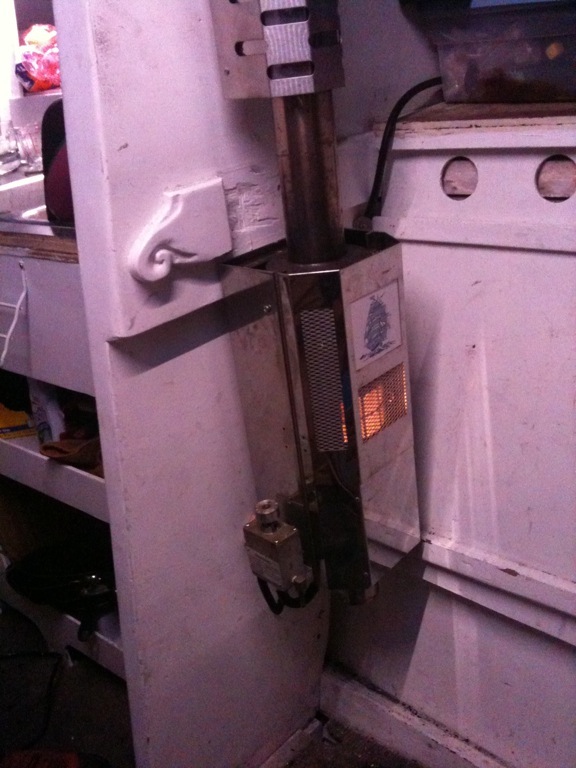
aft furnace installed and operational!
The aft furnace was critical during this period – prior to having the furnace working I was mostly confined to the forward cabin for pretty much everything except cooking, working my day job from either my bed or the “guest nest”, which is what Miya has named the port-side single berth.
Upon first lighting of the new furnace, I nearly burned the boat down! It started up just like normal and worked great, but shortly after this photo the furnace began making a “chuffing” noise and the walls of the burn chamber started glowing red hot – I quickly shut it down, but it kept burning for a good five minutes afterwards. Apparently the diesel metering valve had been set for a much more viscous fuel, and when I measured and tuned the meter it was delivering more than three times the normal amount of fuel to the burner. Since the tuning the furnace has worked 100% as expected, keeping the aft cabin warm for days on end.
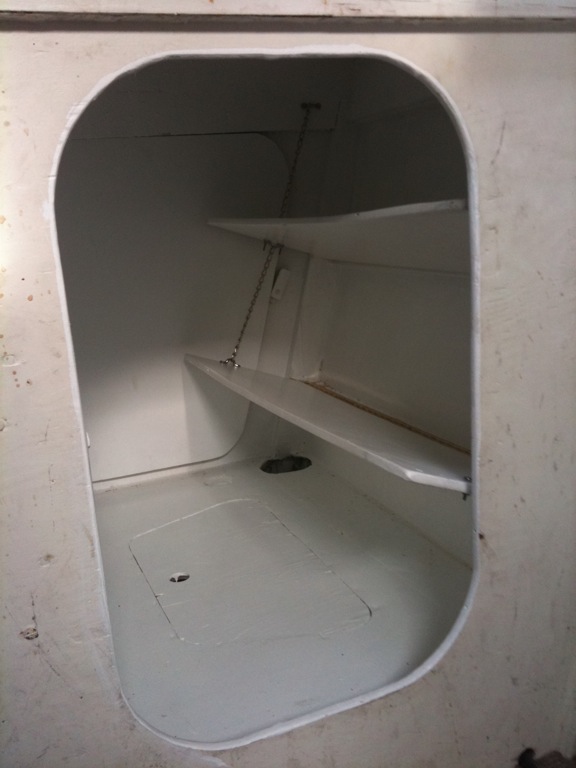
the 'boudoir' cubby, painted and shelved
Speaking of the “guest nest”, here is a pic of the newly-painted and newly-shelved cubby below the port side berth, which Miya has named ‘the boudoir’, and we’ve decided is her personal storage area while she’s living aboard with me. My personal storage space is the opposite cubby, which I have dubbed ‘the study’.
the yankee headsail, spread out at the sail loft
In the sail across from Vancouver, we tore the mainsail in no less than five places, mostly due to poor reefing skills but probably the fact that the sail is fifteen years old might have something to do with it. I brought the sails in to Sidney’s Leitch and Mcbride sailmakers to have it repaired and to get a quote on a replacement sail. I was impressed with their workmanship and attention to detail, and by the personal service I received – they even picked me and the sails up from the boat, and dropped me off again afterwards.
cutting the hole for the new switch panel
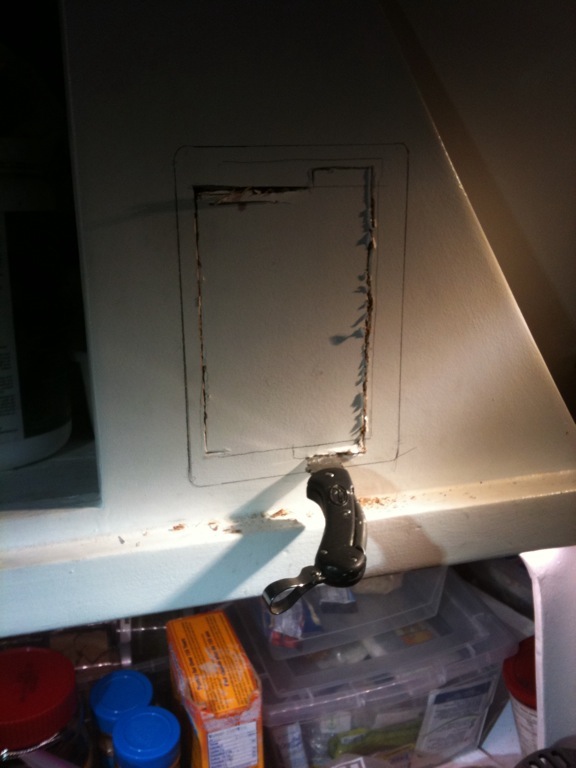
The biggest project of all, while living at anchor in Sidney, was to gut and replace the entire electrical system of the boat. This meant making final decisions on the organization and placement of the switch panels, and cutting into the walls of the cabin to install them. Here I’ve discovered that the panel above the stove is only 1/4″ plywood, and that I’m able to cut through it quite easily with my pocket knife.
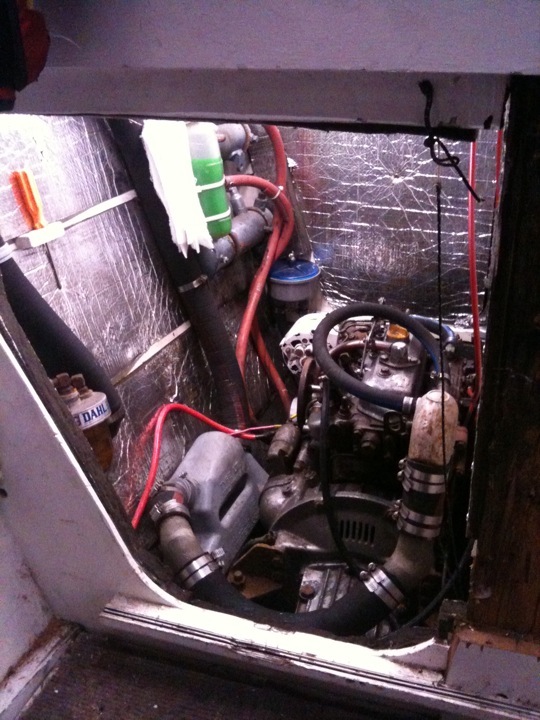
LED lighting in the engine compartment
As a part of the electrical system upgrade, I installed LED lighting into all of the under-cockpit cubbies, with the engine compartment getting extra attention as it’s probably the one where having good lighting is the most critical. Amazing how much cleaner Maude looks with good lighting!
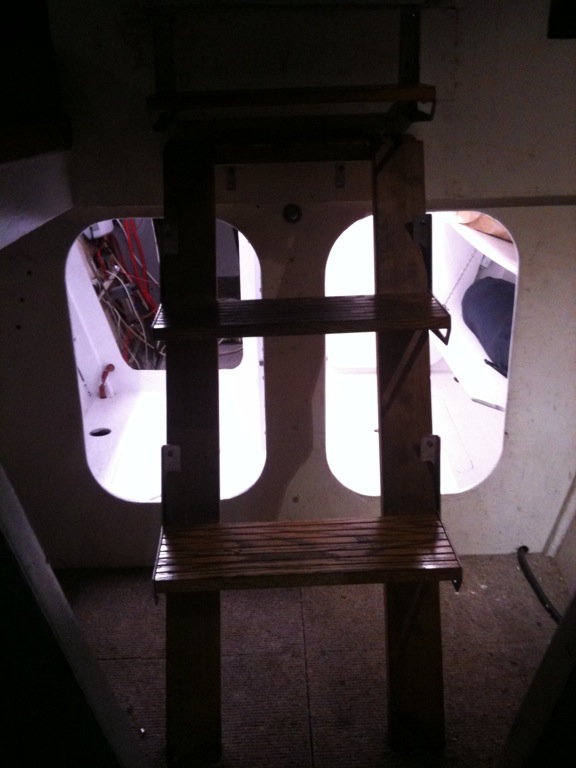
cubbies in the forward cabin, lit up with LED strips
The forward cabin cubbies – the ‘study’ and ‘boudoir’ – shown lit up brightly with the new LED cubby lighting system. What a phenomenal difference it makes, having these formerly dark and dirty spaces now clean, white and bright.
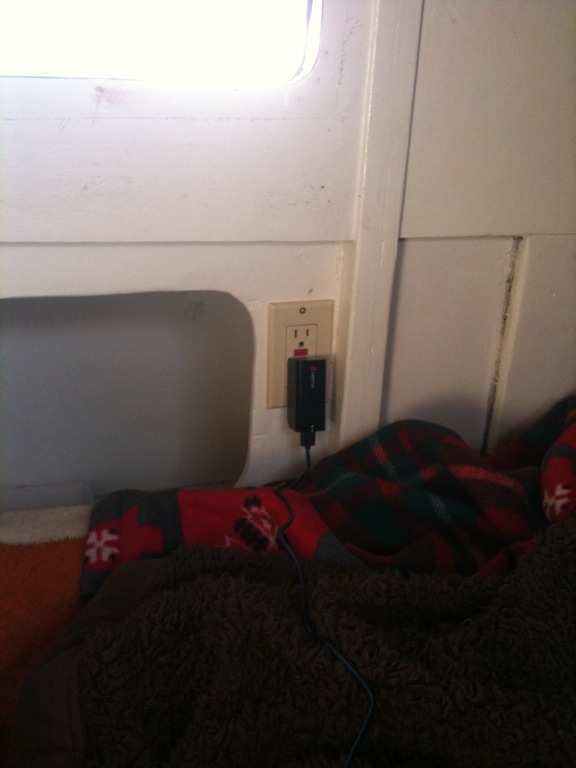
a new outlet beside the bed
I only have a 400w inverter on the boat currently, but that’s more than enough to run things like laptops and cellphone chargers – I really don’t have much else to plug in anymore! Still, it’s nice to have the convenience of being able to plug things in wherever you are, so I’ve installed GFCI outlets all over the boat. This one is only temporary – I’ve replaced it already with a more modern outlet that has a green LED, so that you can tell at a glance whether or not the inverter is turned on.
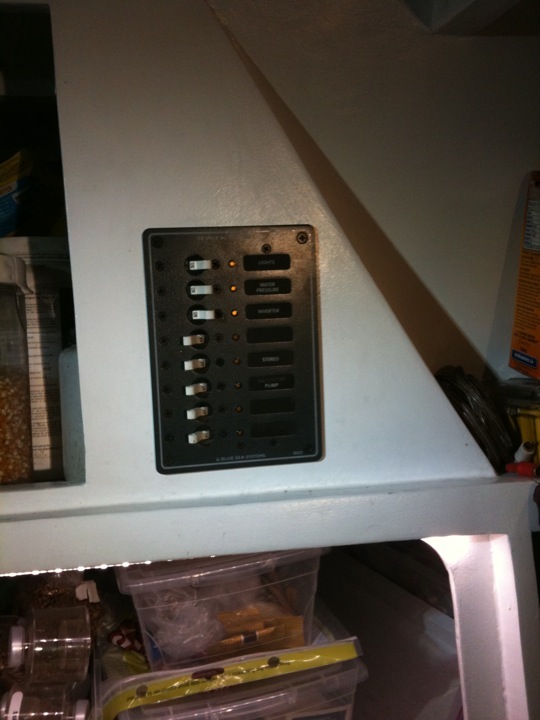
the finished electrical panel in the galley
The galley electrical panel installed and active! I’ve since also added a backlighting kit to this panel, so the panel labels glow a soft green at night. It’s the little touches that really make the work feel professional, and give me great pride in having done it all myself.
the completed electrical system wiring
I’m very proud of my wiring job – apparently fifteen years of being a network tech has some boat benefits after all! All wires to the switch panels are cut to length and terminate in double-crimped flanged spade connectors on terminator bars, all grounds are bussed together with appropriately-sized wiring, and every subsystem on the boat has an individual circuitbreaker. TIE Fighter now has a modern, well-installed electrical system, onto which I can build with confidence. Next steps: a much larger battery bank, then a powerful solar array and possibly a wind generator. The “grid” just keeps getting further and further behind me.
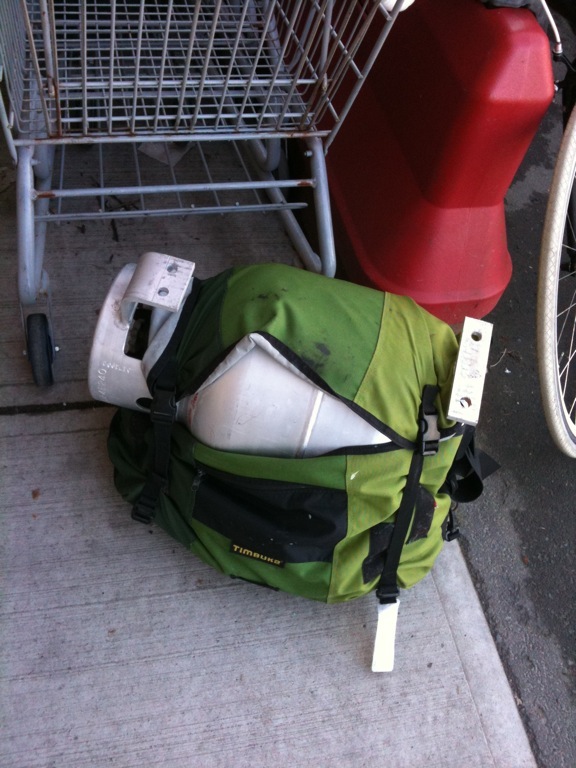
propane canister packed up for bicycle transport
On yet another trip to the Sidney Boater’s Exchange I found a pair of nearly-new horizontally-mounted propane tanks for $100 each. This was a great deal, as used horizontal tanks are very hard to find, and new ones are over $400 each – my propane locker can fit two twenty-pound propane tanks, but they have to be horizontal tanks, standard vertical tanks (like on a barbeque) are too tall for the locker. Packing a propane tank home on my bicycle garnered some strange looks from the locals.
Xantrex LinkLITE installed and operational
I also picked up a Xantrex LinkLITE battery monitor, which conveniently fit into the hole from the ancient (and dead) Heart Interface battery monitor that was installed on TIE Fighter when I purchased her. Yet another step towards complete mastery of my electrical system – a former boss of mine was fond of saying “that which gets measured, gets managed”. This is absolutely true with regards to battery life; I can now measure how much electricity the boat is using at any given moment, and know at a glance how much battery life I have left before I have to run the generator to charge back up again.
sitting on a stoop on Vieques Island, Puerto Rico
After three solid weeks of heads-down work on the boat, a vacation was in order. Miya’s close friend and cousin Stacee was getting married in Puerto Rico, and Miya was the maid of honour so I was invited along as her date. We flew to Vieques, a small rustic island about an hour east of San Juan. Vieques is known for beautiful beaches, quiet towns and a large population of unfenced horses running free over the whole island. At times I really felt like I was back living in Costa Rica again, and within the week my spanish came rushing back to me.
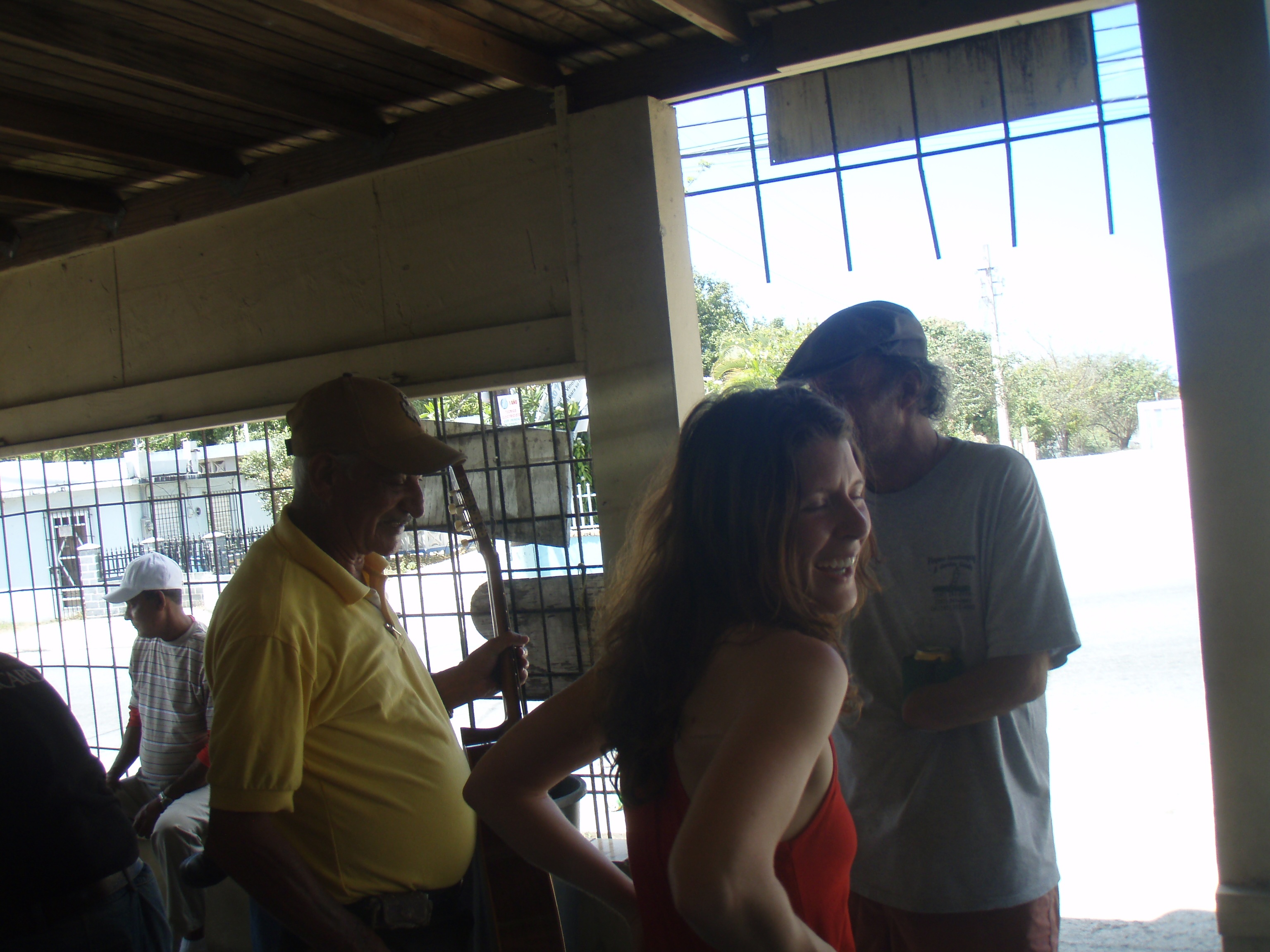
Miya, post-serenade
At some point, walking from our budget hotel towards the posh resort the wedding was being held in, we were flagged down by pensioners in a small bar by the side of the road, invited in for a drink and to listen to the locals playing music and gabbing. Here Miya has just been serenaded with very decent spanish folk music by the man on the left, and the one-armed man on the right had just finished telling her the story of his being stabbed in the abdomen two nights earlier, on the street a block from our hotel.
first scuba dive!
We took advantage of the tourist industry on Vieques and signed up for a one-day ‘Explore SCUBA’ course, which took us out to the end of an unused (but heavily secured) military pier for a pair of dives. The waters under the pier were teeming with life, and I discovered to my great relief that the sinus and inner-ear problems that plagued me as a youth have not in fact followed me into adulthood – I am able to dive after all.
click for a high-res version
I’ve included this pic because I think it makes an excellent desktop wallpaper; subtle and not too busy. Click the pic – or for that matter, any of these photos – for a higher-resolution version. We saw many sea turtles, as well as several types of ray and many, many different tropical fish.
ripping around on a little Yamaha scooter
Vieques is fairly small at only about seven miles long, but we soon felt the pangs of not having our bicycles. Renting bikes was an option, but at $25/day per bike renting a motor scooter for $50/day seemed like a much better option. In the three days we had the scooter the island was opened up to us in a way that was impossible on foot, and we explored the tiny back roads of the island.
probably my favourite pic of the whole trip
There’s something about the sunshine that makes everything a little easier to take… after a few days on the beach it was difficult to remember why we’d been so stressed out about all the little things back home. This pic was taken at the “red beach”, on our way back from the “green beach”, where we’d discovered that tiny, vicious gnats come out in swarms as the sundown approaches. Miya was strangely unaffected, but bites covered my arms in itchy red welts that lasted for several days.
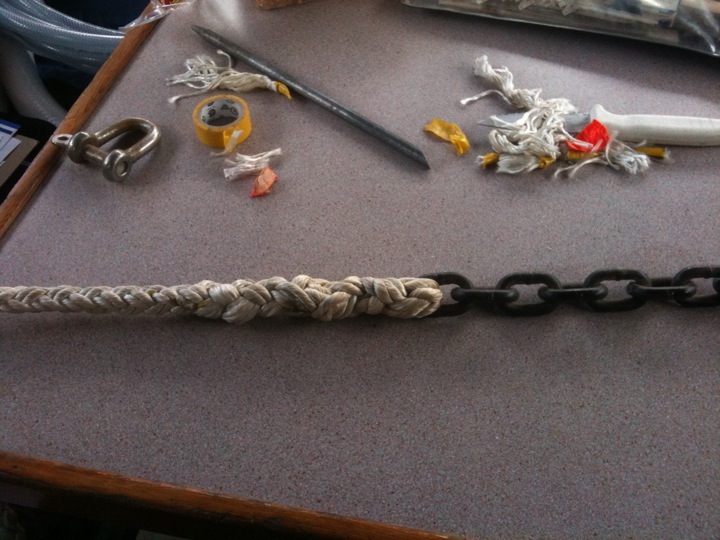
yet another splice - this time it's rope-to-chain
A month or two ago I visited Miya in Seattle and picked up a 150′ length of gorgeous barely-used eight-plait nylon anchor rode at Second Wave, yet another marine consignment store. I think I might be getting addicted to used sailing equipment – this 3/4″ nylon rode was a great deal though, at $50 for 150′, compared with $1.60/foot locally! I spliced the rope to a 40′ length of 5/16″ heavy steel chain, and this splice is currently holding me at anchor quite handily.
motoring away from Tsehum Harbour
On April the 6th, I left Tsehum Harbour and headed back towards Vancouver. I missed my tide window for Active Pass that day – with a sailboat you can only traverse the pass at slack tide, and slack tide was at 1pm. I ended up sailing slowly up the Trincomali Channel and spending the night in Montague Harbour, which is a lovely anchorage but in a complete cellular reception black hole, ruling out any extended stay. In the morning I packed up and headed out through Porlier Pass to begin my solo crossing of the Georgia Straight.
racing the rainstorm
The weather for the first days sail was a mix of sun and rain, with long periods of spring-like warmth followed by cold rains and wind. This rainstorm followed me up the channel for several hours, but when it finally caught up with me late in the afternoon it turned out to be an unexpected hailstorm!
sailing ninja self-portrait, about 4km into the Georgia Straight crossing
The only real downside to sailing in cold weather is the long periods of inactivity, requiring you to basically sit outside in the cold wind for hours on end with nothing to do. Even with proper foul-weather gear, two layers of wool sweaters and wool hats and gloves, it’s still freezing. Pair that with the inexplicable lack of a fly on my overall-style foul-weather pants, and the only real movement you have for the vast majority of the journey is the occasional trip indoors to pretty much completely disrobe to pee. Still, apart from the puzzling lack of zipper, I am completely pleased with my Helly Hansen foul weather gear.
Here’s a video, taken once everything had calmed down and I was moving steadily forward. After I came through Porlier Pass I was expecting some heavy winds and probably some waves, but the addition of the tidal surges from the pass made for some very, very stressful moments! I got my second reef into the main, but not before stuffing all three bows into the waves several times, strewing tools from one end of the cabin to the other, and spilling the contents of my cupboards all over the floor, breaking a bunch of dishes and making an awful mess. The rest of the trip across was spent with the double-reefed main and staysail, which I finally shook out near UBC. I made an average of about 6kn across the Straight, but once I got the headsail up in more protected waters I reached 9.2kn coming into English Bay.
creamcycle, built up and listed for sale
This is the “new” Creamcycle, built up as a fixie with all the brand-new components from the Montague bike and listed for sale on Craigslist. Do you know anyone looking for a rad (if well-used) bike for the summer? 🙂
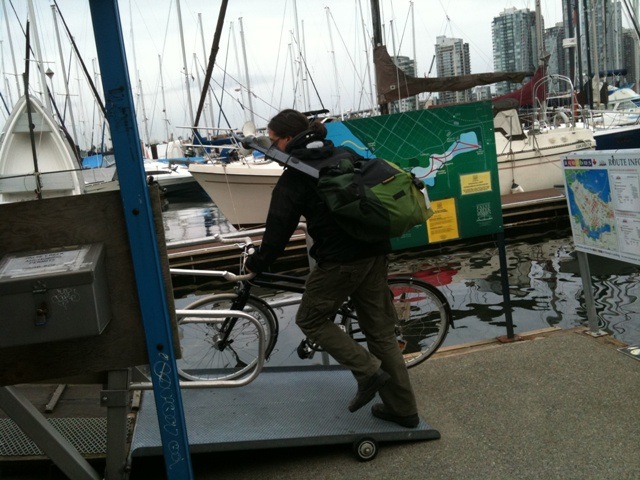
off to class, with a 20kg outboard in my backpack
Yet another class with the Bluewater Cruising Association; this time an outboard motor repair and maintenance class. Here it is Saturday morning at 8am, leaving on my bicycle with the heavy outboard in my backpack.
The outboard, we like to say, “worked really great until it didn’t”. In Sidney, during a trip to shore, the outboard very suddenly quit with no warning, in the sort of way that makes you think something is very, very wrong. Reading up a bit on the internet, I found out that you’re supposed to change the gearbox oil regularly, which I hadn’t – though apparently when you go to drain the gearbox oil it’s supposed to be oil, not dirty water and metal filings.
outboard repair class, saturday morning, 10am
Sitting in class, we learned all about the workings of outboards, stripping out sparkplugs and taking apart carburetors, and I slowly dug down into the problem that had caused the outboard to stop so suddenly. Clearly the problem was in the gearbox, but could it be repaired?
what came out of the gearbox of the outboard - photo by Jennifer Craig
When I finally got the gearbox opened up and stripped, a few pieces fell out – and some of those pieces were ball bearings. Well – I use the word “ball” somewhat loosely there; the parts that fell out were anything but spherical. D’oh!
End result? The engine is apparently a write-off. I can probably get a few bucks on Craigslist for it, for parts – but the cost of the replacement bits to get her running again are approximately four times what I paid for the engine originally, and given that it was quite underpowered for the dinghy it was on anyway, I guess I’m now in the market for a good used 8hp motor.
freshwater system complete!
Lastly, I finally added in and plumbed the third 100-liter water tank to the freshwater system. This has been on the bench for a while, but now the freshwater system is pretty much 100% complete – there’s still a slow, weeping leak on the galley sink that I need to tend to, causing the water pressure pump to kick in about once an hour to keep the pressure up. As far as I can tell the only fix for that is to replace the whole faucet assembly it hasn’t really been high up on my list of priorities.
—
Phew! And that brings us pretty much up to current! So many updates, with so little time. I’ve got to remember to try to spew this stuff out in smaller portions, but when things are moving fast it’s really tough to keep up.