La Paz, At Last!
Ok! Hopefully this will be the last big photo-dump update for a while and I'll be able to get back on track with regular updates - but really, how many times have I said that before? I do take a great deal of pleasure in having this adventure online, but at some point the adventures have to be simply enjoyed without worrying too much about documentation.
On January 29th, a solid two days before we'd be legally in the doghouse with US Customs for overstaying our welcome in the United States (well, technically only I would be in trouble, Miya is American), we left San Diego harbour, turned left and headed for Ensenada.
On to the photos!
The yellow flag, flown at the top of the flag halyard on the starboard spreader, represents the letter 'Q', which, flown alone with no other signal flags, signifies 'quarantine'. The quarantine flag is flown when crossing a border, to let the governing bodies know that the vessel has not yet cleared customs for that country but does intend to.
We left San Diego in the afternoon, and we figure we crossed the border just as the sun set. We had excellent weather and a beautiful moon for most of the trip down.
What a stark difference over sailing down the Oregon coast! The water was a startling sapphire blue and the mornings were warm and sunny.
Arriving in Ensenada late at night - apparently no matter how we plan our trip we seem to be completely unable to arrive at our destination during daylight hours - we followed the instructions of our guidebooks and anchored "inside the breakwater". In the morning we discovered we were anchored near the navy base, so we quickly pulled anchor and headed further into the harbour to find the sailing docks, just past the cruise ship terminal.
Customs was a bit of an adventure, but with our careful organization of documents and rudimentary knowledge of spanish (and a great deal of help from the Downwind Marine Cruising Guide), we made it through in about three hours of standing in various lines.
The courtesy flag (in this case the Mexican flag) is a show of respect to the country that a yacht is visiting - it's usually followed by personal colours, in this case an American flag because Miya is American, and then by club colours, in this case the almost-destroyed Bluewater Cruising Association burgee.
Miya set her lines every day - three lines, one per person on the boat, each of us having purchased a Mexican fishing license - and was finally successful in catching what was either a skipjack tuna or a bonita, we're not entirely sure. It was delicious, if a little bit oily.
Within a day or so of this catch, we found ourselves looking down off the side of the boat at a five-foot mako shark! The shark swam up to the boat, turned on its side, looked up at us for a moment and then swam off again. When Miya pulled up her lines later, all three were missing their lures and her downrigger/diver thing had a few deep scratches where it had been attacked by something with sharp teeth!
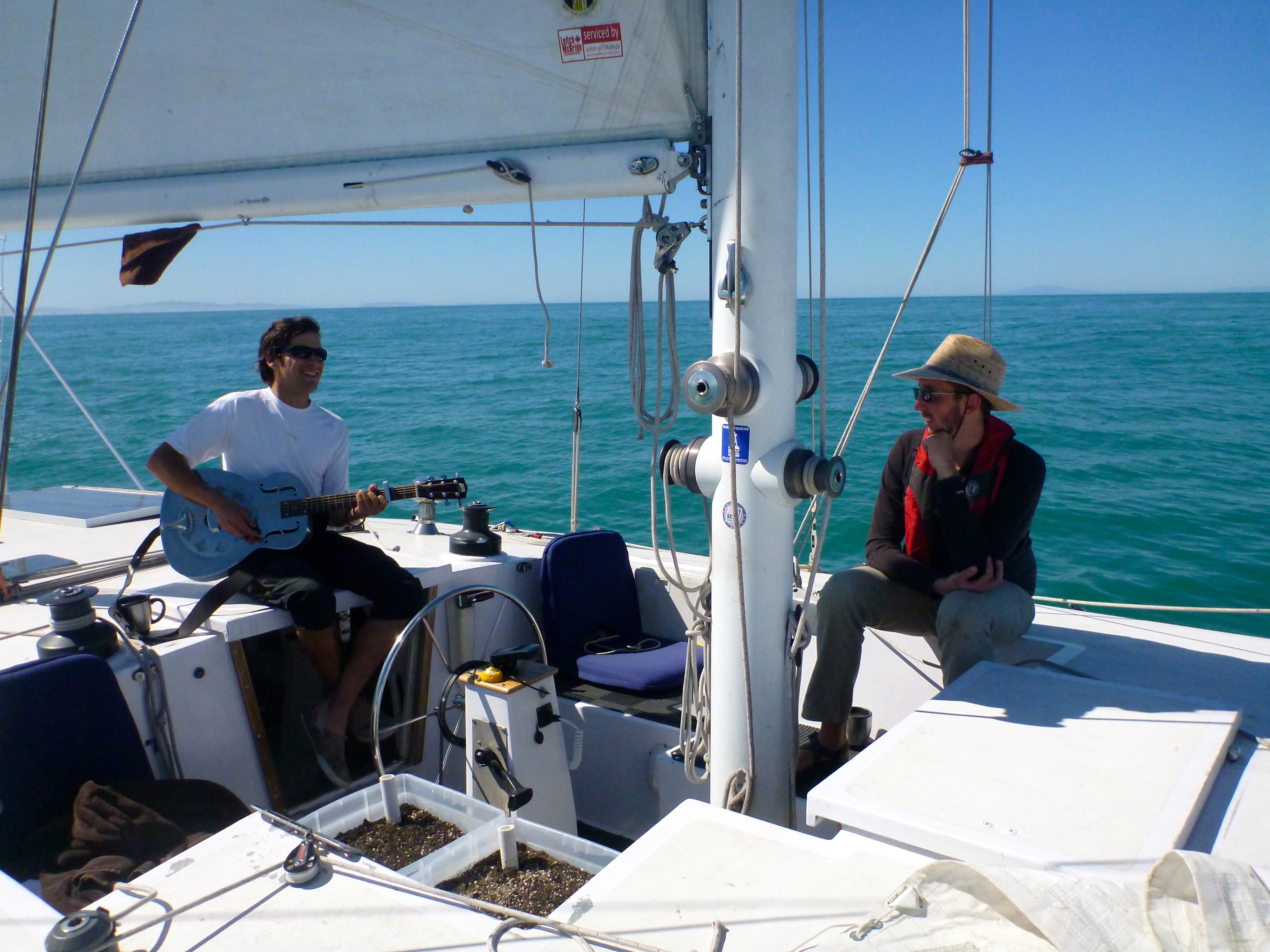
Sailing settled into an easy rhythm, with everyone getting ample sleep and the weather (mostly) cooperating. Our main problem during the long sunny days was a lack of wind - we had to be satisfied with trundling along at 2-3 knots.
Let me say that again: we spent days at a time on our 1200km sailing trip travelling at approximately 5km per hour.
It quickly becomes obvious that sailing is for people who love sailing, not for people who are in a hurry to get somewhere!
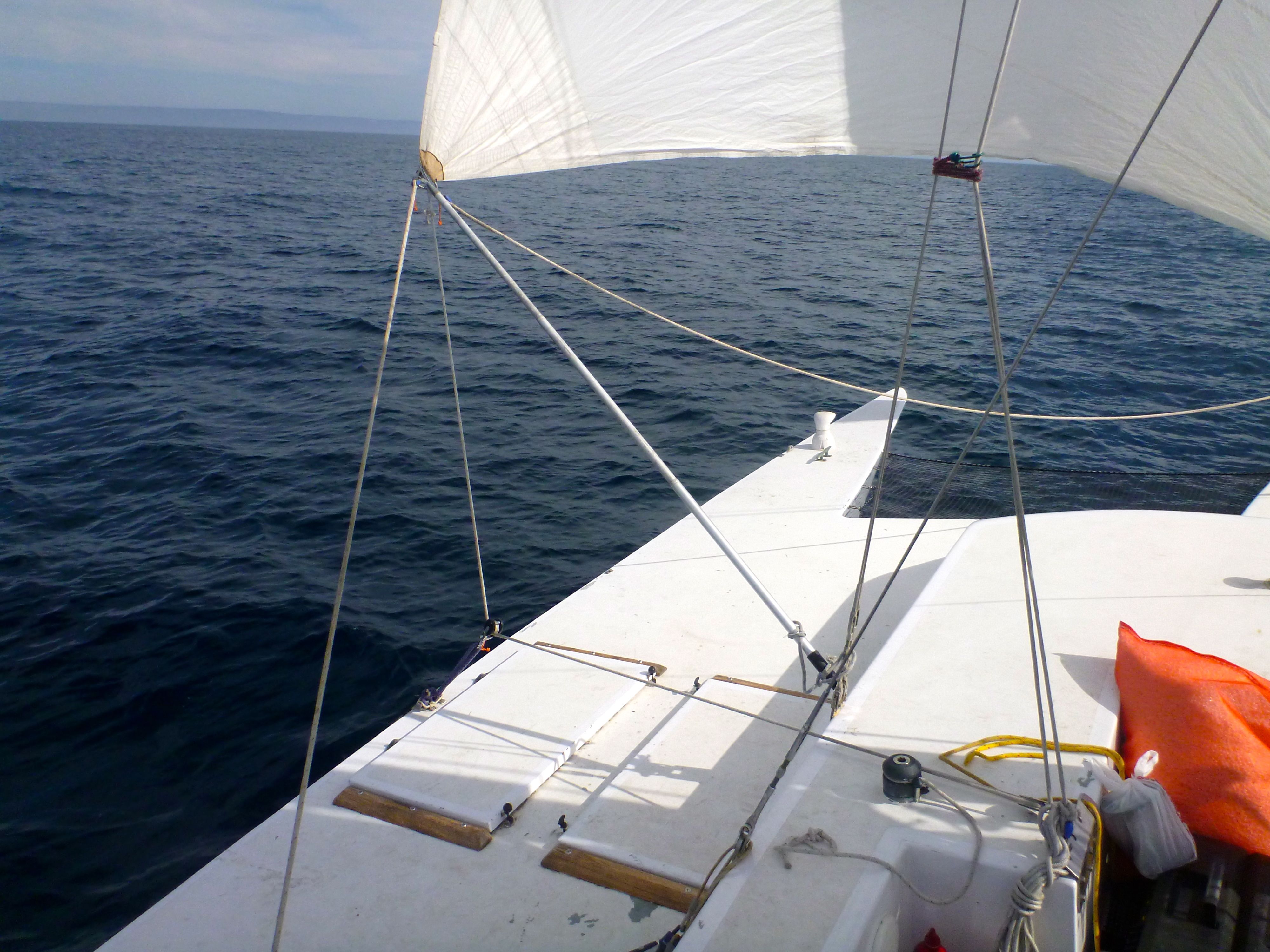
After a time, we realized that we could optimize our downwind sailing by dropping the staysail, switching the headsail to the 150 genoa and "poling it out" to fly the main and headsail in a wing-on-wing configuration. Unfortunately, we do not have a spinnaker pole! We improvised with our boathook as seen in this photo, but the collapsible boathook pole kept... collapsing. Eventually we tried an oar instead, and it worked very well - though we're shopping for a used spinnaker pole now, as a very large percentage of sailing in the trade winds is downwind sailing. In the photo you can also see us using a snatch block and the staysail sheet winch to pull the sail downward, giving us much better control over trim.
This photo represents an adventure! Miya heard about the Laguna Ojo de Liebre on the internet, and we made plans to visit the lagoon on our way south. We pulled into the large bay that houses the lagoon late one night, and shortly after I got up for my midnight watch we encountered our first squall of the voyage, with winds gusting to... oh, I have no idea, our wind instruments have never worked properly. Suffice to say we required a double reef in the main, and we were still doing eight knots under just the main and staysail.
The squall was a northerly, and the lagoon was to the south - when we went to enter the long, shallow mouth of the lagoon we found ourselves swiftly approaching sand dunes, surfing down steep three-meter breaking waves. We broke our all-time speed record, hitting 15kn, before realizing that if one of those waves were to cause us to dig an ama bow into the sand the entire trip would come to an abrupt end. We quickly turned around and headed back out into the open bay.
In that bay, we saw something floating off in the distance, and I was curious so I took us on a fifteen-minute detour out to find out what that something was. It turned out to be a dead, bloated grey whale, which Miya found endlessly fascinating. The whale was blowing a steady stream of some sort of decay-gas from its mouth, and as it bobbed up and down in the small waves the gasses would alternately hiss into the air and bubble into the ocean.
Once back out into the open ocean, the water took on that unreal deep sapphire blue hue again, and we all took advantage of the warm, clear water to jump in with a handful of shampoo and get ourselves clean. With a pair of swim fins, it's surprisingly easy to keep up with a sailboat travelling at about 2kn, even with both hands occupied with shampoo.
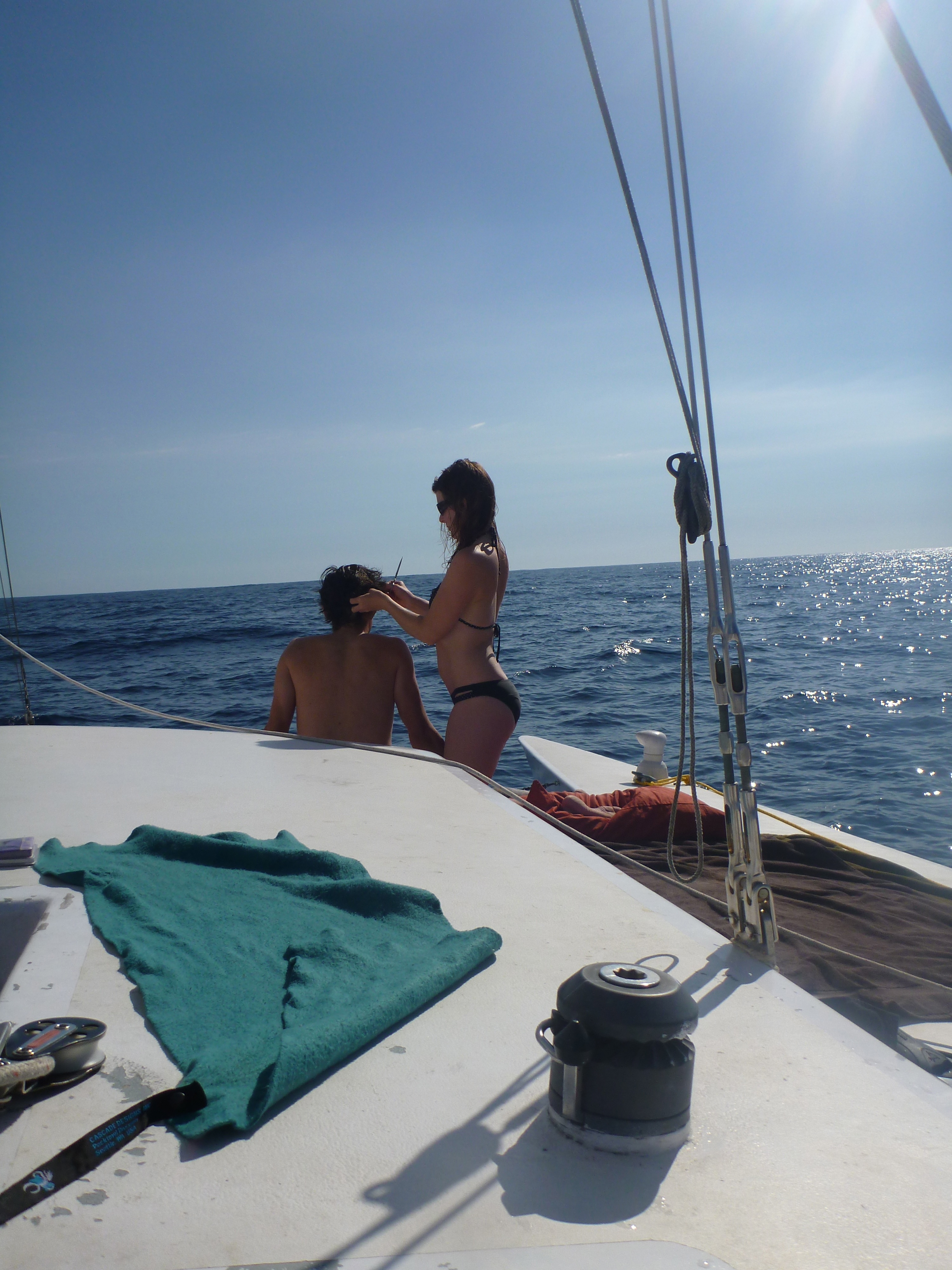
By this time it was almost three months since my last haircut, so we figured it was time to let Miya have a go at it. She's performed probably thirty haircuts before, so I wasn't that worried - and besides, even if it was botched utterly it would just be an excuse to give myself a nice, easy-to-maintain buzz cut.
She did a fine job - arguably one of my best haircuts of the past few years.
Just after breakfast one morning, Miya called me up on deck excitedly - a sea turtle was swimming along behind the boat, apparently following the thick white fishing lines. The turtle came closer and closer to the boat, eventually seeming to play in the slipstream of the main hull - it stayed with us for probably an hour, coming close enough for us to look it in the eyes and have a lovely conversation about fishing. Miya named her 'Marguerite'.
I took a video of the turtle, and Miya posted it to her YouTube account.
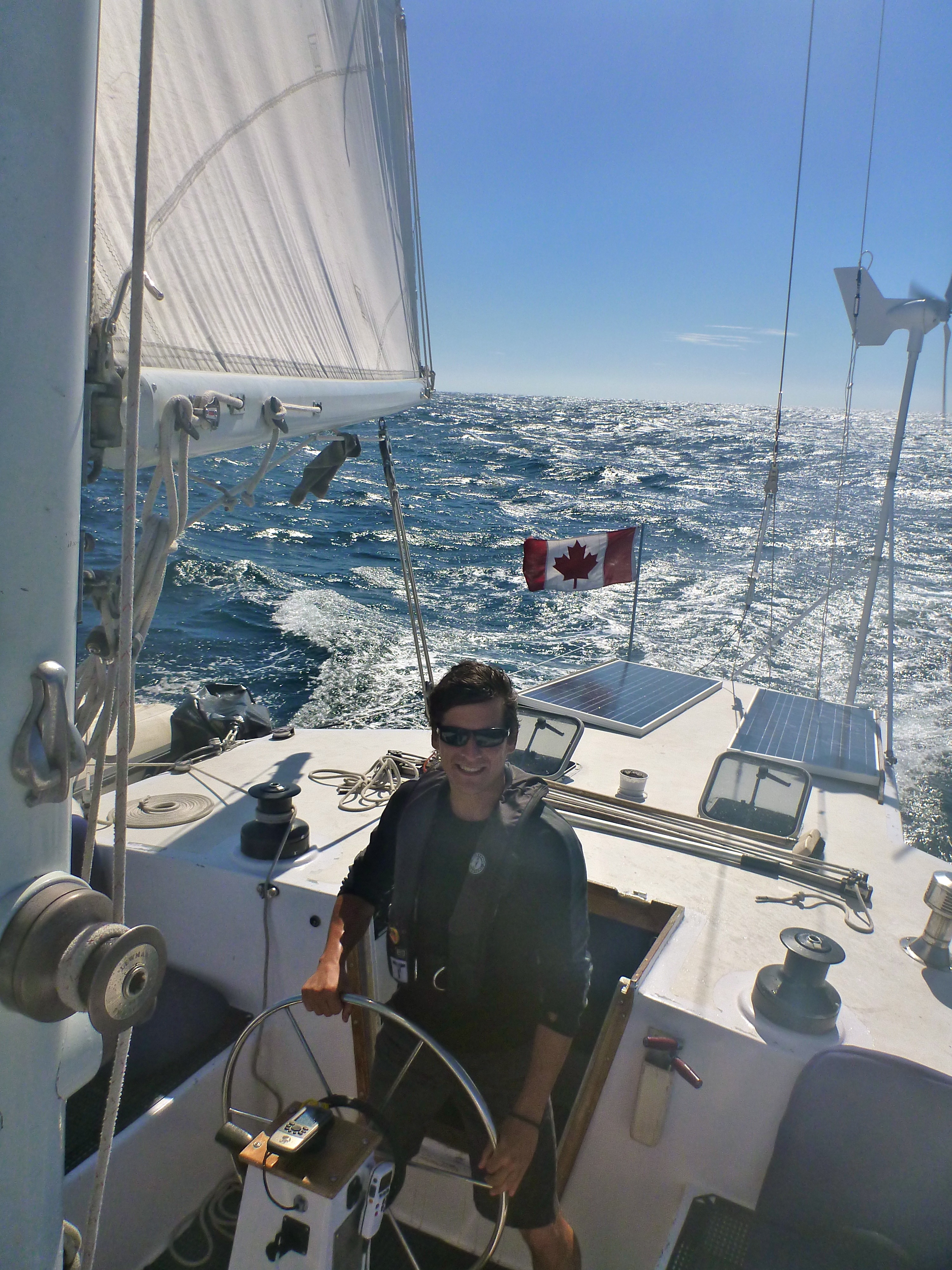
Finally, as we rounded the tip of the Baja Peninsula, we saw some reasonable winds! We estimated around 20kn, and rather than start putting in reefs and taking down the headsail, we decided that it would be nice to "open her up a little", and we spent most of the afternoon flying past Cabo at between 7.5 and 9.5 knots, splashing through whitecaps in the Mexican sunshine.
After rounding the peninsula, we had about 12h of good winds to ride north to La Paz - but then the winds shifted, and we spent the next day trying to beat our way northwest into northwesterly winds, gaining little ground. We were running low on fuel, so we couldn't just motor the whole way - luckily we had time, so the next day or so we sailed to weather as best we could, with the winds taunting us, switching between "utterly dead" and "decent but in the exact opposite direction from what we'd like, regardless of our current tack".
Finally, we had had enough - I looked at the fuel tank and decided that we had enough fuel to make it into La Paz by nightfall, and so we turned directly into the wind and motored for the next eight hours. The wind had been blowing steadily from that direction for at least a day, so the wind waves had built up quite a bit, and we were motoring right into them. We discovered at this point that if we harnessed ourselves in and went to stand at the absolute tip of the bow, the bow would dive down into the wave trough and then leap eight or nine feet straight up with the next wave! We all had a few turns; it was a fun diversion for an otherwise gruelling day.
The closer we got to land, the more Mexico started to show up in the boat. This was a giant moth that was found sleeping in the sink drain the last morning before arriving in La Paz. It was huge!
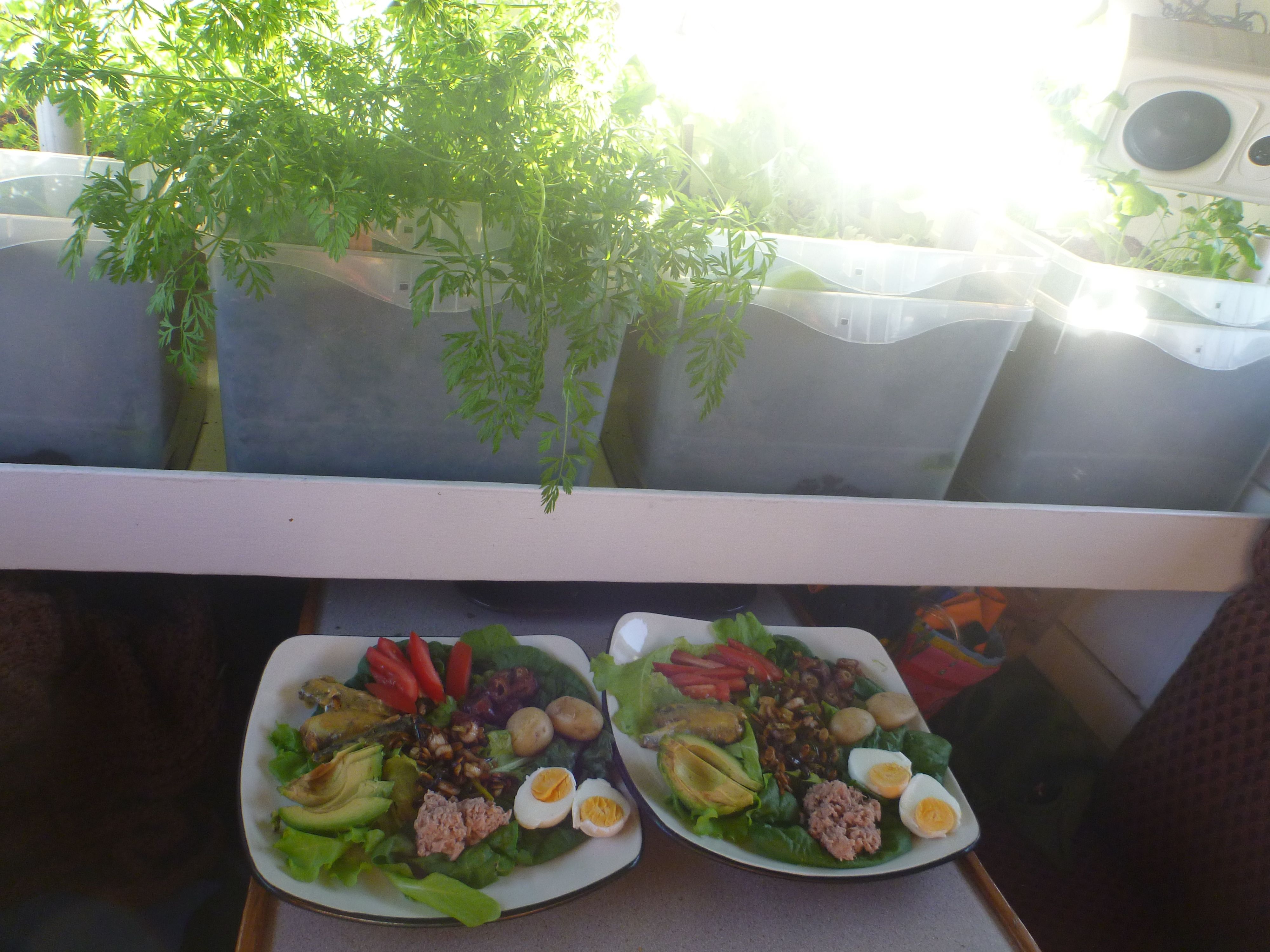
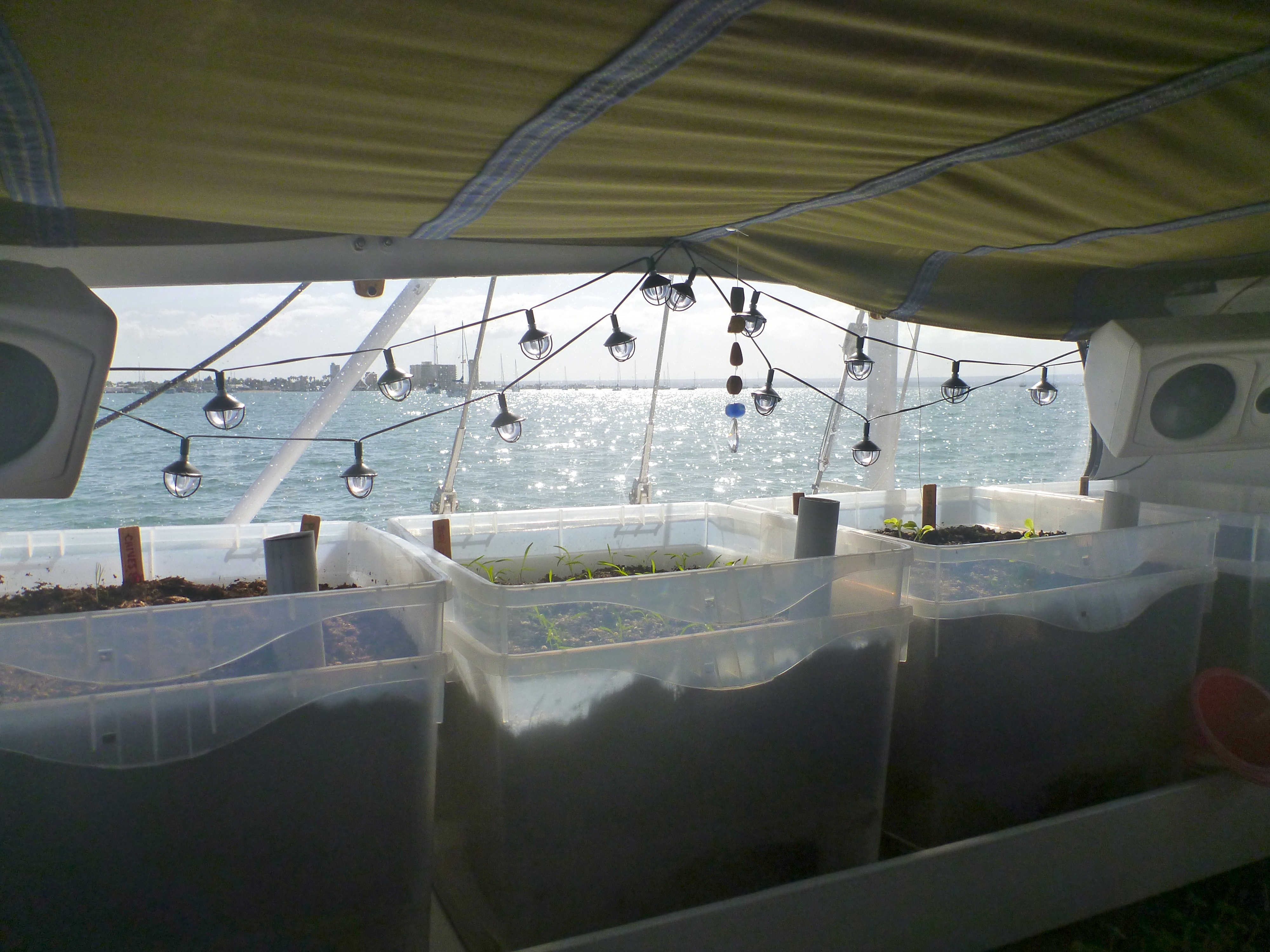
On the long trip down from San Diego, Miya's garden began to thrive! Her carrots, broccoli, spinach and lettuce all sprouted, and the chives and parsley came up soon after. Combine all of those with her regular sprouting of a 'salad mix' of sprouting seeds, a 2kg bag of which she found on the internet, and her new sprout-in-a-towel technique for her micro greens, and we've got a very solid influx of green leafy things in our diet.
Finally we arrived in La Paz - we anchored out near the 'Magote', which as far as we can tell means "sand bar" (upon which someone decided it a wise choice to build timeshare condominiums; the mind boggles). The air is warm, the water is blue, and we're settling in for a month or so while we get used to living in Mexico.
And that, my friends, brings me nearly up to date. The reality is that we've been here in La Paz for almost two weeks, and we've had a few adventures already, but at least I'm writing about the same country now. More to come, soon I hope, and with more regularity!
San Diego, Round Two
We were in San Diego for almost two months, but that time seemed to blow past us at an extremely accelerated pitch. Our 'Cruising Permit' (the customs paperwork allowing the TIE Fighter to remain in the US while being a Canadian-flagged vessel) would expire February 1st, so we had to hustle if we wanted to get all the pending projects completed before we left for Mexico, where everything would be an order of magnitude more complicated!
When we originally cleared customs in Port Angeles, Washington back in September, the customs officer asked how long we'd like the permit to be - we laughed and told him that we intended to be in Mexico before Christmas. He nodded and said
"I'll just give you a couple of extra months anyway, just in case you run into bad weather..."
I guess he must had some experience with that sort of thing...
Anyway! On to the photos!
San Diego, despite being a bizarre mix of old-money Republicans and impressionable young military personnel from the midwest, had its moments of beauty. Click this photo for the full-size version; check out the sunbeams reflecting off the mirrored buildings and through the early evening fog bank!
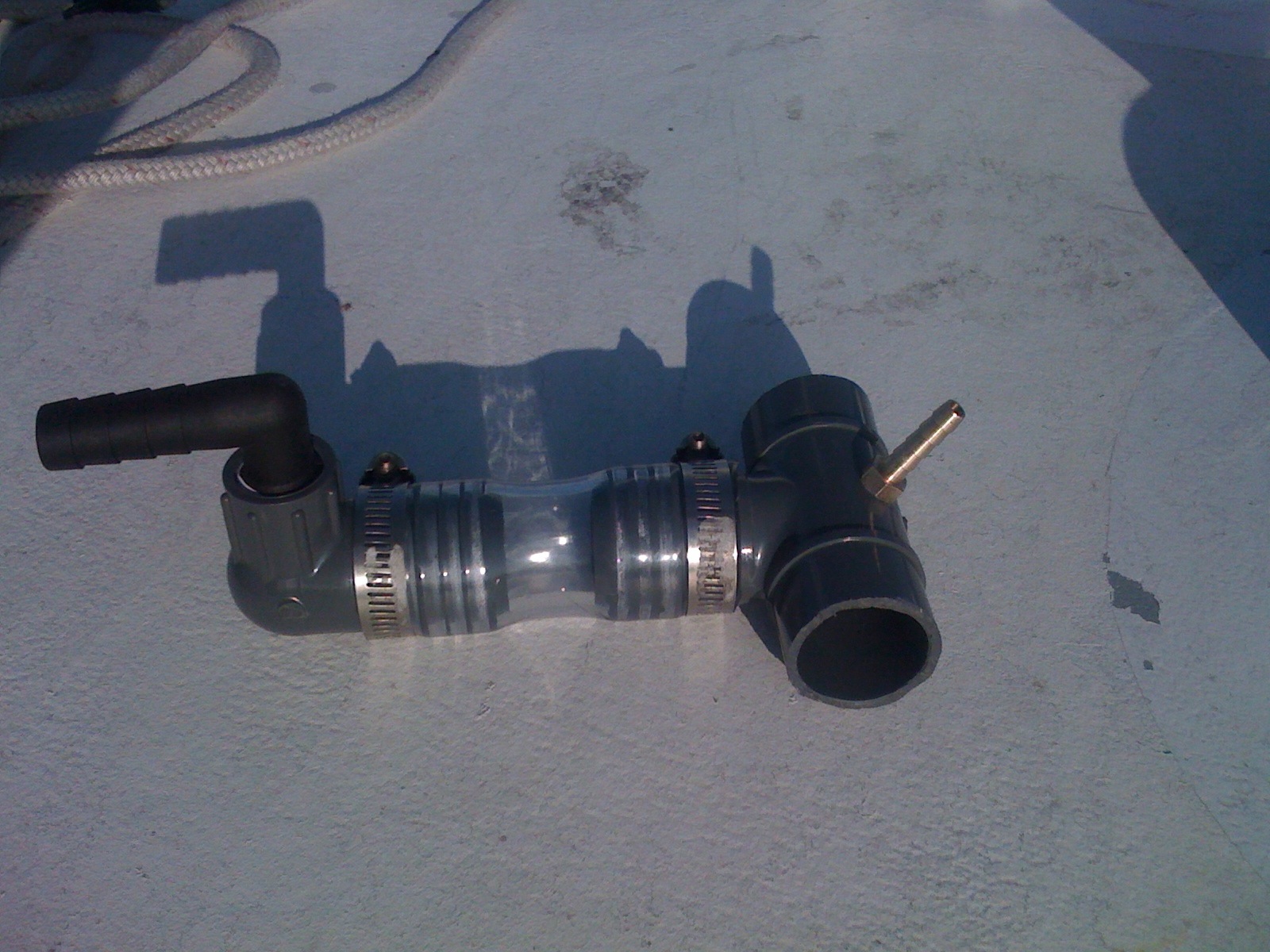
At no point did we expect that the water maker install would be simple, but I have to admit I was expecting all of the parts to be readily available. That wasn't really the case, and I had to build this fitting to attach the product water feed to the tank inlet, while also adding a vent line so that the water maker water feed will never see more than 3psi in back pressure - apparently that would irreversibly damage the water maker membrane, which is a very expensive replacement.
One night just before Christmas, just prior to having the water maker up and running, we decided to make a run to the fuel dock to fill up our water tanks. We made it out of the A9 anchorage and around the corner a few hundred meters when suddenly our engine alarms started screaming...
We blew the seals on one of our freshwater pumps on the way down - it was still working, but leaking coolant. I had a guy in San Diego rebuild the pump ($50 instead of a $400 new pump), but when I reattached the pump I didn't properly bleed the air out of the coolant lines. A brand-new impeller was just spinning away with nothing to pump, and it was destroyed within minutes.
Mostly I'm impressed with myself, that I was able to determine the cause of the problem and fix it within about an hour, without having to call for help or even consult any manuals. That kind of thing really helps with a person's confidence in taking their vessel far offshore.
As it turns out, Tijuana is a $2.50 public-transit train ride from downtown San Diego, and so we decided to take a brief day trip south of the border. Tijuana is everything that I dislike about Mexico, condensed into a single city - a stark contrast to La Paz, which is absolutely nothing like it.
Between hundreds of shopkeepers (all bafflingly selling the exact same items for the same prices) yelling at us to come into their stores and restaurant owners offering cheap tequila (followed by "I've got something for your nose, amigo!"), there were random street "displays". This one, a burro spray painted with zebra stripes, was apparently available for tourists to take their photo with... for a fee, of course.
The first step to arriving in a new city is to figure out where the basics are coming from - internet, showers, groceries, laundry, etc. Most of the facilities were a good five kilometres away from the anchorage, however, so we made the most of our time and split up the tasks between us. This is Miya, with all of our laundry packed into a series of heavy dry bags and our collapsible pull cart, headed for the laundromat.
In my last post, I began by describing hundreds of tiny acrobatic fish hurling themselves at the side of the boat. Later that day I discovered that several of the fish had leapt into the dinghy! The internet told us that these fish were mackerel, but unfortunately it also told us that you should never eat fish that you've found dead; there would be no way to know how long the fish had been dead. Pity I hadn't looked into the dinghy earlier, these little guys would have made for a delicious breakfast.
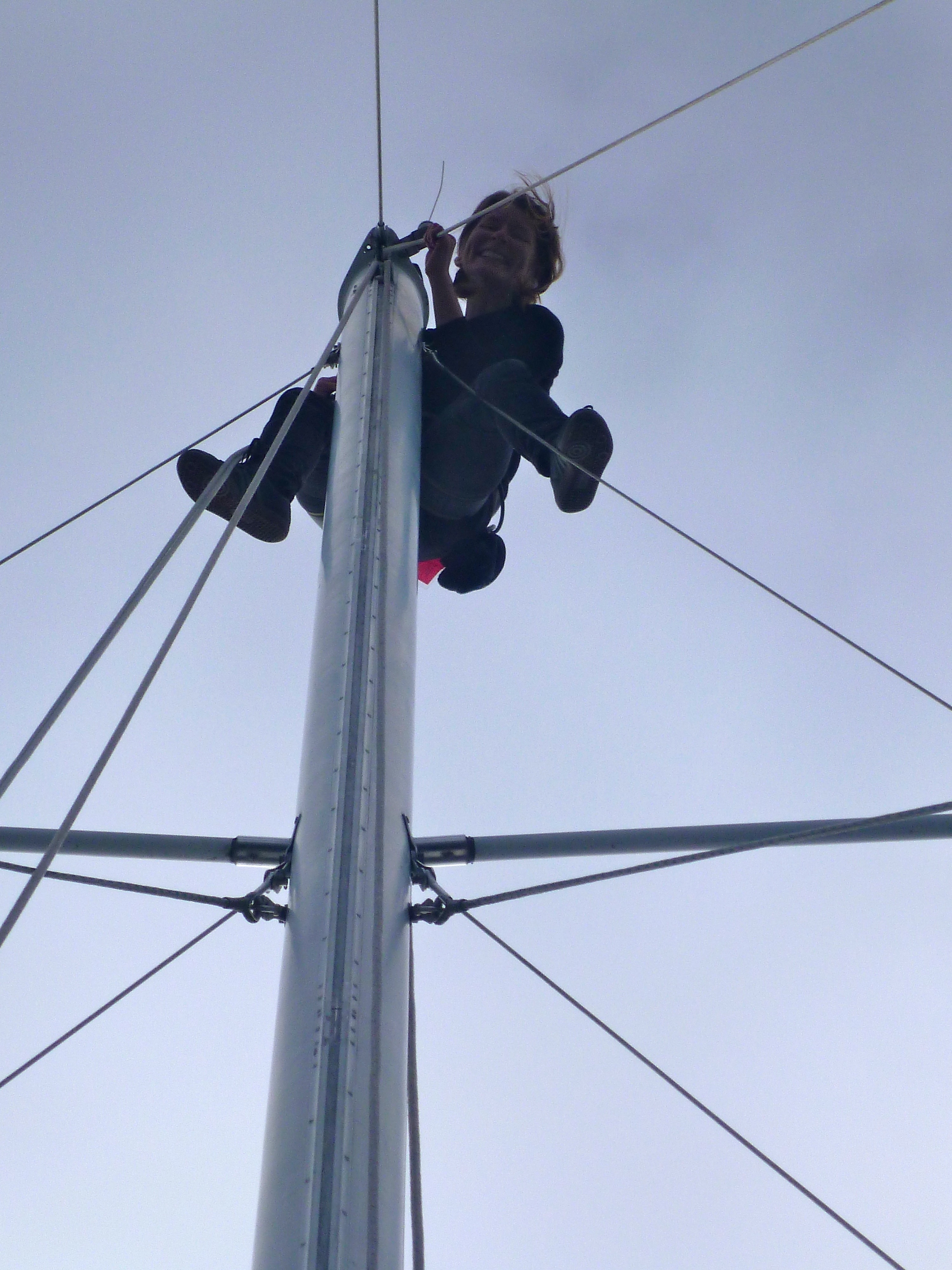
One of the biggest projects I wanted to have completed before leaving offshore was the ham radio install. This required several trips up the mast; one to affix a temporary backstay (length of steel cable holding up the mast) to measure the length of the new antenna, one to take down the temporary backstay, and one to affix the new backstay.
After hoisting me up the mast with our largest winch, Miya decided that it would be easier for both of us if she went up and I manned the winch.
The pelicans in San Diego were pretty much completely unafraid of humans, and would regularly surround our boat during their fishing expeditions. A few times they almost appeared threatening...
When we realized that the Grand Canyon was a short-ish eight-hour car ride away, and that we'd be unlikely to be anywhere near as close to it every again, we decided to take a few days and go on a road trip. Despite the cold January air, the canyon was everything that television and movies made it out to be: a very large, very beautiful hole in the ground.
This is us enjoying the last moments of warm sunshine, just prior to the sun falling below the horizon and sending us sprinting for the car and warm sweaters. The desert gets COLD at night!
The canyon was nice, but to be honest we preferred the drive through the Painted Desert and the strolls through the petrified forests. If you click this photo and look right at the centre, you can see the 6000-year-old drawings on the side of this boulder, known as "Newspaper Rock".
Miya and I have a habit of visiting places with identical names to larger, more famous places; in 2011 we visited Moscow and Paris, both in Idaho.
Salvation Mountain, at the entrance to Slab City (as seen in the movie "Into The Wild") was probably the highlight of the epic January road trip. The life's work of a devout born-again Christian artist, the mountain is made from found materials, mostly dirt, hay bales, wood and leftover paint... lots and lots of paint.
Slab City was fascinating as well, though less photogenic - a squatter community in the desert, completely off the grid and self-reliant, on concrete slabs left over from an abandoned military base. I could see myself spending time there, especially if it were with a group of like-minded adventurers.
Following the trip to Arizona, we jumped a plane and headed to Vancouver to help throw Sequential Circus 10, an event series that I've been throwing (well, with the heavy assistance of a group of close friends and dedicated volunteers) for the past five years or so. In this photo, Rich Hamakawa is recording voiceovers (in the booth, the vocal talents of France Perras) for use as the introductions on each of the podcast recordings. Sitting in the TopFloorUnderground studios with good friends and a bottle of nice tequila is a fine way to spend an afternoon.
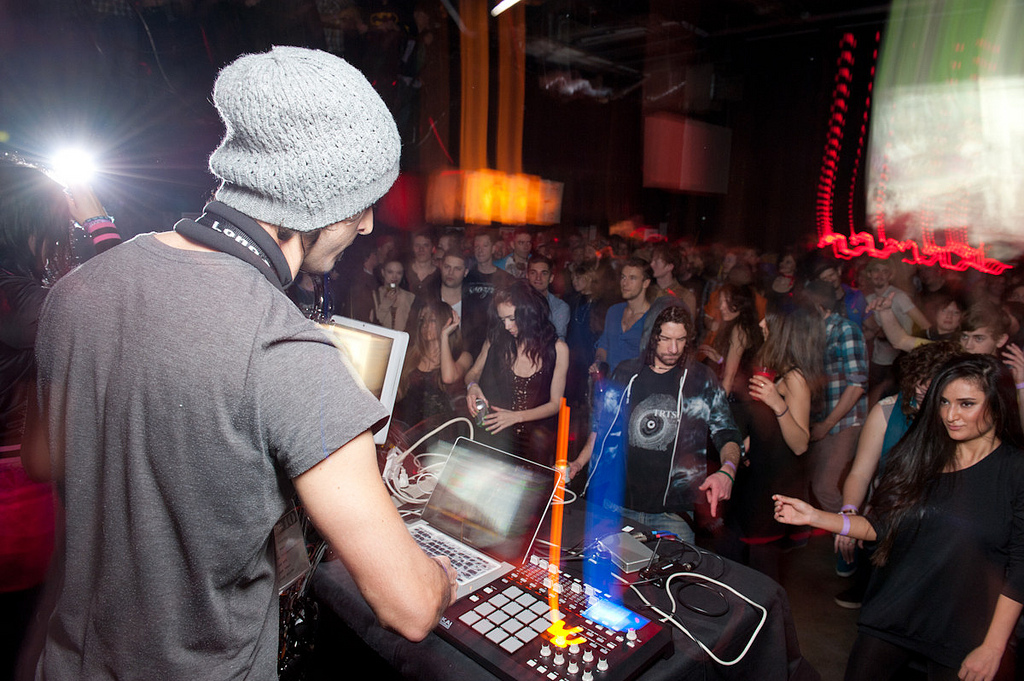
I have to admit, we do throw a helluva party. This is Drew 'Vespers' Betts performing for a packed dancefloor. All of the performances at Sequential Circus shows are live acts.
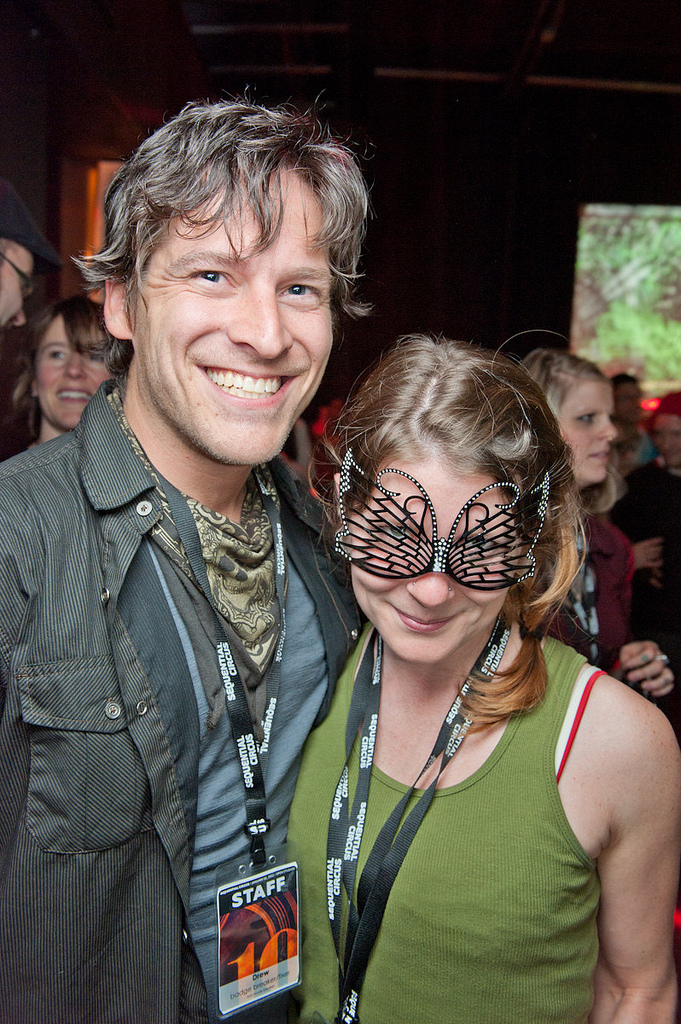
Much fun was had by all - thanks for the great photos, Luke! Much more of his most excellent work can be found on his Flickr site.
Back to San Diego and back to the grind - with only a few short days left until we left, I had my hands full with important travel-related boat projects, like finishing the water maker install and getting the ham radio up and running and retrieving up-to-date weather info. Miya took advantage of the boat being in "project mode" to make a mess on the deck, building her custom garden boxes. It's worth noting that Miya's blog, http://www.thenomadist.com, has lately been far more up-to-date than my own.
The hardest part of the install was the through-hull that needed to be installed below the waterline. Normally this would require a haul out, but we decided to try it in the water. I plugged the new brass scoop fitting with a small softwood plug, got all the tools and fittings ready, and then did the unthinkable: I drilled a hole into the bottom of the boat directly into the ocean!
I figured that given the balmy San Diego weather the water would be warm enough to do the install in just my swimsuit, but once I jumped in I quickly changed my mind and switched to my wetsuit. In the end verything went smoothly, and overall we only had about four litres of seawater pour into the bilge.
The project days were fruitful, and if you click into this photo you can see many of them on the go - the flippers on the deck from the water maker install, the detritus from the garden construction, pillows out on the bow nets to air out, the blue bins of winter clothes out in preparation for cold offshore nights, the new Achilles dinghy and the old Zodiac dinghy alongside our venerable folding "beater" row dinghy... so much going on in this photo!
And that brings us to the end of January! One more blog post to go and I should be actually up to date and back to posting about things as they happen, instead of posting about them two months later...
San Diego
Soooo, once again I've been too busy to update the blog on anything approaching a regular basis, and now I'm left with a tonne of things to post about.
It's currently 7am on a Saturday morning, and I've been driven out of bed by the noise of dozens of little fish hurling themselves out of the water and at the side of the boat. Currently we're surrounded by hundreds of seagulls, pelicans and a few sea lions all feasting on what apparently is a huge school of these acrobatic little fish. WTF, nature. I'd prefer another couple of hours of sleep, but the coffee pot is on the stove and I have a list of projects to work on today, so I guess an early start isn't such a bad thing.
(update: it's now three weeks later and we're just about to leave SD, and I'm *still* trying to get this post finished. switching over to the "gallery" format again to save time.)
(update #2: it's now almost a month later again, and we're in La Paz, Mexico with a billion more stories to tell so I'd better just get this one finished as quickly as I can...)
I've actually made some progress on the studio front, something I've been trying to figure out since moving onto the boat. I picked up a pair of decent headphones and a little technological miracle, the Focusrite VRM Box. This box simulates the sound of sitting in a tuned recording studio (or bedroom studio, or even a living room) in front of a user-selectable range of different speakers. Sure, it's not really the same as my previous techno studios, but it's 90% of the way there - and for a boat that's pretty incredible.
With a reasonable monitoring setup, and finally having a laptop capable of handling large audio files, I finally got around to putting in the hours and hours of editing needed to launch the Sequential Circus Podcast! This is big news; forty-five high-quality recordings of original live electronic music online so far, with more to come soon. It's about time, too - we've only been talking about launching the podcast for... oh, almost five years now. The next show, Sequential Circus 10, is coming up on January 21st, so if you're in Vancouver you should definitely come check it out.
(edit: Sequential Circus was a fantastic time - there are some of Luke Szczepanski's fabulous photos on Flickr if you're interested).
Anyway. We're in San Diego now! It's 2012!
San Francisco was lovely, and to be honest I could probably have happily stayed there indefinitely. The energy of the place, the politically-charged, creative, outgoing flow of it all spoke to me. It was fascinating how many places were familiar to me from television and movies. Getting to spend time with so many people for whom activism and productivity and creativity were more ways of life than dinner-table conversation topics was incredibly inspiring! It seemed like everyone I met had a grand project that they were working on, that they were passionate about, that they wanted to share - by contrast, in Vancouver it often seems like people downplay their interests, as though it weren't cool to be working on something big, or maybe that it wouldn't be polite to be excited about it. Strange!
We wore out our permits at the two SF anchorages and moved the boat across the channel to Richardson Bay in Sausalito, where we anchored near the ferry terminal for a few days. Despite very little protection from the northeast, with some fortunate weather it was quite calm, and once we managed to pick up a free wireless network nearby and got a lot of work done as well. Sausalito is very pretty, with hundreds of boats on mooring balls and a very laid-back atmosphere - it was clearly a community of artists and ex-hippies. This photo shows a couple of dozen mailboxes near a dinghy dock, each one painted brightly with scenes of waterways and landscapes, each addressee a live-aboard sailor on a mooring ball in the bay nearby. What a difference from Vancouver, where live-aboards at anchor are often seen as vagrants or 'floating homeless'! In Sausalito, live-aboards are clearly a respected - or at least tolerated or even acknowledged! - part of the community.
Just another example of the kind of place Sausalito is - this is a giant baby in the back of a pickup truck parked behind a marine electronics store.
Miya remains pleased with our acquisition of a Sailrite Ultrafeed LSZ-1 sewing machine, a rugged bit of gear that can sew through something ridiculous like seven layers of leather at once. We had immediate use for it, having torn our headsail on the sail down from San Francisco.
The second sail repair, after the mainsail was patched up, was the 150 Genoa headsail, which I had torn the grommet clean out of while single-handing near Sidney, BC, back in 2009. I had reached 8.5kn on an absolutely gorgeous day when suddenly there was a BANG from the rigging, followed by some flapping... Miya added a new sailmakers thimble and some nylon strapping she got from a sail loft in Sausalito.
We took on a new crew member - Aylan Lee, whom we met in our Wilderness First Responder class in San Franciso, joined us for the sail from SF to San Diego. Aylan was working as a river rafting guide in Washington State, but given that this is the off season for rafting, he was seeking an adventure and thought perhaps sailing might fit the bill.
We left SF as the sun was going down, and as we cruised out under the Golden Gate and into the open ocean, the moon rose behind us. We were lucky to have the full moon for most of the trip, though each night after moonset the world was incredibly dark, with only the light of the stars to see by.
Aylan acclimatized quickly, but the first night was cold and damp and windy and when we woke up he had a look on his face like he was wondering if he had made the right choice or not, coming out here in the big blue with some people from his first aid class!
The difference having a third crew member was immediately noticeable, and we found ourselves better rested, with a lot more energy and a tonne more free time to hang out with one another, as well as being better fed and generally in better spirits.
By day three, Aylan was quickly becoming a competent sailor - I awoke to find that the wind had risen during the night, but he'd handled it just as we'd taught him, tying in reefs and taking down the yankee to avoid being overpowered. Good show!
After the first few drizzly days, the weather was lovely! With a hundred miles of sea room to spare, we were able to see rainstorms from quite a distance away and adjust our course accordingly. At least, we could during the day - at night we had a harder time despite the full moon.
The crew swiftly fell into a rhythm, with our watch schedule working out to being Miya on from 8pm - midnight and again at 8am - noon, my watches from midnight until 4am and again from noon until 4pm, and Aylan on watch 4am-8am and 4pm-8pm. With eight hours between our watches, we all got plenty of sleep, which made for a much happier crew - I have to say I didn't envy Aylan's having to wake up at 4am, but I did envy the fact that he got to see the sunrise and sunset every day.
We had a bout of strong winds just as we approached the Channel Islands, so as we screamed past San Miguel island at 8+ knots, we cut the wheel to starboard and dropped the anchor for the night in a protected bay. We were woken early by hundreds of sea lions yowling on the nearby shoreline, and we were back on the road again by 10am.
Afternoons became the time to hang out and socialize, which worked out well for me as I could expect to have some company on my noon-4pm shift. The last few days of the trip, once the novelty of sailing had worn off and the realization that off-watch there's really not that much to do, naps became happily commonplace.
We arrived in San Diego! What a strange city - the photo above shows a brigantine sailing vessel that regularly arrived in the harbour and challenged the Lady Washington with cannon fire. In the background you can see not just one but TWO aircraft carriers.
We celebrated our first night in SD by meeting up with some friends of Aylan's and heading out for some drinks. If there's one thing that a city of military and snowbirds does well, it's drink - the bar in this photo must have had 400 different brands of whisky!
The carefully-regulated San Diego anchorages made it a lot more difficult to row back and forth to the TIE Fighter, and so we spent a lot more time in the zodiac than usual. The travel and sun took their toll though, and the zodiac began to come apart at the seams. You can see the hand pump in its habitual place at the stern - voyages of more than five minutes began to require bailouts mid-trip.
After much dancing and negotiation, our KISS Energy wind generator finally arrived at Downwind Marine! Another few hundred dollars for a a pole-mounting kit and we found ourselves finally generating electricity, even after dark.
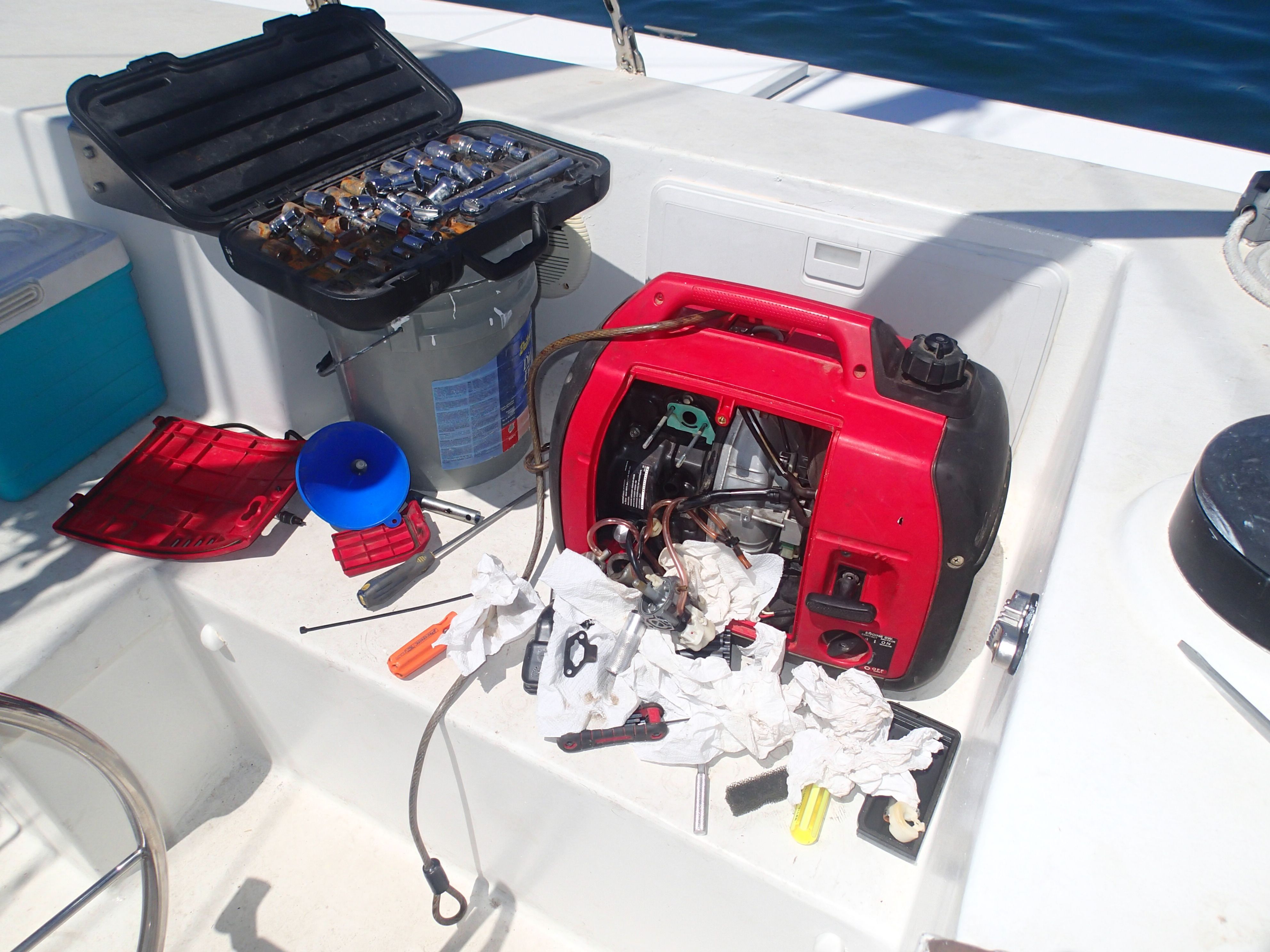
With both wind and solar power contributing to the house bank charging, we found ourselves having to use the Honda EU-2000i gasoline generator less and less - though still probably two to three times per week, which was a big disappointment. I guess the January sunshine in San Diego just wasn't enough for our electrical needs, and the anchorage was a little too sheltered to pull in any serious amperage from the wind turbine.
A lovely part of San Diego for me was the proliferance of my third-favourite bird, the noble pelican. Nothing makes you believe the theory that dinosaurs evolved into birds quite like the long beaks, large wingspans and creepy-good flight ability of these birds.
My second favourite bird was also new to me in San Diego, the Black-Crowned Night Heron.
Unfortunately, I couldn't take a decent photo of the heron that chose the starboard bow of the TIE Fighter as its nightly perch, hunting fish in the teeming waters of the bay. The herons don't have much of a neck, so they constantly look like they're skulking around... the one that visited us every night looked at me suspiciously (accusingly?) every time I went outside to change cabins in the dark. We had many a short conversation, though I never figured out if he/she was actually interested in being friends.
My favourite bird is, of course, my baby sister's daughter, my niece Wren.
One HUGE success for the TIE Fighter was the completion of the Spectra Ventura 150 water maker install! This took me a long time, and though I was able to finish it before we finally left San Diego, it required a swim to install the 5/8" through-hull fitting. I thought I'd be able to handle the swim without my wetsuit, but after jumping in I quickly changed my mind.
With the water maker, now we can make our own drinking water from sea water. This is exactly the sort of thing we've been working towards all this time - with the electricity coming from solar and wind, and the water coming from the ocean (by way of the electricity we just made), we are yet another step closer to self-sufficiency.
Christmas and New Years came and went without much fanfare - Miya and I spent a couple of nights in a hotel downtown to celebrate, enjoying hot showers and poolside drinks, albeit slightly chilly ones. Our Christmas tree was, for the second year in a row, a rosemary bush, and Miya made hearty rosemary bread to ward off the chilly nights.
More to come as I find the time...
San Francisco
Now that we've been in sunny San Francisco for over two weeks, I guess I should blog the fact that we've arrived here safely.
The offshore sailing portion from Coos Bay to San Francisco Bay was mostly uneventful - the weather turned gloomy and damp and the winds shifted to a meandering northerly 10kn, and days at a time were spent drifting along at 3kn. For our new US friends, that's three nautical miles, or a whopping 3.4 miles per hour, and for the Canadians (and the rest of the world) it's a speedy 5.5km/h. Not exactly the kind of speeds that win you any races, but obviously enough we did arrive in SF safe and sound. The single most surprising thing learned during the five-day sail? Minke whales have terrible breath! We had one surface several times within about ten meters of TIE Fighter.
We anchored in the lovely Aquatic Park for the first few days while we got our footing, then motored over to Treasure Island when it became apparent that the Aquatic Park anchorage would be the best place to stay while taking our first aid course and we didn't want to wear out our welcome too early.
That first weekend I had the opportunity to spend a couple of days attending Hackmeet 2011, a gathering of technologists, cryptophiles and social activists at a hack space called Noisebridge near Mission and 16th Street. I got to meet a few folks with whom I'd only communicated online before, and met a few others in the process. I've been describing the event to non-geeks as "...a meet-up of the IT staff for the Occupy Wall Street movement". There were talks about everything from email cryptography to anti-forensics to effective tools for using the internet for social activism, with a particularly memorable presentation about open-source hardware for sex research taking the flow of the conference off into left field for a few minutes. The Noisebridge staff seemed a little bit nervous at the sheer number of people in their space - I'd put it at around 150 at peak - but they stayed calm and everyone was very well-behaved.
Noisebridge itself was inspiring - I really wish something like it had existed when I was a teen. The space was a large upstairs warehouse space in a busy ethnic neighbourhood, with the main area populated with row after row of shelving units jammed with members' personal projects - everything from stencil art to clothing [de]construction to lasers and makerbots and arcane old computer hardware. Honestly, just from the idea of a "hackspace" I would have expected more computer gear, but it was surprisingly free from the clutter of old broken computers that seems to fill every hacker's bedroom. I particularly liked this wheelchair robot - note the "NOT THREE LAWS COMPLIANT" warning posted on the front.
Once the Wilderness First Responder first-aid course started, life got quickly more complicated. The class was held in the Precidio, which was a real treat aesthetically but a bit of a pain to get to every day, with two busses and about a kilometre walk between us and the class. That is, at least until we met Jon and Mark, two classmates who were conveniently staying at a hotel just two blocks from where we were anchored! Jon gave us a ride to and from the class every day, making things a lot easier - not to mention cheaper, those bus fares add up after a while.
One really nice thing was that the bulk of the classroom work for the course was held in a yoga studio in the back of Planet Granite, a gorgeous rock-climbing gym and fitness facility. We were given breaks of ten to twenty minutes every few hours, and about half the class started bringing their climbing shoes every day and spending the breaks on the very extensive bouldering walls. The first day with my shoes I tried too hard to keep up with the children's climbing class and could barely lift my arms for three days after - but with concerted effort over a few days I found myself regaining my former levels of bouldering "skill", climbing most of the V2-rated routes, and finally mastering a couple of V3's. Like any climbing gym, all I could do was watch in awe as lean, skinny pros made their way up V10's and V12's.
The class itself was very hands-on, and we spent about two-thirds of the time in classroom lectures and the rest in 'scenarios', responding to simulated emergencies. Many of these situations involved makeup to make them seem more realistic, which made us feel more confident that we wouldn't panic if faced with similar injuries in real life. Everyone took turns being the rescuers and the rescue-ees, and we all got very comfortable diagnosing and triaging major traumas, documenting vitals and establishing trends, and preparing patients for evacuations whether or not advanced medical help would be available.
Still, the days were long. Miya and I got up each day at 6am to be ready for the 8am class start, and by the time we got home at 7pm we didn't have much energy left for... well, for anything really. Most nights found us asleep before 10pm! This was the first time I'd been in a full-time class since college, and my body had a really hard time adjusting to the change. The fact that the course only gave us one day off during the whole ten days was difficult; we all agreed that one day just wasn't enough time to completely rejuvenate.
The course culminated in a night-time scenario where we were presented with a multi-casualty incident; a plane crash in a heavily-wooded area. We organized ourselves into an incident response unit, performed a search-and-rescue sweep and found and treated all of the victims - all of which were strangers to us, and in full theatrical makeup, with bones and blood and intestines (technically condoms filled with oatmeal, but surprisingly realistic) everywhere. The hardships of such a rescue were magnified when later on it was discovered that the woods were infested with poison oak. I apparently got away unscathed, but many of our classmates - Miya included - had a rough time of it. We spent the next class day washing all of the rescue gear down with Tecnu.
The class is now finished, and slowly we're recovering and returning to normalcy. The boat is anchored at Treasure Island once again and we have a 21-day extended anchoring permit to stay here, though we have yet to decide whether or not we'll still be in the city in 21 days, or whether we'll be headed off to Monterrey, Big Sur, San Diego and beyond. For now I intend to spend much of my time working on contract work and experiencing all that San Franciso has to offer - so far it seems very similar to Vancouver, with the notable exception of my not having had to wear socks for the past week.
What up, San Fran? Send me your activities! I want to go out and do things!
Weather Window!
Lovely and quiet as life in this tiny, remote coastal fishing village has been, after eleven days it's somewhat of a relief to finally pack up the boat and prepare to leave Neah Bay for the open ocean. The NOAA weather forecasts for the next few days show a favourable window, with the gale-force southerly winds that we've been experiencing for the past week subsiding and slowly giving way to gentle northwesterlies, which combined with the dominant currents should give us a safe and quick offshore passage south to San Francisco. We have enjoyed it here, but we're looking forward to being back in an anchorage with easy access to more modern amenities than a rustic general store - and somehow nobody managed to mention the fact that Neah Bay is a "dry community" in any of the cruising guides! I can't wait to have a frosty pint at a yacht club bar in SF.
The sprocket for the steering system came in with unbelievable swiftness - funny how parts shipped from the US to Canada always seem to take a few extra days, while shipping this hunk of metal from Canada to the US took less than twenty hours from the confirmation email! With the help of our new local diver/fisherman/handyman friend Daren Akin, we had the sprocket cut to fit and installed in a matter of hours, and since then the steering has been working far smoother than before.
The weather has been the most stressful part about living in Neah Bay; the return of predominantly northwest winds comes as a huge relief as we wondered whether or not we'd missed our window to head offshore this year at all. For the past few days the winds have been howling day and night - during the day we seem to get gusty winds in bursts of about a half-hour of 25kn winds every two hours, but after dark the winds have been rising to much higher. Strangely, it seems like the only time we've seen really strong winds - 35kn-40kn - has been at 4am... for three days in a row now.
I've been trying a new technique; anchoring from the stern instead of the bows. The benefit is that the TIE Fighter tends to swing less at anchor, less "sailing" far to the left and right with the wind - but I can't really take credit for that. The real reason is that I installed the fancy Wi-Fi antenna to the side of the aft cabin, and apparently once the cabin sides are wet from rain there's no passing a Wi-Fi signal through them. We have to have the boat faced to present the Wi-Fi antenna at the marina a kilometer or so away if we want a signal!
The downside of this stern-anchoring trick is that I have never had to handle a dragging anchor from the stern before - the engine starts just fine, but with an anchor line off the back I would have to be very careful not to back over the line; in an anchor-dragging situation, wrapping a line around the propellor shaft could be disastrous! Combined with the howling winds and rains and utter darkness of the night, I've had a rough time sleeping, even with the anchor-drag alarm set on the Garmin GPSMap76cx on the pillow beside my head. I've left a second anchor rigged on deck, ready to throw over the side at the first sign of dragging - but to my surprise and relief, the Fortress FX-37 anchor has held through the worst of it, without giving a meter!
We've taken advantage of the few days of the fall sun non-rain of the Pacific Northwest to relax, nail down some final boat-readyness projects (at least one project is now literally nailed down) and to explore the areaaround Neah Bay. Yesterday we hiked the little island that marks the entrance to the anchorage and explored a huge, partially submerged barge at the western end of the bay.
Mostly though, we've been working through stresses, finding our centers and getting our heads ready for the upcoming step; arguably the biggest step we've made so far.
Tomorrow we leave offshore. Within the next ten days, we'll arrive in San Francisco.