With less than two weeks until our scheduled departure, every single day is filled with project work! I’ve been trying to balance boat projects with tying off the last loose ends of life ashore, with good, steady progress. Still, I’m faced with having to carefully choose between which projects can be left for the time being and which projects are critical to the offshore voyage portion of our adventure.
the rock that nearly wrecked the boat
I’m definitely feeling “in touch” with the TIE Fighter and the ocean, however. This morning I was awoken by a wake from a passing boat, one which must have been pretty massive because it lasted for far more than the typical three or four waves. After about the twentieth wave or so I figured something was amiss, so I jumped out of bed and checked – sure enough, TIE Fighter was lying perpendicular to the incoming ocean swell, causing her to rock sideways. Usually the anchor line holds her bows pretty much directly into the swell, so this was out of the ordinary. I pulled out the GPS, and just as I suspected, the anchor was dragging.
The anchor I’ve been using lately is a Fortress FX-37. The benefits of a danforth-style anchor are many, but the real value of the Fortress model is that it’s made out of cast aluminum alloy instead of steel. The FX-37 weighs a mere 21lbs, but the holding strength is reputed to be that of a steel anchor at least double its weight!
The biggest downside of the folding anchor model is that if the anchor should fail to fold, it ceases to work. This morning I was nearly blown onto the rocky shore as a result of a little one-inch rock getting wedged between the anchor flukes and the shaft! Fortress anchors may have the best holding power in their class, but they don’t handle being re-seated due to shifting tides or winds very well. I’ll be spending some time re-thinking the anchoring situation in the near future, let me assure you.
Update: when I went down to Seattle to help Miya move out of her apartment and onto the boat fulltime, disaster struck – I received a phonecall from the Kits Beach lifeguards saying that the TIE Fighter was about 100m off the rocks and headed in fast! Fortunately a friend from another boat rushed out and deployed a second anchor for me, and a phonecall to my good friend Simon had him scrambling to rescue the boat. He was able to pull the anchor and head in to False Creek, albeit with some hassle as the new fuel polishing system apparently siphons fuel from the engine lines if the valves aren’t closed properly! He made it as far as the Burrard Bridge before the engine conked out, and had to enlist the help of the Coast Guard to tow the TIE Fighter in to safer waters.
Lately it’s been difficult to find time to post here on the blog, as things have been moving forward at a fantastic (or even alarming) rate. It has come to my attention that I haven’t even posted about the moving-forward Plan, and a deadline is approaching fast!
One major change: Miya and I have gotten back together. Though at times we’re at odds with one another our bond is fierce and beautiful, and we’ll face the upcoming years shoulder-to-shoulder. She will soon be again living full-time on the boat.
So! Without further ado, the Plan:
Stop being a directionless cubicle drone
Purchase and move onto a sailboat
Live aboard in Vancouver
Make the boat offshore-ready – almost complete
Sail south until the water gets warm
Continue sailing with no destination or schedule until it stops being fun.
Obviously with a plan this grand in scale, there has been constant hustle on both of our parts, sorting out the remaining ties to the land, legal considerations, health and dental priorities, and of course continuing to repair and upgrade the s/v TIE Fighter to a point where she’ll be stable and strong on a long offshore voyage. I’ve come to terms with the fact that the boat will never be “finished”, but we’re almost to the point of “good enough”.
There have been many jobs on my list for the past few months, and slowly but surely they’re being finished. All of the major jobs fall under one or more of three major categories, which are, in order of priority:
Ensure the boat is safe,
Ensure the boat is sustainable, and
Ensure the boat is comfortable.
electrical system, now with solar
One job which I have nearly completed is the addition of two massive solar panels to the roof of the aft cabin – well, I have nearly completed it, anyhow. The wiring is all in place, the solar charge controller is mounted and configured and the system is tested and active… but the panels aren’t yet mounted on the boat itself. I still have to figure out how to properly attach them, and the hardware available just isn’t up to the kind of abuse the ocean tends to throw at things! Hopefully this weekend I’ll be able to sort that out, and with around 20a of current flowing into the batteries on sunny days we shouldn’t have to run the generator anywhere near as often anymore. This both removes a point of failure (the generator could die, leaving us without power) and adds to the boat’s sustainability.
Another job which has yet to begin is the installation of a watermaker. While not critical, in the strictest sense, the watermaker will remove our need for constant connections to the shore for fresh water. Here in Canada that just means motoring up to a nearby marina for 300l of fresh water from the city supply, but elsewhere that might mean getting tainted water, or more likely having to purchase water in disposable plastic jugs – either way leaves a bad taste in our mouths.
Miya, apart from all of the stresses of packing up a life on land to pursue a life on the ocean, has been working to make the boat a more beautiful place to live. She’s converted the spartan master and crew berth situation into what she calls the “master nest” and the “guest nest”, lined with blankets and pillows and hung with silks like some Afghani tent. She’s crafted curtains for the windows and a privacy curtain for the head, and begun sprouting miscellaneous seeds in the kitchen. Together we built a box across the back of the aft cabin, housing eight large plastic bins, in which we will eventually plant a garden full of green leafy vegetables.
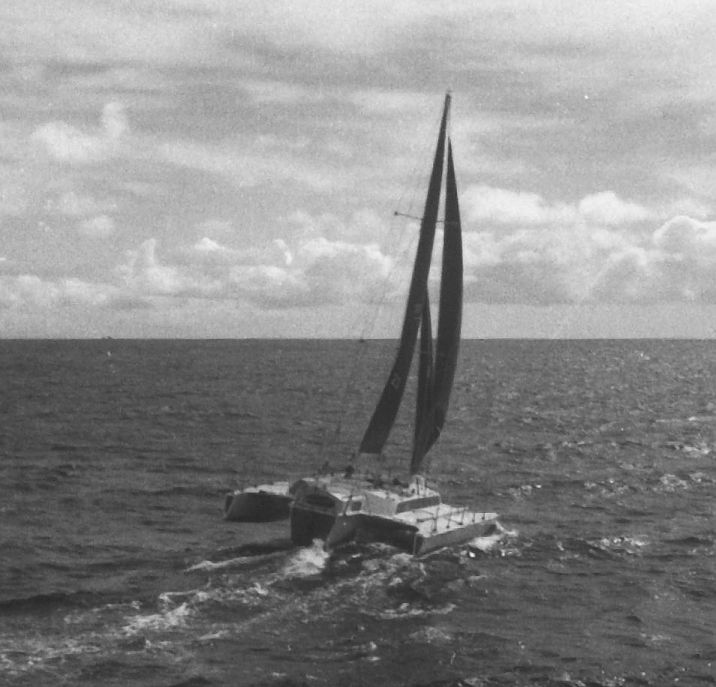
a Searunner (not TIE Fighter) close-hauled near Hawaii
There are projects that won’t be finished before we leave; the boat still has bare exposed ceilings, for instance, and rough uncarpeted floors. Some of the paint from last years’ intense labour in the Shelter Island boatyards has chosen not to stick to the primer, and there are ugly scuffs and scrapes and chips around that make us wince to see them. The anchor line is still tied to a cleat at the bow, retrieved hand-over-hand instead of a proper windlass and bow roller, and the edges of the bow have been worn through the fiberglass down to the bare wood underneath in several large patches.
Still, most of the remaining projects are cosmetic, and the vast majority of the critical tasks are already complete. The resounding chorus of cruising sailors remains “just go“. There are plenty of sailors who spend their lives getting ready for a great adventure only to discover that they’ve waited too long and now they’re made fast to the shore by family or work obligations. There are no projects left on the TIE Fighter than cannot be completed at some marina in Mexico, probably for significantly less than they’d be up here.
On Friday July 8th 2011, I said goodbye to a dear friend, one who stood by my side for far longer than was expected of her. Her passing was with some sadness, but her memory will live on.
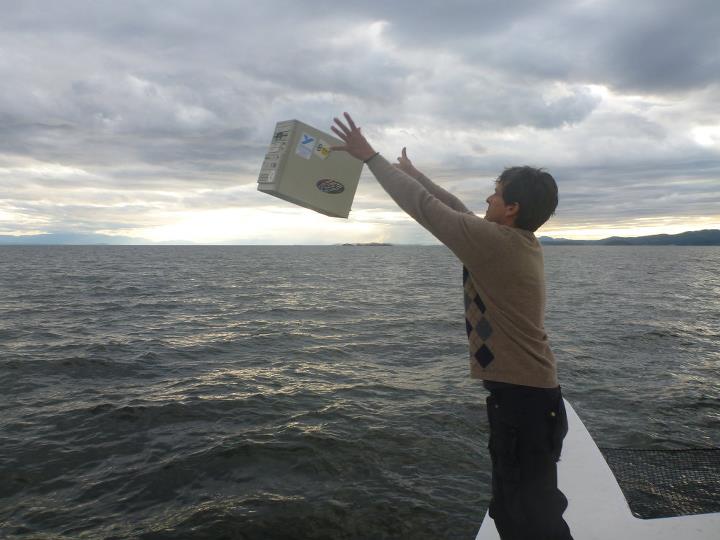
delivering the eulogy
Schaltwerk.riotnrrd.com began her life in a Magitronic assembly house on September 25th, 1994. She was a very fast machine for her day; although Pentium processors had begun to arrive in the local computer stores they were still thousands of dollars, and as a 486DX2-80 boasting a 40MHz bus she gave machines twice her price a solid run for their money. I worked at the time at the larger of the two local computer stores, and as such I was able to source a single 16M RAM SIMM for far below the retail price. I (or rather my father) paid $800 for the RAM alone!
Schaltwerk spent the next few months running OS/2 Warp, supporting an active Telegard BBS and many, many hours of Doom, Doom 2 and Heretic deathmatches over 14.4k modem – and later over a local ARCNet network, cabled through my parents house with chained 25′ phone extension cords from the dollar store. When I left for college in January of 1995, she came along as my primary college computer, the task for which my father had intended her. At college she continued to support the BBS, running Renegade and then Iniquity software, but the BBS was often suspended to allow me to spend long nights mastering Autodesk 3D Studio and Photoshop. At some point I also discovered Linux, and when a friend began handing me surplus computer hardware from his work, I was able to add several more hard drives and increase her RAM to a whopping 40 megabytes. I would give a lot for photos of my workstations at this time, but as far as I know none exist.
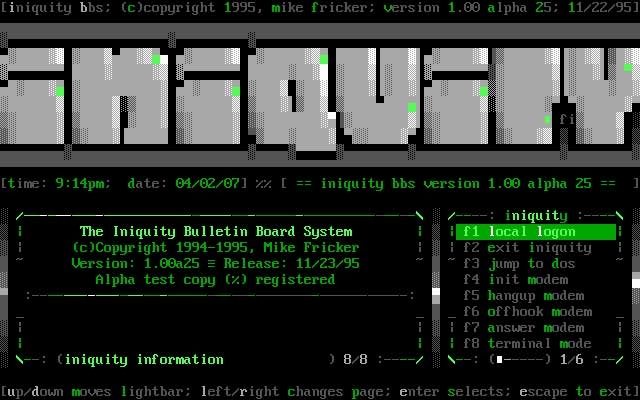
the SysOp screen for iNiQUiTY BBS
As college came to a fruitless end – a diploma, but zero job prospects – I took a job as a graphic designer for a college web project. Schaltwerk was the main graphics workstation, putting in months of midnight-until-dawn marathon Photoshop sessions. I was also working hard on my own Linux interface design projects, working closely with the Enlightenment window manager team.
In about March of 1997 I moved back to Sussex and took a government-funded web design position. I was offered a Pentium workstation of my own, but after struggling with drivers and software installs and an unstable machine, I moved Schaltwerk into the office to be my primary workstation. This didn’t last too long, as I couldn’t deal with the lack of computer at home! Schaltwerk, nestled in her basement lair in my parents’ house, had sprouted two more monitors – a monochrome display addressed with a second video card and a Wyse 60 dumb terminal attached to the serial port now accompanied the main SVGA monitor. One mouse, two keyboards and three displays – pretty fancy stuff for 1997!
the first Enlightenment theme designed on Schaltwerk
In 1998, my friend Darren, my baby sister Jen and I packed all of our worldly possessions into Darren’s car and drove across the country from New Brunswick to Calgary, Alberta. We only had about $800 between us, but with one minor speedbump we managed to get settled and employed and much to our parents’ collective surprise, we made a go of it. After we all landed jobs at a major ISP, Schaltwerk became a networking powerhouse, having half a class-C subnet (128 addresses) of real internet IPs delegated to her for several months! Of course, at the time I really didn’t know what to do with that kind of resource, so I occupied myself learning Linux networking and DNS, and Schaltwerk got her first live, static-IP instances of BIND, Sendmail and Apache. Thankfully by this time I had gotten over the debilitating CircleMUD addiction I picked up in college!
In early 1999, my new girlfriend and I moved into a new house with our friends Ivan and Andy, who were running what was at the time the most technologically advanced Shoutcast station in the world, BeNOW. I became their network administrator, and together we whipped eleven machines and hundreds of gigabytes of storage (a big deal at the time) into shape. Schaltwerk took over as the router and firewall, also handling DNS and mail services for the BeNOW and riotnrrd domains, as well as primary and secondary DNS for dozens of other domains.
Jonnay's desk, Schaltwerk's home for years
In late 1999, I had a job offer in Vancouver, so we packed our things and moved into a geek house in East Van. Schaltwerk stayed in Calgary and went to live with my friends Jonnay and Shell, where she spent the next few years humming away under Jonnay’s desk. During this time, she remained on a static IP address, becoming the primary DNS service for scores of domains, handling primary and backup mail services for dozens of others – but most importantly, she became the webserver for a number of domains. The most popular by far of any of the websites hosted on Schaltwerk was eastvan.bc.ca – a Slashcode site boasting ‘News For Crackheads – Nothing That Matters‘ which quickly gained notoriety as a gathering place for Vancouver’s dot-com underbelly. Most of the people I call close friends can trace their roots in our friend group back to eastvan.bc.ca. During this time, Schaltwerk also hosted the Black Hole Club email list, gathering a sizeable portion of Vancouver’s electronic music production scene together online.
In 2001, we moved to Costa Rica, leaving Schaltwerk with Jonnay and Shell – to her credit, Schaltwerk worked almost completely without interference from her hosts, only requiring several reboots and a hard drive replacement over the four or five years that she spent in their home office. In 2003 we moved back to Vancouver, moving into a house on 10th Avenue. Schaltwerk became part of a cluster of media and internet servers driving the geek house, which we dubbed ‘Pod6’, a reference the Adult Swim cartoon ‘Sealab 2021’. For a while Schaltwerk ran the website, but soon the site outgrew the humble 486 and we built an upgraded machine, relegating Schaltwerk to just email and DNS.
the Pod6 network operations center, Schaltwerk top left
In 2005 we purchased our first home and Schaltwerk took her new position – alongside a server from Jonnay and Shell, in reciprocation for their years of hosting – in a basement closet. Too slow now to support much in the way of modern web services but still providing email and DNS services for dozens of domains, Schaltwerk also provided SSH shell endpoint access, allowing my friends and I to casually tunnel through even the fiercest of corporate firewalls.
In 2007 I began the long process of migrating all of the services off of Schaltwerk and onto a third-party host, Dreamhost. Many domain owners had to be notified, many small webpages had to be migrated and dozens of cryptic user scripts had to be decoded and disabled or ported. By 2008 almost all of this work was complete, and Schaltwerk remained online but rarely used until April of 2009, when I moved out of my basement and aboard the S/V TIE Fighter. I could not bring myself to just throw away a machine with such a history of faithful service, and so I brought her aboard, intending to find a way to celebrate her life.
goodbye, Schaltwerk. you will be remembered.
Schaltwerk gave me fifteen solid years of faithful work, far more than can be reasonably expected of a PC. Her only fault was her lack of processing horsepower, and while I will admit that I entertained fantasies of one day putting her back in service as a terminal somewhere, life on a sailboat is not kind to electronics, and a slow death in a storage locker just wouldn’t suit her. With a few respectful words about her life and service I sent her to her final resting place in the ocean, about a kilometer off the Sunshine Coast.
I have to admit it took a few minutes for the lump in my throat to pass.
My brand-new, custom-built folding bicycle now lives at the bottom of English Bay, just off of Kitsilano Beach.
It happened a week ago actually, on the first of the month. I was headed across calm waters in my zodiac, looking off at the beach, when suddenly I found myself tossed upwards by an unexpected wake. A wake from a large boat is usually three large waves in a row, and this one was no different – the first wave, hit at an angle, pushed the zodiac up and over, the second hit at an opposite angle, causing my footing to slip and my butt to descend into the dinghy, and the third threw me back in the other direction… and bounced my bicycle overboard. I scrambled across the dinghy and lunged for it, but it sank immediately into the murky waters.
I immediately stopped the engine and pulled out the only navigation tech I had on me – my iPhone – and tried to get a GPS fix. I was able to, but with the inaccuracy of the iPhone GPS who knows just how close I was. I immediately went back to the boat and grabbed my Garmin GPS, some rope and a grappling hook, and spent the next hour dragging the bottom trying to snare the bike – but I had no luck. I tried with the rope and hook for a few hours the next day as well, but still no bike.
Butch in the dinghy, laying out floats
In retrospect, the navigation tool that I should have used on my iPhone was much simpler – that close to shore, snapping a few photographs would have made it much easier to triangulate the position of the bike. I could have just lined up, say, the buildings downtown, or trees on the shoreline, or the end of Stanley Park with a building on the North Shore.
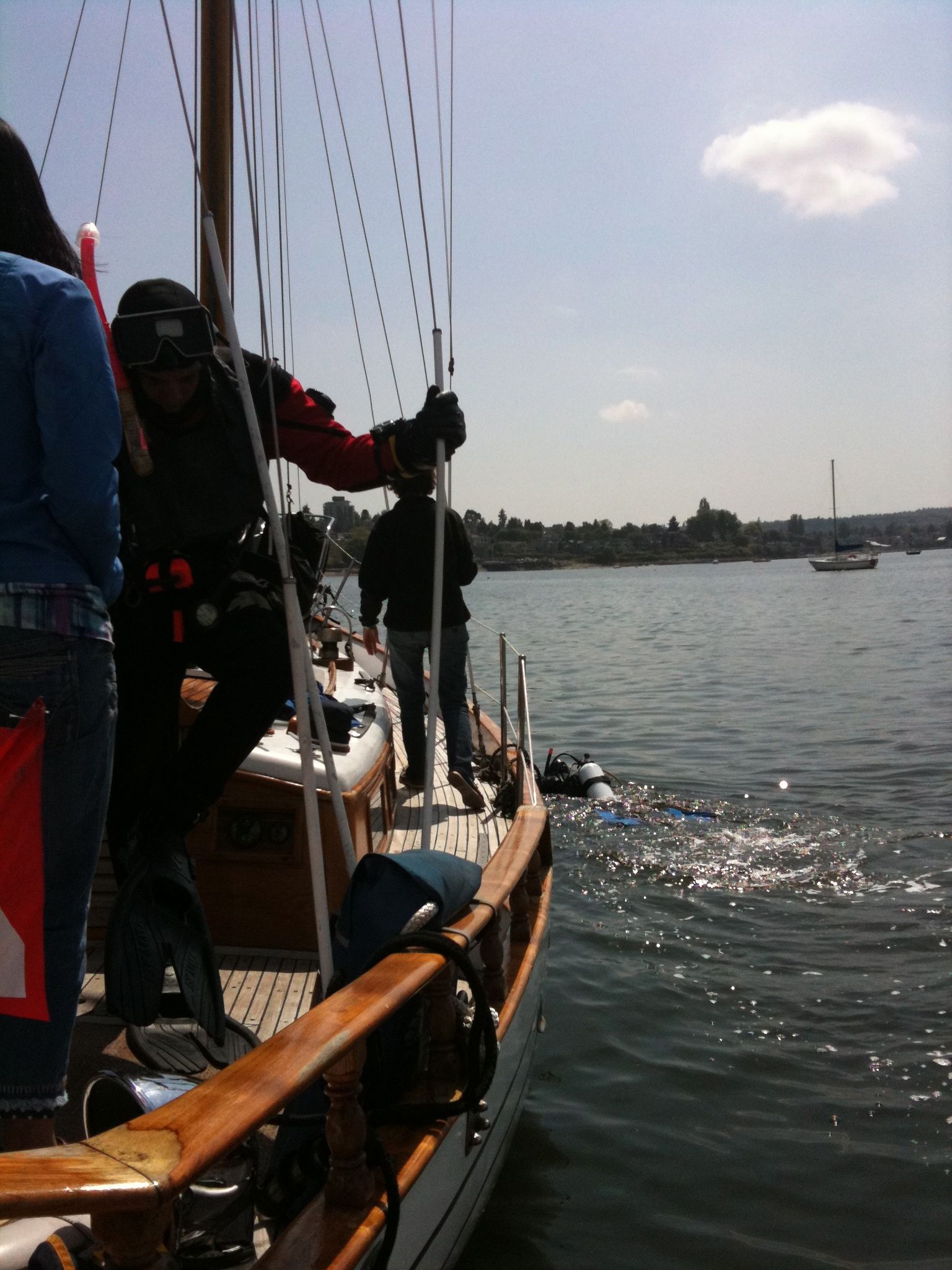
I sent out a message to the Bluewater Cruising Association mailing list, and received a few replies, and from those I contacted an ex-Navy diver named Joseph who offered to do the dive for a nominal fee – which I’m sure barely covered their expenses, and definitely not their time! Yesterday Joseph and his crew came out on his sailboat, Southern Cross, to search the bottom for me.
We first rowed around the area laying out a grid of buoys to provide a search area, and then the divers criss-crossed the area searching for the bike, but due to a combination of terrible visibility and strong current they had no luck. The two divers each expended two bottles of air, for a total bottom time of around four hours each, so it certainly wasn’t for lack of trying! Thanks again Joseph, Nelson and Butch for your efforts, it really meant a lot.
Nelson in the water, Joseph about to dive
I haven’t entirely given up hope, to be honest – there are at least two remaining options. For one, I could use a fishfinder or sonar and scan the bottom carefully, looking for a bike-shaped lump. The ground around there is mostly featureless mud, with very few rocks or outjets of any type, so a bike would hopefully stand out. If that fails, I may have to approach the source of the wake, the cruising boat ‘Abitibi’, which might well have insurance to cover just such occurrences – apparently BC marine law says that loss or damage to property from wakes are the responsibility of the vessel causing the wake. We’ll see, I guess. I’d happily offer a reward for her safe return!
And it figures, too – the ONE time I head out in the dinghy without securing my bike with a rope or a bungee tie-down. I guess things could be a lot worse; it could be the one time I forgot to fasten my seatbelt on the highway, or the one time I forgot to look both ways when crossing the street. Still, this was a very expensive and painful lesson on the unforgiving nature of the sea.
On a further and very sad note, my girlfriend Miya and I ended our relationship this week. Entire volumes could be written about this, but some parts of life just aren’t meant for the internet. Miya is an amazing human being, and I wish her nothing but happiness and love.
A confession: I am a bike nerd. I have never actually owned a car, and at the rate things are going there’s a distinct possibility that I never will.
As a bit of backstory, I grew up in New Brunswick where having a car meant freedom but also slavery, or at least indentured servitude. Insurance rates for young male drivers were insanely high, only dropping to reasonable rates after age twenty-five. If you wanted your own car you had to either have very generous parents, a (non-existant) high-paying job, or you had to spend all of your free time working at whatever minimum-wage job you could land. Since my folks were big on teaching me the value of a dollar (thanks, by the way), I resigned myself to the fact that I wouldn’t own my own car until after age twenty-five, and drove my mother’s Mercury Tracer hatchback around whenever she’d let me.
my first adult bike, a sketchy hand-me-down commuter
Just before I actually turned twenty-five, I moved to Calgary, Alberta. Calgary is very much a car-centric city… unless you live and work in the downtown core, which is where I along with nearly all my friends lived and worked. Combined with a great public transit system, there wasn’t really any need to own a car. That ‘downtown’ mindset prevailed through a move to Vancouver, which also has a great public transit system. Still, walking and transit are restrictive, and in about 2005, inspired by the fitness and social agility of a few friends, I decided to become a “bike person”.
Once you’ve pushed past the first six months of getting into half-decent shape, and you’ve realized that suddenly any point in the city is reachable by self-propulsion (often faster than by any other method of transport), then – then comes the realization that bicycles are simple machines, and with a bit of maintenance or upgrading they can be strong, reliable friends. Very much like Robert M. Persig’s famous message, there is much joy in keeping the machines tight and tuned, and I fell headlong into the world of bike-nerddom.
my first 'real' bike, built by Mighty Riders
My first adult bike was an ancient, beat-up mountain bike given to me by a friend years prior, that I had lugged around from apartment to apartment but never really ridden. Once I made up my mind to get off the couch, I rode that bike to and from work for about a year. I slowly upgraded from fat knobby tires to ‘slicks’ to ‘skinny slicks’, learning as I went that my initial idea of the “perfect Vancouver commuter bike” was quite far off from reality. Sooner or later, foot retention became an obvious choice, and fenders became beautiful to me.
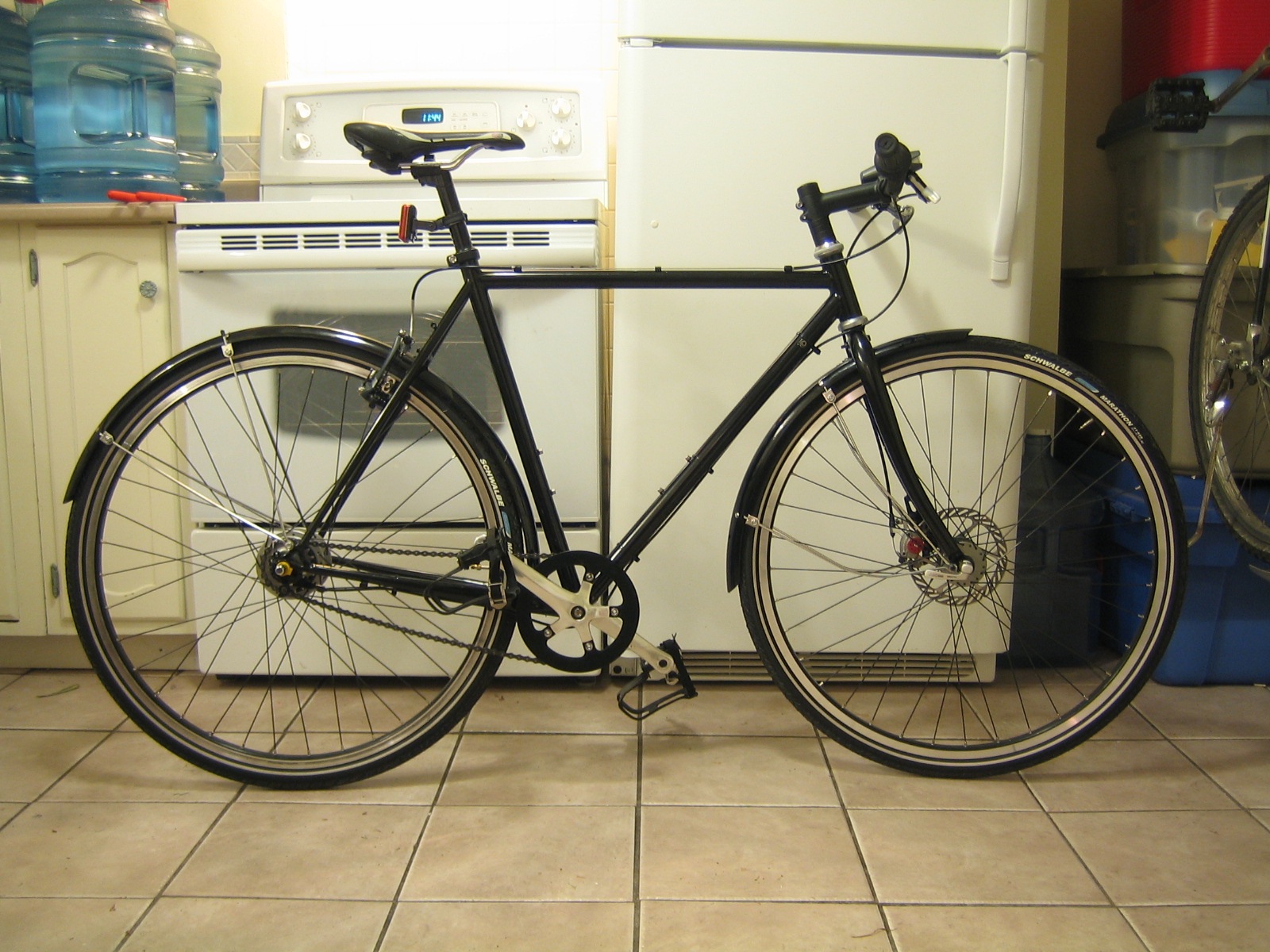
Then one rainy day I slammed into the back of a BMW – at the time I was sure it was the driver’s fault, but upon later reflection I’m not so sure it wasn’t all me. I rode off (mostly) unharmed, but later I found that the impact had cracked the age-brittle aluminum frame of my commuter bike, and it was no longer safe to ride. I knew by this time that a bike would continue to be a big part of my life, so in early 2006 I bit the bullet and had Ed and his wizards at Mighty Riders build me the “perfect Vancouver commuter bike”. It was a steel Surly Cross-Check frame, built up with a Shimano Nexus-8 internally-geared rear hub and a disc brake on the front wheel. Nearly weatherproof!
my first track bike build, the Creamcycle
However, within a year or so of riding the new bike, I was bitten by the track bike bug. I went out to the Burnaby Velodrome with Trent and rode a few times on the steeply-banked wooden track, but concluded that while track racing wasn’t really for me, riding “fixed gear”, with no gears and no coasting, definitely was. It can be difficult to explain the zen state of riding a fixed gear bicycle – it feels a lot more like running than riding a bike, since you use your legs to both accelerate as well as modulate your speed. If you want to go slower, use your leg muscles to force the bike to pedal slower. The feeling of riding a perfectly-tuned fixed gear bicycle is incredible, as though this simple, elegant, rattle-free machine were more an extension of your body rather than an accessory; more a katana than a shotgun.
So, I built up a track bike from parts purchased on eBay at a steep discount – a KHS Aero Track frame, Sugino cranks, and a wheelset built up around Phil Woods track hubs – and rode it hard for the next few years. I have to say that I really enjoyed the act of building a bike up with my own hands, knowing that it would carry me reliably from home to work and anywhere in between. I named the bike ‘Creamcycle‘, shelved my black bike for rainy days, and put several thousand kilometers on her as my main method of transportation.
'rad playa cruiser' before/after shots - click for big!
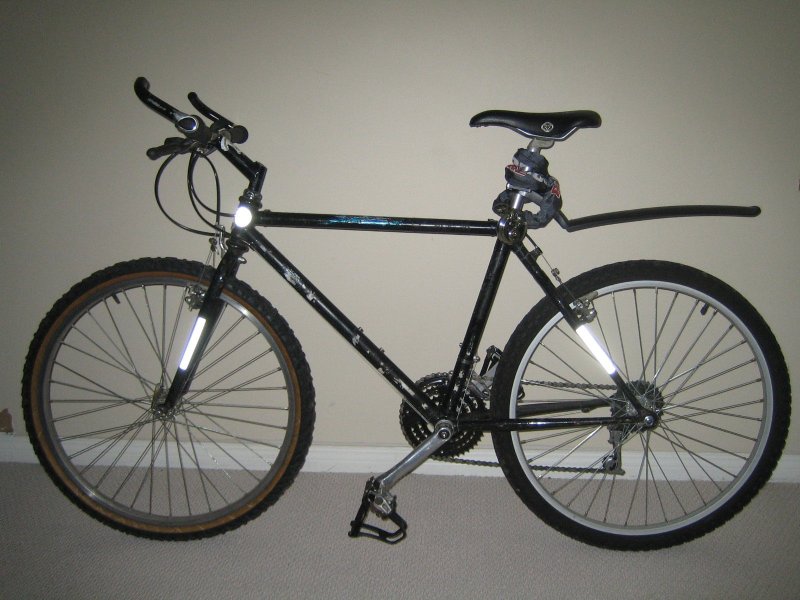
As the summer of 2008 drew nearer, the Burning Man Festival approached. A bike is a necessity in the Black Rock Desert, but not a good bike as the desert environment kills bikes in very short order. I set out to find an appropriate bike to modify for the task; I searched for a long while, but was unable to find anything that was even remotely up to the job. Eventually I widened my search to include bikes that would require a complete rebuild, and at a Main Street junk store I found the black mountain bike in the photo on the right, for which I paid a whopping $25.
I tore the bike down to the bare frame, sanded and painted it, then reassembled the bike with spare parts and supplemental bits, buying old, used parts as much as possible. I spent many hours in Our Community Bikes learning the ins and outs of rebuilding a bike, but even with the hours of shop time the grand total in costs for the bike ran me somewhere in the vicinity of $150, with the most expensive component being the new basket at approximately $35.
The design of the rad playa cruiser was carefully considered – wider ‘beach cruiser’ tires to handle the sometimes-soft surface of the Black Rock Desert, cruiser handlebars and flat pedals to enable riding in all forms of dress and/or states of sobriety, lock washers on all bolts to prevent bits shaking loose, and extra-thick grease on all the (repacked) bearings. In my opinion however the most important feature – and incidentally the most inexplicably absent from the vast majority of playa bikes – are the BMX-style stunt pegs on the back axel. With the stunt pegs, I can ‘double’ someone on the bike if needed. How useful is that?! “Heading to the temple? What a coincidence, me too! Hop on, baby!”
'ghost', a vancouver city bike through and through
On a roll at this point, the next bike I built was a singlespeed road bike for a close friend who was still riding her hand-me-down mountain bike, similar to my original commuter. We picked out an appropriately-sized bike together at a bizarre private bike junkyard-slash-workshop on Main Street, getting a better price on the frame by sitting on the shop floor and stripping off all the components and leaving them with the previous owner for resale. Then, using mostly parts from my closet and a decent track wheelset found on Craigslist I built up “Ghost”, a sexy little number well-suited to both the the streets of Vancouver and the rider for whom it was built.
Life on a boat is very hard on a bike. The constant exposure to salty ocean air accelerates corrosion, and even though the TIE Fighter has a great deal of storage, fitting a full-size bicycle into the storage lockers in the amas wasn’t always easy or even possible. For at least a year after moving aboard I had my black “perfect bike” stored in an ama and the Creamcycle up on deck for near-daily use, but slowly the weather began to take its toll and I watched as she began to lose her luster, with the deep scratches from regular (ab)use turning from silver to the darker orange of rust.
goodbye, creamcycle. you were a good bike.
I put the Creamcycle away in an ama and began using the black bike, but within a month of making the switch back to a geared bike I made a fatal mistake and left my bike – well locked, mind you – at a bike rack that I should not have. At some point in the night, a thief made off with the rear wheel and handlebars of my beautiful bike – incidentally the most expensive components. I researched replacement parts for a while but sadly concluded that I don’t need two bikes, and that the best answer would be to sell the remaining carcass of the black bike to some bike nerd friends who would build her back up and put her to good use.
Finally, earlier this year I heard about Montague Bikes, a company in the States that makes folding bicycles with fullsize wheels! I had looked into folding bikes several times, but after trying a few I came to the conclusion that the small wheels on the average folding bike are better suited to short trips to the store, and not so much as a primary means of transportation around a city. With fullsize wheels, however, a folding bike could definitely solve the problem of storage (and, by association, weather-resistancy), while continuing to be a solid means of transport.
The Montague Boston turned out to be the be-all and end-all answer to my problems. Priced at around $800 after taxes and shipping, I could strip all the components off of the Creamcycle and build up a new bike around the Boston’s folding fixed-gear frame, then build up the Creamcycle with the Boston’s components and sell the resulting bike on Craigslist, minimizing my total expenditures. Almost all of the Creamcycle’s components fit onto the Boston frame without hassle!
the new ride, 'harlequin' - click for bigger
The result, show here in all her glory, is the best bicycle I can come up with given my style of cycling and difficult storage and transportation needs. The new bike, named ‘Harlequin’, folds in half to make the row to and from shore easier, and when folded she stows away quite handily into a wing locker on the TIE Fighter. The first few weeks with her were a little trying, as I slowly worked out the kinks in fit and sizing, tightening the bits that creaked and rattled and replacing any components showing signs of rust with similar components of stainless steel, but I think she’s finally out of the woods and settling into the final configuration that she’ll keep for the next few years.
So far, I’m very pleased with the new build. ‘Harlequin’ is a fixed gear, with a gear ratio of 49/17, giving me 75.4 gear inches, or 32.6km/h at 90RPM. To date I have not met a hill in Vancouver that I cannot climb – though I know better than to brag the same about the North Vancouver hills!
Longer term, we’ll have to see what happens. I doubt I’ll be on nicely paved city streets and bike paths much in the next few years, so perhaps the racing wheelset and fixed gearing will end up being a mistake. Still, so long as I’ve got a beautiful bike I know I’ll find any excuse to ride around town… especially with the summer approaching so fast!