What I Did On My Summer Vacation – August Edition
Given that we're a few hours away from 2011, I guess I should probably clear this posting out of my 'drafts' folder! This is the third and last installment of the 'Summer Vacation' blog series; the series of photos showing the brutal amount of work done to Tie Fighter over the summer months.
If by some chance you missed the June and July editions, I recommend you read those first. Without further ado:
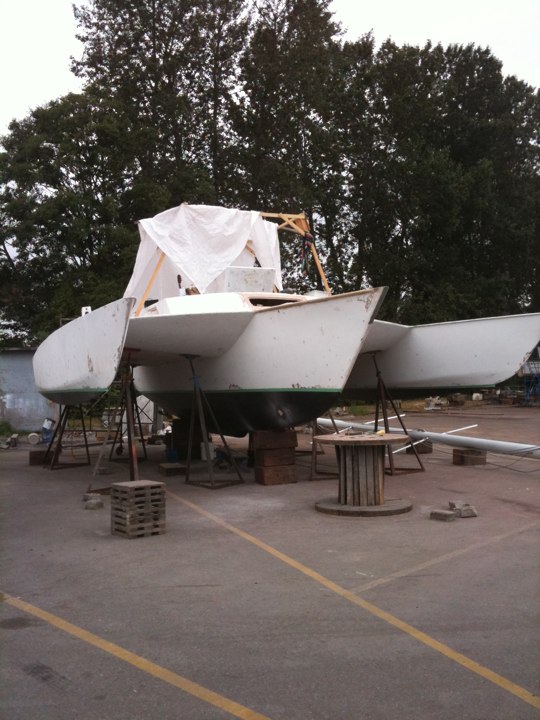
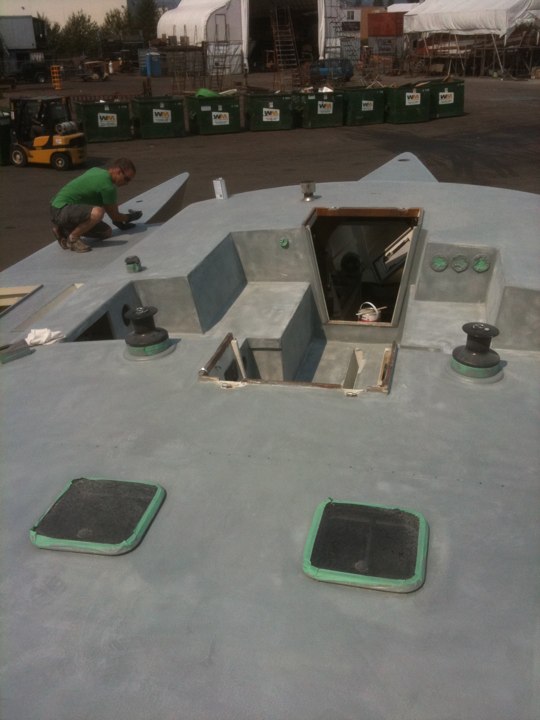
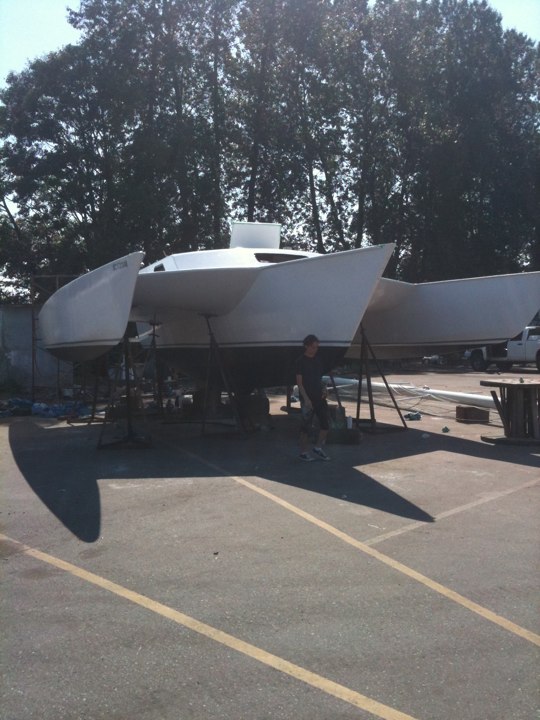
With the sanding finally finished, it was time to re-tape the hull and apply the primer paint. A darker shade of gray paint was chosen, because while white paint reflects the visible spectrum of light and doesn't absorb heat, it still allows ultraviolet light to pass through which will eventually destroy the fiberglass. The pigment in the gray primer absorbs the UV light, protecting the fiberglass underneath.
In this photo you can also see the patched hole in the hull near the main bow, where I removed and replaced the oddball old, seized 2" ball valve for the head output with a proper 1.5" stainless valve. While I had her out of the water I replaced all of the old ball valves with new stainless valves, and removed and sealed up two that weren't used anymore... the handle on one of those ball valves had rusted completely off and the outlet had been capped off with a copper pipe cap. I have no idea what that through-hull was for originally but it obviously hadn't been used in years and was a liability.
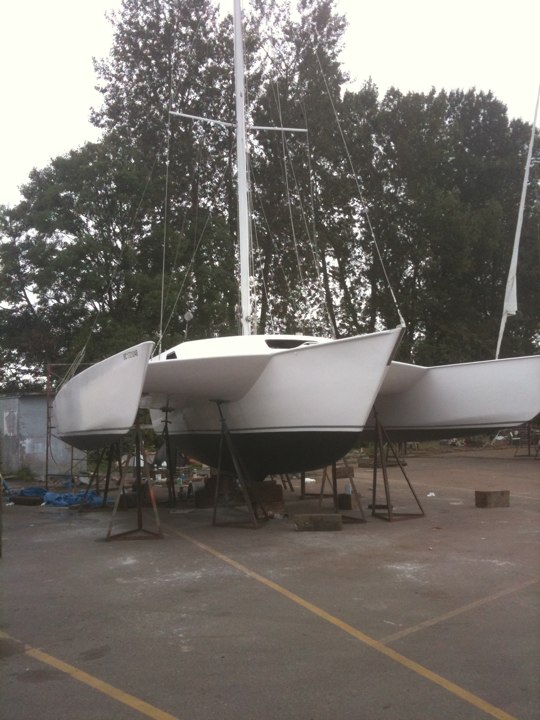
This is what Tie Fighter looked like primed with the military gray paint. I loved the way she looked, and if it were possible I would have left her this way - the problem is that as a wooden boat, she has to be painted white. Anything darker absorbs heat, and causes the wood hull to expand and contract, which will eventually cause the fiberglass to separate from the hull. If that happens, moisture (via condensation) will form between the fiberglass and the wood, and eventually the whole boat will rot from the inside out. So yeah. White.
Pity though! I wished I could have just painted a big white number on the side and left her this way - she'd look like a Canadian warship!
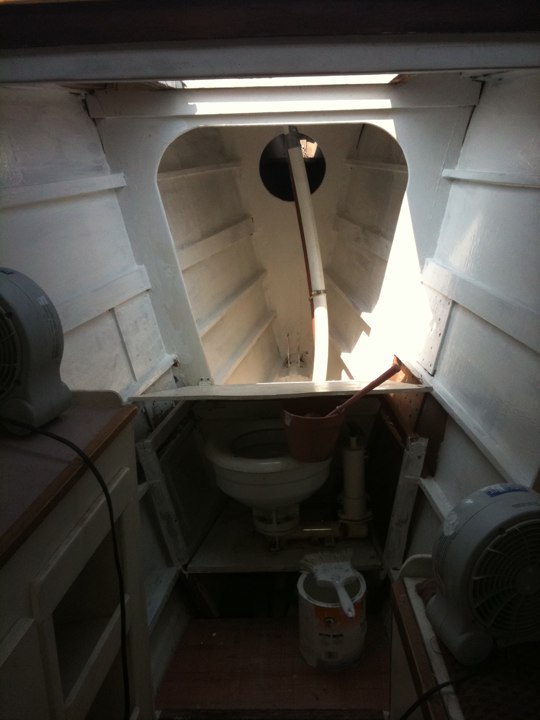
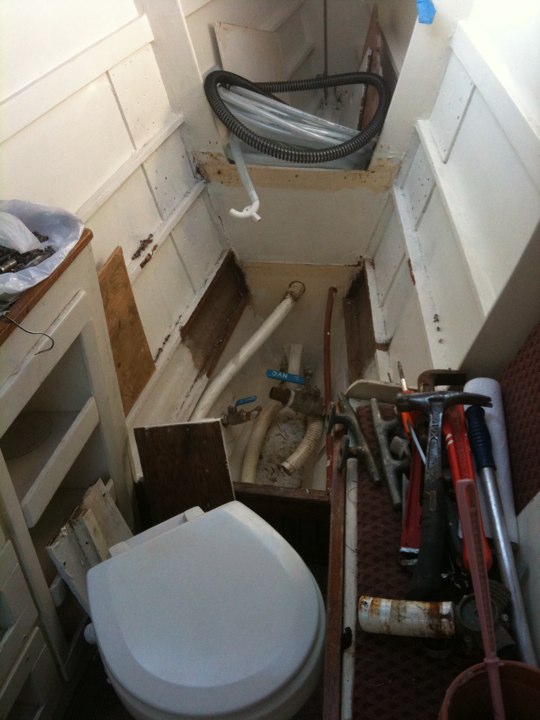
While she was up on the hard I might as well use some of the extra epoxy paint to update the insides... here's the head, prior to ripping out the toilet, pedestal, floor and... well, everything really. The head is much nicer now, as you'll see in later photos...
After the first coat of primer went on, the whole boat had to be sanded again and wiped down with solvents before the second coat.. Those sanders went through hell and back, and the solvent fumes made us dizzy and melted several pairs of rubber gloves.
In the background you can see that it's garbage day in the boatyard; all the dumpsters are being lined up right across from Tie Fighter, so that the garbage trucks could spend an hour making a huge racket at 5am. By August we didn't even hear them anymore - after long hard days in the sun, sleep was deep.
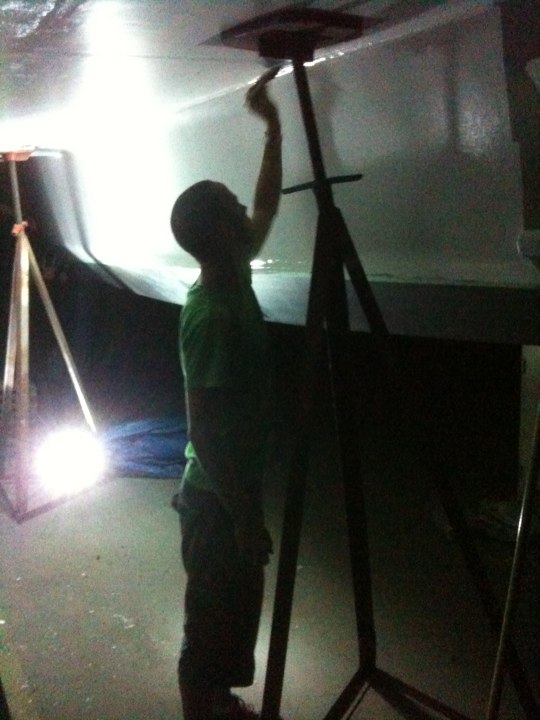
Once the second coat of primer was on and sanded, it was time to put on the first coat of the finish paint, Interlux 'Brightside' white. The paint is a single-part polyurethane - which we now know isn't a good thing to put over top of a two-part primer (ie, paint that comes in two cans, a base and an 'activator', which need to be mixed together before application). Brightside gives a very professional-looking finish when "rolled and tipped"; first the paint is applied with a roller, and then you lightly brush over it with a foam brush to knock out all the tiny bubbles, leaving a sexy, glossy finish. When we finally figured out how to do it properly we worked long into the night painting the hulls, fighting off the swarms of mosquitoes from the nearby swamps that showed up every night as soon as the sun went down.
Within a couple of days, the whole boat was shiny and white. At this point, however, catastrophe struck - the paint on the bottom and hull was drying properly, but the topsides didn't seem to be drying at all!
I don't have clear memories of the next few days - I do remember being brought closer to tears of frustration than I have been in many years. Dark times indeed.
At least the paint on the hull sides and bottom seemed to be drying properly... the primer used there had been a two-part epoxy primer by Interlux, but the topside primer was a two-part epoxy from a different company, and as far as we could tell it didn't dry the same as the paint on the bottom, and the off-gassing of the primer drying caused "solvent entrapment", causing the Brightside to still be tacky three days after application.
We had no choice but to sand all the new white paint off and start over from the primer again. Two more solid days of sanding nonstop, and we were back to square one. Sanding gummy, partly-dried paint is way more work than sanding old, dried paint, and we went through hundreds of sanding discs.
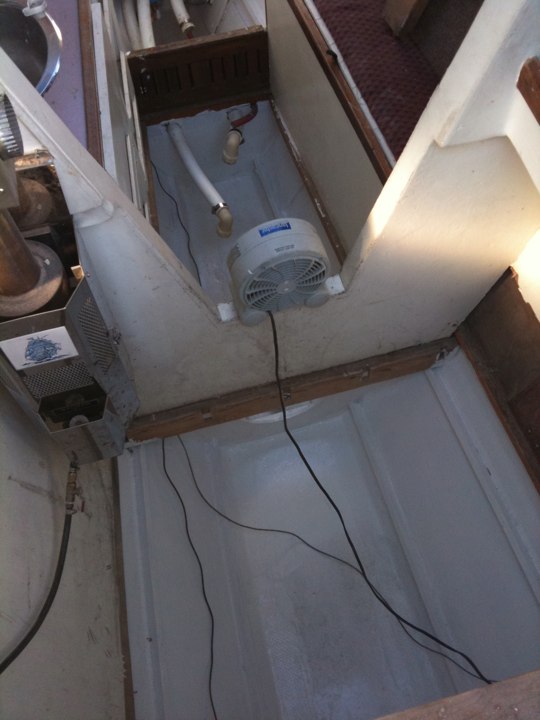
Since there were three of us sanding, but only two sanders, we took the time to gut the bilges in the forward cabin and apply a couple of coats of thick, tough Interlux 'BilgeCote' epoxy paint. Wow - the bilges went from a dark, dirty, scary gutter to a reasonably nice place for extra storage!
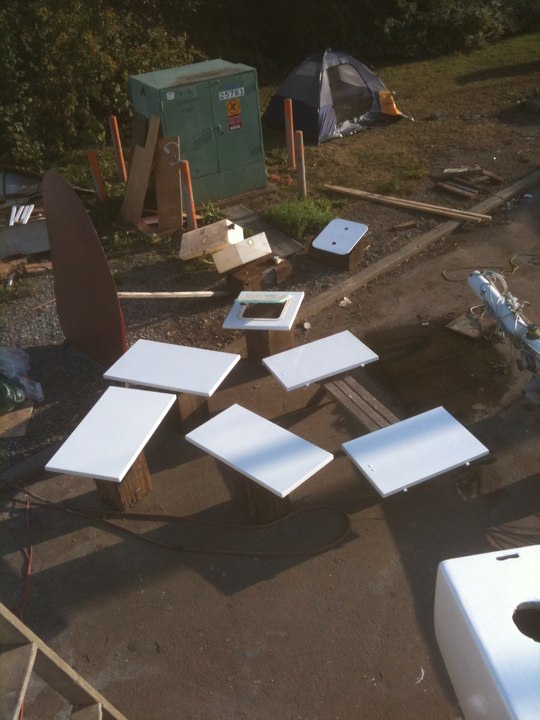
I had nearly forgotten about the hatch covers - all of them needed minor repairs, a good sanding and several coats of paint. A few days of work and they were shiny and new again.
In the background is James' tent, which he lived out of for several weeks.
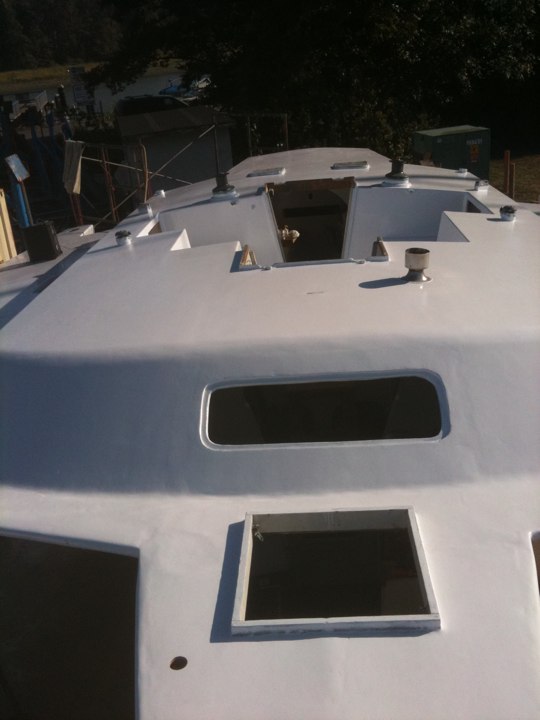
FINALLY, the topsides were painted again - it took far longer than expected, and I got my first sunburn of the summer, working 14-hour days trying to get this goddamned project finished and back in the water!
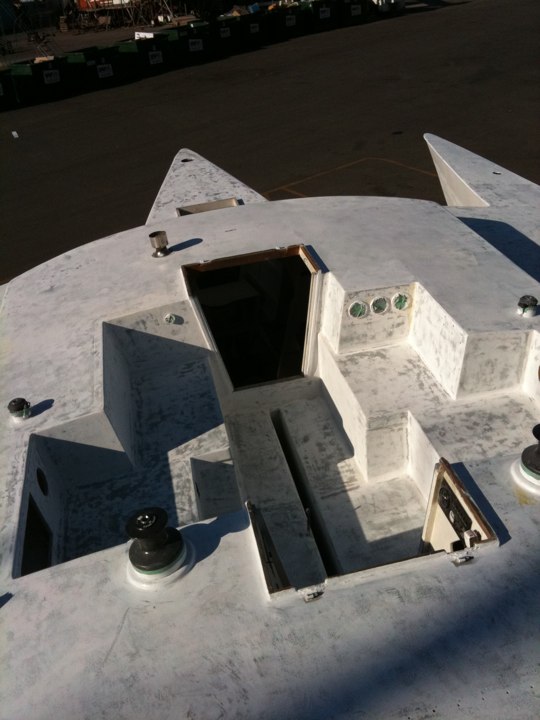
In this photo you can see the repairs to the front window evident, now that it's all one color; I thought I had spent enough time sanding the area, but I guess it could have used one more pass with thickened epoxy and another hour or two of sanding.
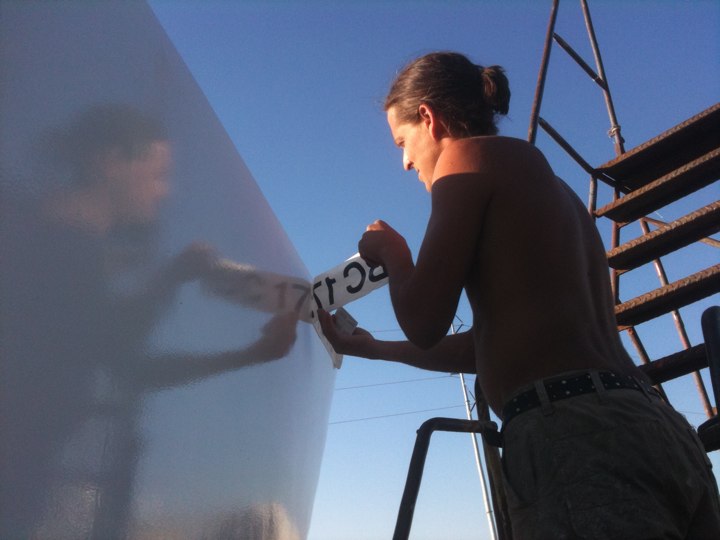
The registration numbers going on, for the first time. The VPD would be pleased about this, since they'd fined me $100 earlier in the summer for not having them displayed. That was my first police fine since a speeding ticket fifteen years prior!
I love how shiny the hull is in this photo!
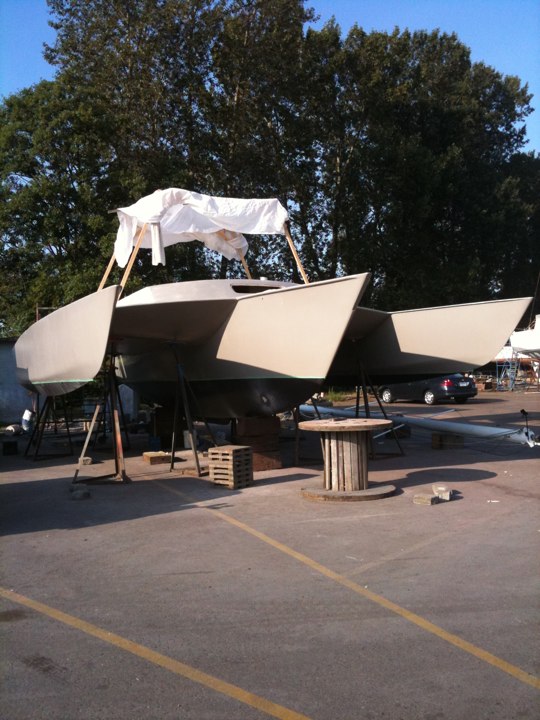
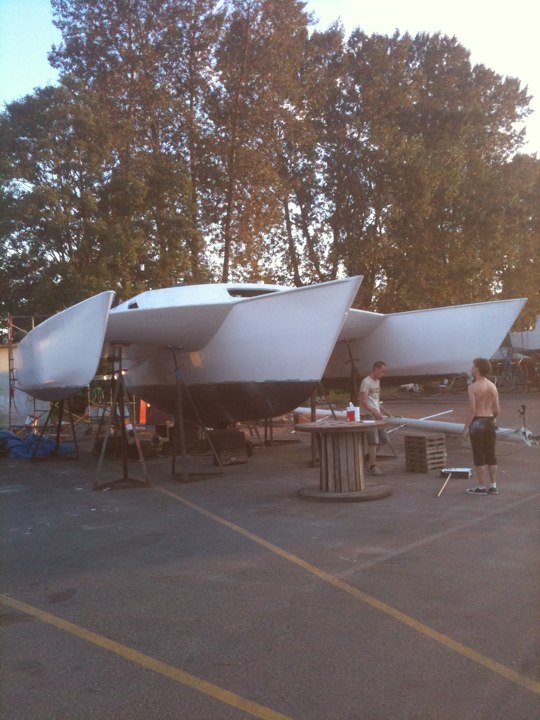
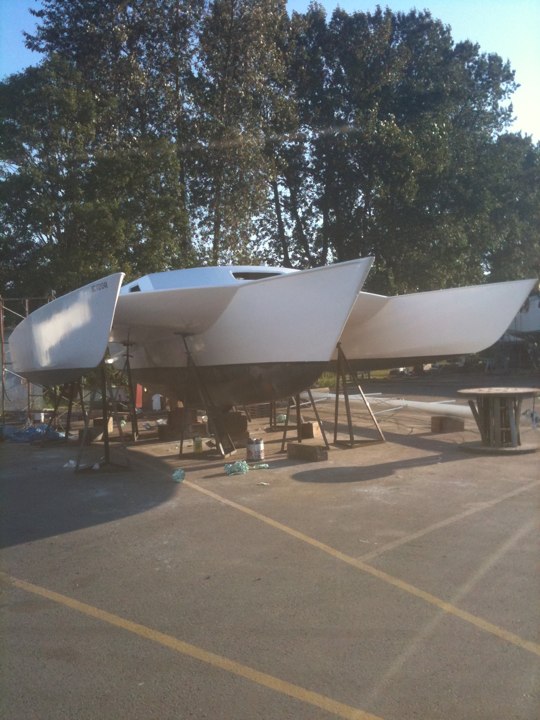
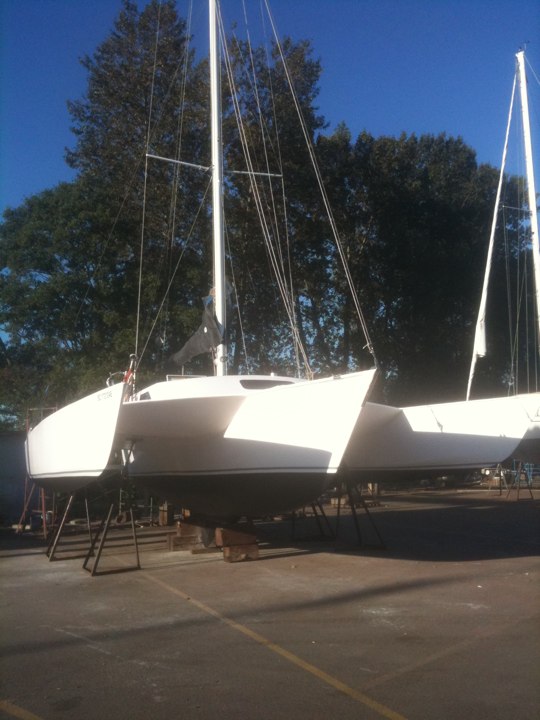
When the tape finally came off, she was looking amazing! I had many boatyard folks come over to congratulate me on the work, saying how impressed they were. Dan, James and I had been working on her nearly every single day since the start of the summer, and it was finally starting to show. Of course, there was still a tonne of work to be done before she could go back into the water - but at least the outside was (mostly) finished...
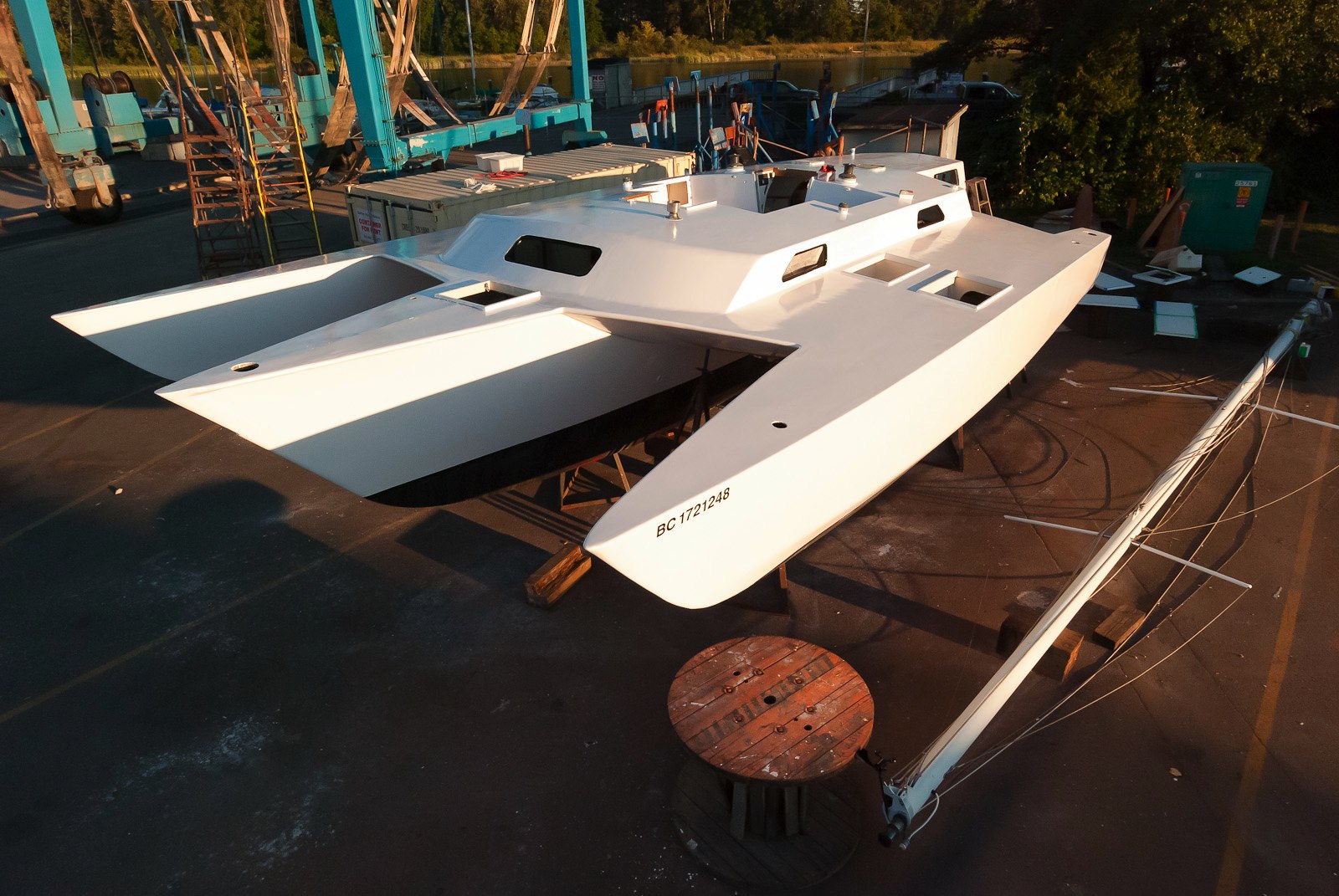
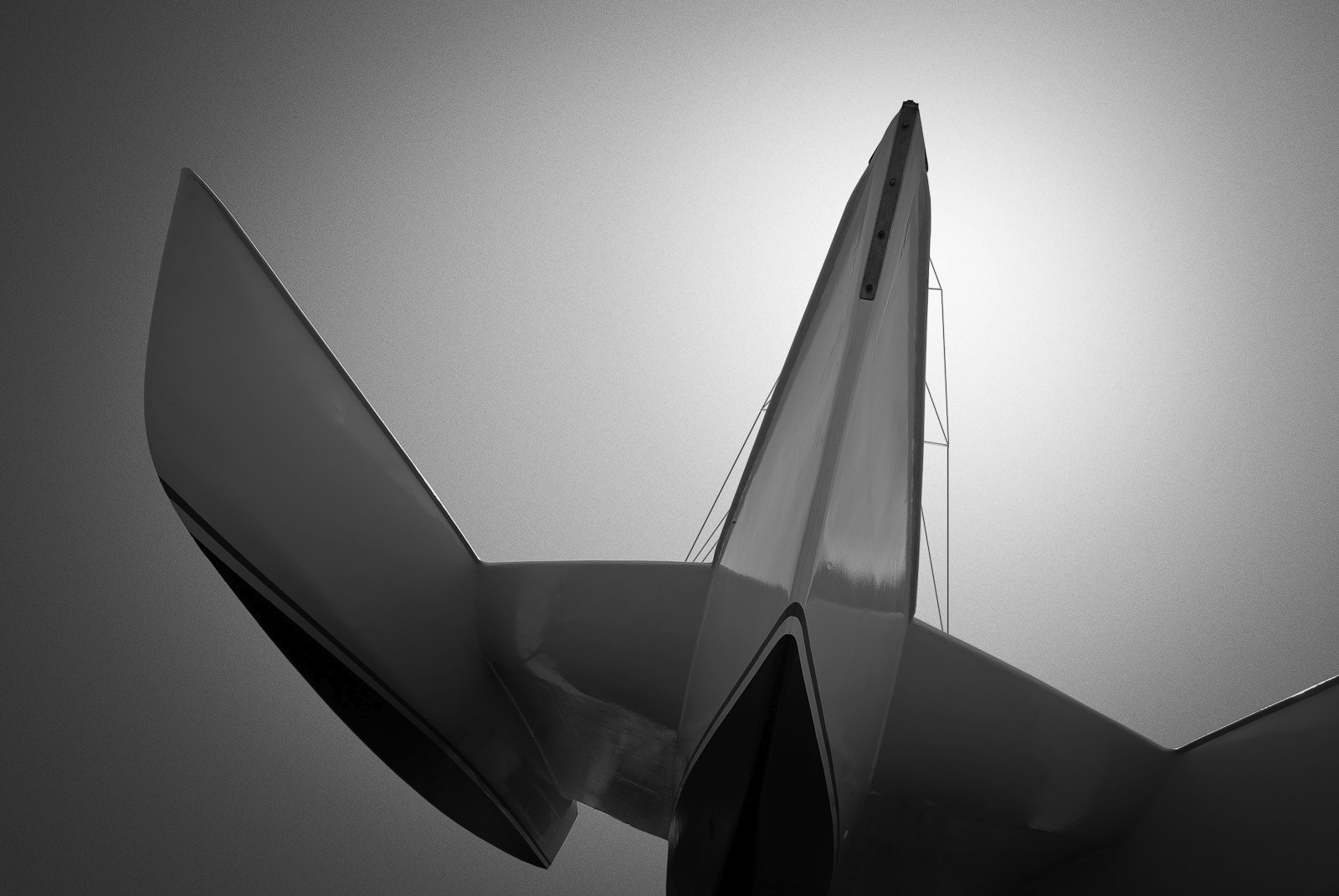
Ernst came out to visit and take a few pics with his fancy camera-on-a-stick rig - a long, extendable monopod with a remote trigger. He got this shot and the next one on a beautiful sunny afternoon.
This is probably my favourite shot of the entire summer - she just looks so fast and smooth! The decks are so shiny - of course, we'd still have to apply two more coats of paint yet, a couple of coats of anti-skid paint so that walking across the wet deck wouldn't result in a swim.
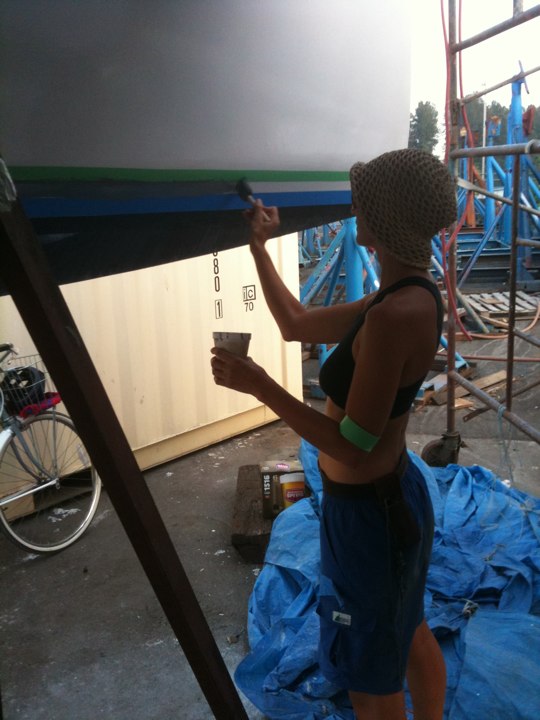
Kym came out and spent a few days in the boatyard to help with the work - she had some time off, and as someone who enjoys working on boats she was happy to help. I put her to work taping off the bootstripe, a just-for-looks stripe around the base of each hull. This was a much larger job than either of us anticipated, and taping alone took almost seven hours!
With the masking tape removed, the bootstripe looked fantastic, well worth the effort. The Searunner Construction Manual says that a bootstripe can make the difference between a boat and a yacht.
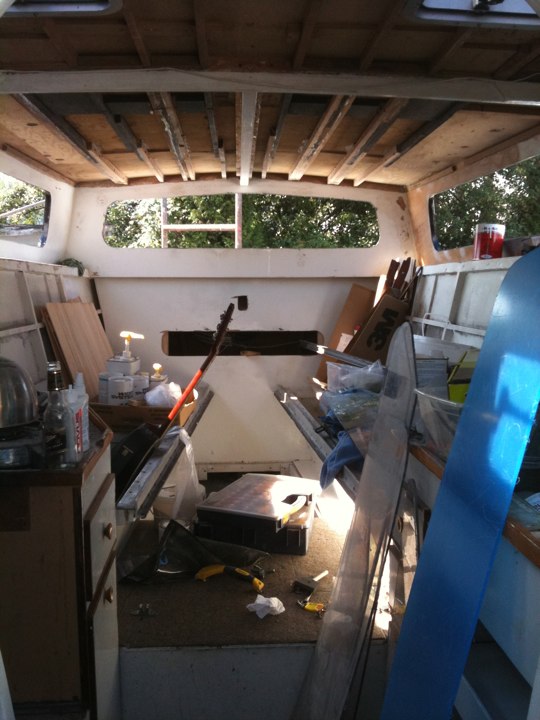
With all the work on the outside, we had pretty much completely neglected the interior of the boat which was still completely gutted. If I had any intention of moving back into the boat as my home there would be a lot of work to be done yet!
I found a new marine toilet - a Groco 'Model K' - on Craigslist for $200 delivered. Given that the Model K retails for over $1000, I thought this was a great chance to upgrade my bathroom facilities, and jumped on the deal. The new toilet was a good 10cm taller than the old one, however, and so the pedestal would have to be lowered - it was as good a time as any to rip everything out and start from scratch.
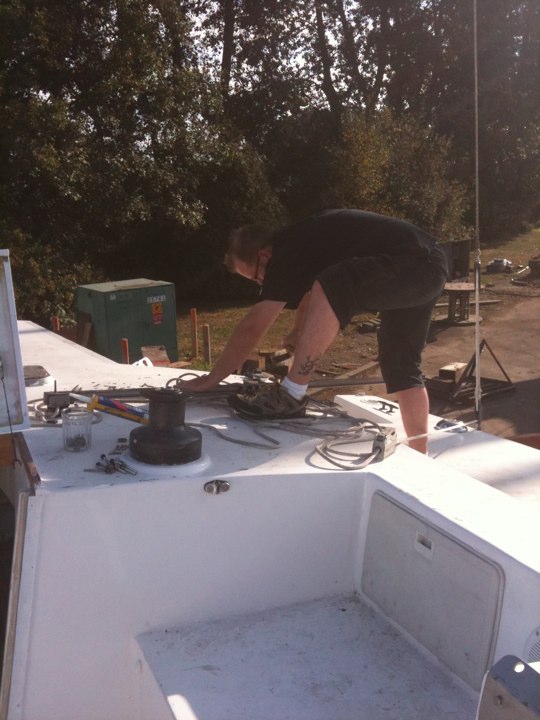
Once the chainplates were reinstalled and the two coats of antiskid paint were applied, it was as good a time as any to get the mast back up. Michael Flynn took the day to come and help re-rig Tie Fighter - his help was welcomed, especially since he's a professional rigger with a tonne of sailboat experience!
Of course, re-masting the boat left a chunk of rope at the top of the mast. Someone had to go up to retrieve it, so I tied my climbing harness into the mainsail halyard and Michael cranked me up with the main winch while Kym tailed the line. This was the first time I'd ever been up the mast.
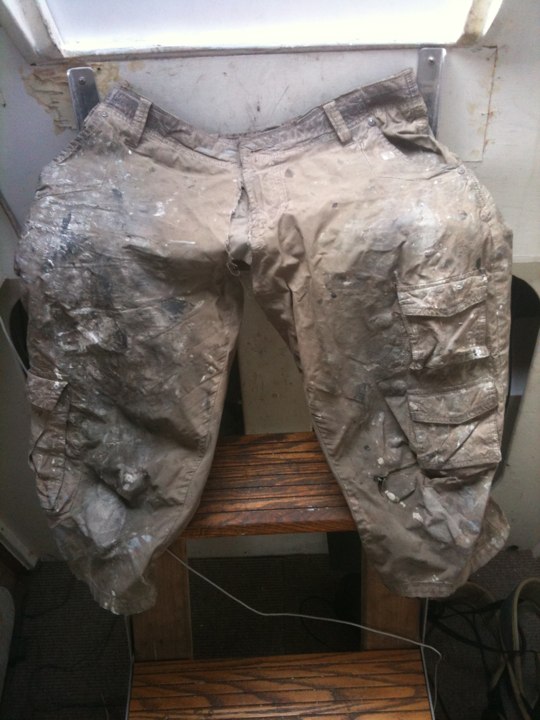
During that day, at some point I was pulling some line and managed to tear the entire crotch out of my work shorts. Last year, I wrecked probably half of my wardrobe when working on the boat - this year, I decided early to designate a single pair of pants as my work pants, and I spent most of the summer in these shorts. By the end, the legs were so thick with paint and epoxy and sweat that they were stiff, and the pants could almost stand up on their own!
Ernst came out again to take a few more shots of Tie Fighter - I finagled him into helping me reinstall the centerboard at this point, which was a brutal job - the centerboard trunk is approximately three meters long by two meters deep, and there's a 3cm hole in the centerboard itself which needs to match up to a pair of 3cm holes found deep in the bilge. The process of reinstalling the centerboard is much like threading a needle, only with the needle being 100kg and needing a winch to move it. After several hours trying, Ernst came up with the final solution which was to draw arrow lines radiating out from the centerboard's hole, and to look into the trunk with a flashlight to see the lines. Once the lines were drawn, we had the centerboard lined up and the holding pin installed within minutes!
My brother-in-law Scott came out to help with a few of the final rigging tasks, between working and school. Here he's lining up the bolt-holes on the traveler.
FINALLY, she was ready to go back into the water. I was filled with pride - this was by far the largest and most difficult project I'd ever been a part of, much less in charge of. I took this final photo - you can see my bicycle aboard, ready to go back to living on the water.
The dinghy was lifted back up onto the deck by a friendly forklift operator, and the lifting straps were put into place...
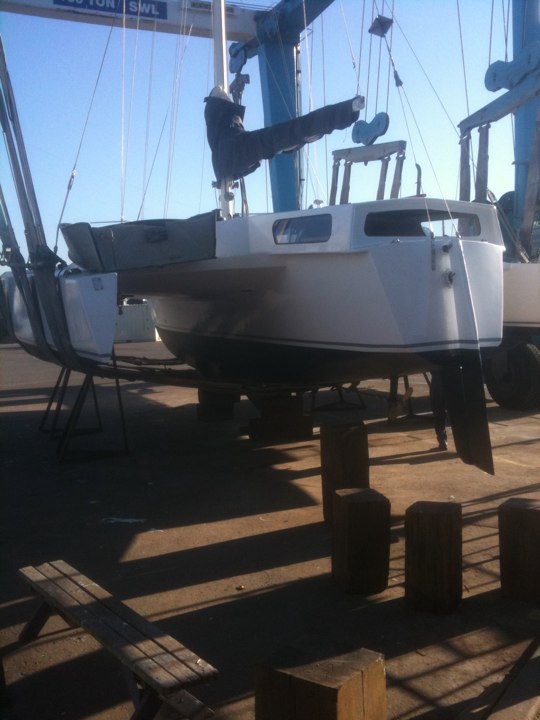
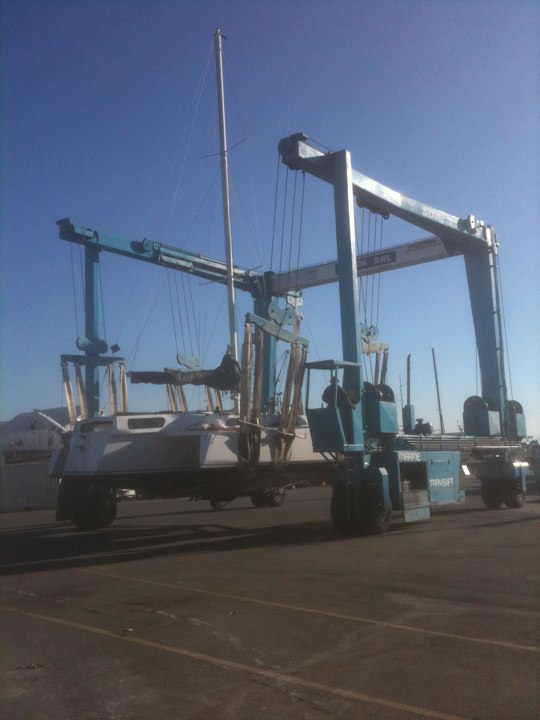
Across the yard we went!
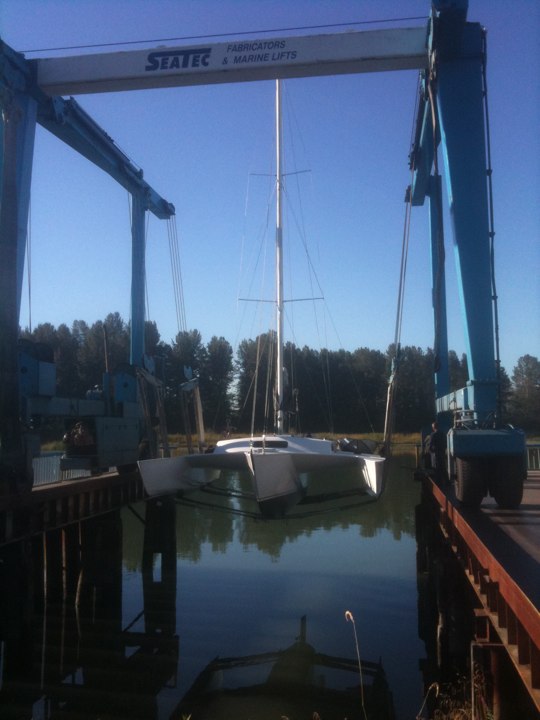
On August 24th, bright and early in the morning, Tie Fighter finally went back into the water. Fortunately, she floated and all of the hull repairs proved to be watertight. Unfortunately, we hadn't had a chance to do any engine work yet, and so I couldn't really do much besides motor down a few hundred meters and dock at C-dock, where I would spend the next two months continuing to repair and upgrade the inside of the boat.
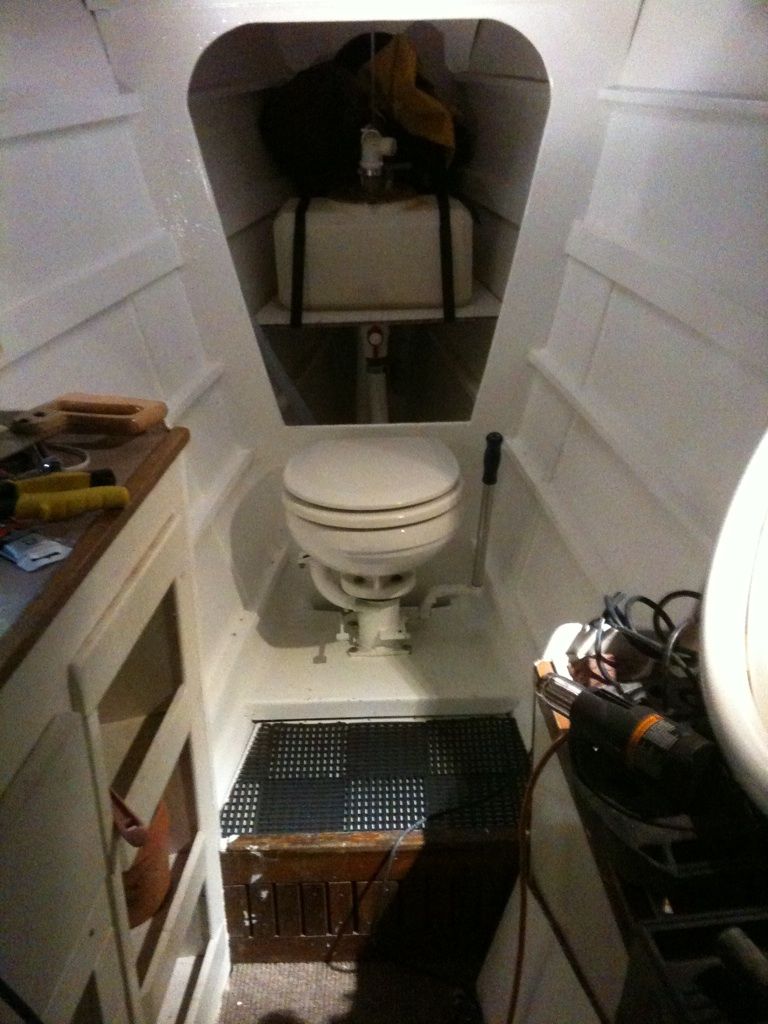
At C-dock, I had time to finish the head. Here's a shot of the toilet installed, with the holding tank plumbed and secured to a shelf with ratcheting tiedown straps. Technically this photo is from mid-September, but I figured it would be best to include an "after" shot, given the two or three "before" pics.
As the summer came to an inevitable close, I spent a lot of time feeling bitter about the fact that I had spent the entire warm-weather months doing something that I thought would be completely finished before the summer even started. I had really wanted to spend the summer living the Vancouver lifestyle, bouncing from beach party to afterparty, sailing as much as possible, and having a great time. Instead it was several months of hard labour ,while paying through the nose for the privilege of doing so. It was my friend Dan Ross who set me straight; I was complaining about the loss of the summer when he said something like
"Actually", he said, "I have to say, this has been probably the most interesting summer of my life - I've learned a tonne of new stuff, and been a part of a large project that we finished. I can't say I have a single complaint."
I was broadsided by that statement but when I thought about it I had to agree. It was the most interesting summer in memory, and at the end of it all I have my home to to show for it. She still has a tonne of work to be done, but she's solid, stable and floating, and eventually she'll take me wherever I want to go. The weakest link in the chain is me, and that's a lesson - paid for dearly - that I'll always have.
What a Week!
Argh - I would like to write about the week I've been having. There have been so many things happening!
UNFORTUNATELY, one of those things that has happened is that I managed to wipe out on my bicycle, pulling a tendon (I think?) in my wrist. As a result, I have had to have my right hand - my dominant hand - in a splint for the past three days. This has also meant that I cannot safely ride my bicycle, so I've essentially had my wings clipped. Furthermore it makes typing very uncomfortable!
On top of that, the winds have been blowing strong from the northwest for the past week - this wouldn't normally be a problem, but what with my diminished capacity for all things manual, rowing included, I am somewhat landlocked. I've spent the past two days working from my friend Carrie's living room couch, while she is on an epic rock-climbing adventure in Thailand.
Lots has happened, and things are moving forward in my grand scheme at a very rapid rate - I'll update this site as soon as it is more comfortable to type.
Lockdown!
It is January the 26th 2010, one day past my due date to get the heck out of False Creek - but here I am, still about two hundred meters from the Cambie Bridge. I've had visits from the VPD two days in a row, but since I haven't been able to start my engine there hasn't been much I can do. Yesterday I managed to get my engine started again, and today I blew a large portion of the day working on day-job stuff and reprovisioning Tie Fighter for an extended stay where there isn't a grocery store a block away. I'm still here, but I'll be leaving in the morning. Tonight is my last evening in the Creek for a while, so I figured I'd relax and enjoy it.
I thought I'd update the blog with a few notes on what has changed in the neighborhood over the past month - besides the constant visits from the VPD, that is. As I write this, there is a massive inflatable boom across False Creek, about ten meters west of the Cambie Bridge. There is a gap of about thirty meters across, and that gap is currently being patrolled by no less than four RCMP boats. Still, I'm getting ahead of myself, so let's start from the beginning.
Southeastern False Creek is home to the newly-constructed Olympic Village. The Village will be home to all the athletes during the games, so of course security is a big question - but the sheer amount of money being spent on this project is astounding. The most recent roadblock to go up, a block or so from my boat, was being staffed by seven people at last check, including three uniformed police officers and four people in VANOC jackets! As far as I can tell, there is a similar roadblock on every road adjoining the Village. The entire area is surrounded by tall steel fences.
Still, this is all stuff you can read elsewhere. This is my blog, and so I will tell (and show) you what I am seeing from the water. For instance, my favourite bike path - the one from Cambie Bridge down towards Science World, past the shiny new Olympic Village buildings, over the boardwalks and sculpted bridge, past the immaculately landscaped gardens and artificial peninsula built for the wildlife - has been blocked off. To get downtown I have to skulk my way through five blocks of alleyways and several blocks of fenced-in sidewalk. I hate riding on the sidewalk.
Anyhow, about a month ago, a large, scary-looking navy tugboat pulled into False Creek. I did a bit of research and found the tug to be the Canadian Forces Auxiliary Vessel (CFAV) Glendyne, a Glen-class tugboat based out of CFB Esquimalt, near Victoria. The Glendyne put a pair of large, orange buoys in place just short of the Cambie Bridge, complete with orange flashing lights on top. I knew that this would be the beginning of the promised 'boom' under the Bridge, but I still hadn't seen any documentation about what the end result would look like, and so I watched with interest as they set the buoys in place. I figured they'd be back in the next couple of days to finish the job, but once they were finished they motored slowly away and never returned.
Off-topic, one of my neighbors has mentioned that he expects to see at least one military gunboat in the Creek, paired up with the RCMP zodiacs and whaleboats currently patrolling the boomed-off area. I am not convinced, but given the focus on security I wouldn't be shocked if there were some kind of small, fast Canadian Forces gunboat deployed here during the games.
Anyhow - a few weeks went past without any change to the buoys, but one morning last week I awoke to the sounds of something very large cruising past me. I popped my head up out of the hatch to see a Department of Fisheries and Oceans and/or Canadian Coast Guard (both were painted on the hull) hovercraft making its way slowly down the creek! The hovercraft - which later research found to be the CCGH Siyay based in Richmond - was outfitted with a crane and a large cargo of cement blocks. I figured they were planning to work on the boom somehow, but instead they spent the day lining both sides of False Creek with smaller, lighted channel buoys, indicating the shipping channel in the center of the Creek. This of course was followed by several days of the VPD visiting any boat anchored too far out into the middle of the Creek, issuing warnings and referring everyone to the notice that anchoring within the commercial shipping lane is banned by Transport Canada.
Personally, I think the buoys are actually a nice touch, and I hope they stay past the Olympics. It's nice to pull into a bay and have your way clearly marked - it makes everything feel a little bit safer, a bit more professional... dare I say "a bit better-managed"?
Anyhow. Sequential Circus 7 was this weekend - it was excellent, thank you for asking - and as such I didn't spend much time on the boat. When I returned, I found that someone had been busy, and there were now several large black inflatable sausages stretched across the Creek! They're about two and a half meters in diameter and appear to be made of a thick rubber, with webbing straps every three meters or so, tie-down grommets on those straps, and large metal rings at the end to fasten the sausages together, or to the shore. In other words, the sausages are clearly designed and built to do one thing only: to operate as a boom or blockade over water.
One question we'd be bantering about on the Creek was what exactly they were planning to use for the boom. One guy thought large logs, another thought a very thick rope - I had no ideas, but apparently the answer was easier than we thought.
While rowing back to Tie Fighter yesterday, I made a short detour out to the opening in the boom, where an RCMP whaler was sitting. As I approached, he was quick to lean out the window and let me know that the area past the boom is now restricted waters - as an aside, I have gotten similar warnings from the people manning blockades as I approached them on my bicycle. Seriously? The huge black barrier, the orange flashing lights and the menacing police boat - or in the case of the roadblocks, the seven people in official-looking uniforms, the flashing lights, the pylons, the big orange-striped barrier sawhorses and the police car parked perpendicularly to the road - do other people really not understand these signs? Or maybe it's just that the barricades are so universally unpopular that anyone approaching them must be some kind of threat. I don't know. Anyhow.
The officer, once he understood that I was just there to ask questions, was quite friendly and explained that the boom would be closed to all boats except official VANOC-approved vehicles. The boom is apparently scheduled for removal at the end of March, but the officer did not know whether or not the shipping lane buoys would be removed.
Speaking of speaking with officers, I've spoken with two different sets of VPD in the past two days, both of whom were somewhat interested in the fact that my anchoring permit had expired. Each time the R.G.McBeath shows up there are at least two officers onboard, and often more. Yesterday there were four officers, none of whom I recognized, and when I explained to the officer doing the talking that I was planning to leave as soon as I could get my engine started, he answered "I'll believe that when I see it.". He then pulled slowly away without saying another word to me. In contrast, when they came by today, it was another batch of officers I'd never seen before, and when I showed them that I'd just gotten my engine running again, the officer in charge said "It's almost 5pm, why don't you wait until morning before pulling out, it'll be dark very soon.". Nice!
Anyhow. I've only blown my deadline by two days, but it's definitely time to go. The only thing I know to expect is significantly rougher waters - False Creek is very protected, and I'm really not looking forward to just how bad the February weather can be out in the open. Rest assured, I'll blog about it as I go.
Countdowns All Around
It's Thursday, and I've got three major, looming deadlines staring me in the face. I think I've got a handle on all of them, but it's definitely not a relaxing time in my life right now.
<Geek>
On the work front, I've migrated two very large web properties into the Amazon Elastic Computing Cloud over the past eight months or so. I've been learning the ins and outs of the new technology as I go, and the playing field really has changed. There have been a tonne of little headaches and bugs and glitches, and I've been pulled out of bed at 5am more often than I care to admit. And now - just when we're finally stable - a directive has come down from the Evil Masters to port both sites to a common backend using the latest new Drupal code. On one hand this will open a lot of doors for us, allowing us to scale a lot quicker and use some of the more modern tools, like storing all images on a Content Data Network (CDN) instead of on our current frontend webservers. Still, the deadline for launch is February 12th and that's coming up faaaaaaaaast. I've barely got the preliminary test servers in place!
</Geek>
On the boat front the engine work continues, though the work seems to multiply every time I put time into it. I'm finding a great deal of satisfaction in it, actually - I mentioned to a friend yesterday that it is very much like 'The Legend of Zelda', in that the puzzles are difficult, but once solved there is immediate positive feedback (ie the engine works better) and you can move on to the next puzzle, often using knowledge or tools you gained from the previous level.
Yesterday's miniboss was changing the zincs in the engine. Sacrificial zincs are bits of... well, zinc. The theory is that if you bind several types of metals together in a marine environment, the weakest metal will corrode. Because of some kind of galvanic voodoo, the other metals will not corrode until the weaker metal is completely corroded away. Zinc is a very weak metal, easy to work with and cheap, and so quite a few different parts of the boat have sacrificial lumps of zinc attached to prevent the more important bits from corroding.
The zincs in the engine should be replaced about once a year, more or less depending on use. My engine has three zincs - at $7.00 per zinc, it's a $21.00 job to replace them all, but compared with approximately $10,000 for a new engine, the price is negligible. The zincs are attached to the end of thick bolts and screwed deep into the heart of the engine.
One of the three zincs is located right on the front of the engine, easily accessed. The other two zincs are located far down the right side, between the engine block and the wall. Once I stepped back and surveyed the engine, I found that I could just barely get a socket wrench in a gap, which allowed me to remove zinc #2 with little difficulty - but zinc #3 was a real hassle. To get at the third zinc I had to remove the fuel lift pump (skills and items gained from previous level!) and the exhaust manifold - and even then the bolt holding the zinc into the engine was seized pretty solidly. I ended up having to extend the socket handle and actually step on it to get the bolt free; never send a hand to do a boot's job. I swear I heard victory music when that bolt finally gave way.
So far in the past month I have rerouted the fuel lines, replaced the fuel filter, installed and plumbed a second fuel filter, replaced the damaged exhaust water trap ($300, ouch), replaced the impeller in the raw water pump, and replaced the zincs. Remaining, I have to have the alternator tested and serviced, pick up new oil, drain and change the current oil, drain and change the transmission oil, take the heat exchangers to the radiator shop to have them boiled out, pick up antifreeze, install the secondary cooling pump, drain the engine cooling system and replace with antifreeze, reroute the raw water intake through the heat exchangers, rewire the instrument panel, and then get the fuel tank polished. Whew! Someday soon, I will have an engine that runs reliably; ideally one that I do not have to climb into the engine compartment with a screwdriver to start. There's almost no chance I'll have all this done by Monday, so I really have to pick and choose what tasks are actually important.
...and then I get to start on the electrical system! For some reason, since returning from Vegas the house batteries aren't holding a charge anymore. I have no idea why; I need to replace the batteries and purchase and install a modern charge manager. I don't expect to get that one sorted out for under $1000.
Lastly, I have Sequential Circus coming up on Saturday. This is a huge show, with six live-pa acts performing 45-minute sets at a local show venue slash warehouse space. Everything is coming together smoothly, mostly because it's our sixth time running this show and we're all getting really good at it. It's really starting to look like we're going to have a solid crowd too, which takes a lot of the financial stress off of my back - if everything works out well, I might just come out of it a hundred bucks richer!
I still haven't figured out where to go on Monday, and the False Creek / Olympic Village security lockdown continues... more on that soon.
Gonzales Bay
It's day two in Gonzales Bay, just east of Victoria Harbour.
It's lovely here! Nicer even than Fleming Beach, from which I was evicted on Tuesday - and even nicer now that it's not pouring rain anymore. I arrived on Wednesday afternoon to grey skies, and it rained all Thursday, so the sun is welcome - I had the sails up this morning for an hour or so to let them dry out. Mildew isn't something I'm really interested in dealing with.
One nice thing that happened: about an hour after I anchored, an older woman with long white hair rowed out to say hello, and to offer me a shower, a dinner and the use of a bicycle, should I need one. What a far cry from the surly stares of the Esquimalt fishermen, or the studied disinterest of the older sailors at the naval base! She offered her back yard as a place to tie my dinghy, instead of the public beach, and told me to feel free to come and go though her property. I took her up on the latter, and rowed my bicycle to shore in the pouring rain last night to go have birthday drinks with Oakley and Amanda. Making my way home much later on was a bit of a trial to say the least, especially in the pitch dark with a head full of Jack Daniels - when I finally found the place, the tide had gone waaaaay out, and my dinghy was stranded about twenty feet up on the steep, slippery rocks. I managed to get the dinghy, my bicycle and myself down to the waterline without falling - at least, as far as I remember. Good thing I remembered my flashlight!
The bay is shallow - only ten or fifteen feet or so where I'm anchored - and I can see the bottom. It's really nice being able to see the bottom, especially after so much time in the murky brownish waters of False Creek. There are large shoals in the bay, and tonnes of seabirds - the only downside is that there's not really any shelter from the open ocean. I get to rock around on the wake of every whale-watching tourboat that goes past - but between the gentle, constant rocking, the sounds of the seabirds and the waves lapping at the rocky shores nearby, it feels very much like the east coast here. I can't see any crabs down there, but I might try dropping the trap later on just to see if I can snag some dinner.
If the sun sticks around, perhaps this weekend I'll get out the flippers and snorkel and give Tie Fighter's bottom a good scrub - she's starting to look pretty scummy down there.
Tonight, a house party. Tomorrow, shopping for Burning Man supplies. Sunday, who knows?
In June 2008 I realized that life in a cubicle wasn't for me, and that a great adventure would never come knocking on my basement apartment door.
I began to actively change my life. I took a part-time, tele-commutable job and began to minimize my "stuff", attempting to disengage from the rat race.
In November 2008 I threw caution to the wind and purchased a large sailing trimaran, and in May 2009 I moved aboard her full-time.
In September 2011 my girlfriend Miya moved aboard and we set sail, headed south until the water gets warm...
This blog is my journal.
Recent Posts
- San Francisco
- Coos Bay, Oregon
- Weather Window!
- Neah Bay
- Anchor Musings
- Adventure Time!
- RIP Schaltwerk
- And Just Like That
- Bicycles
- Electrical System Complete!
- Photoblog: What’s Up?
- Learning to Splice
- Homeless!
- January is a Whirlwind
- What I Did On My Summer Vacation – August Edition
Twitter Feed
- mux: aaaaand FINALLY, we're making our own water! the Spectra Ventura 150 DX is humming away, filling the tanks. January 27, 2012
- mux: a mission to install a through-hull below the waterline with the boat in the water shows me that a wetsuit is necessary, even in San Diego. January 27, 2012
- mux: my new favourite bird: the Black-crowned Night Heron. one has made our starboard bow his evening home base for a month now. we are friends! January 27, 2012
Blogs I Like
- Adventures of Rikki-Tikki-Tavi
- Going Nomadic
- JC McDowell and the Family Unit
- Karma Sluggin
- Loose Moorings
- Nomadness
- S/V Deep Playa
- S/V Nyon
- S/V Resolution
- Sail To Trail
- Tales from Technomadia
- The Nomadist
- Three Sheets Northwest
- Tired of I.T.!